
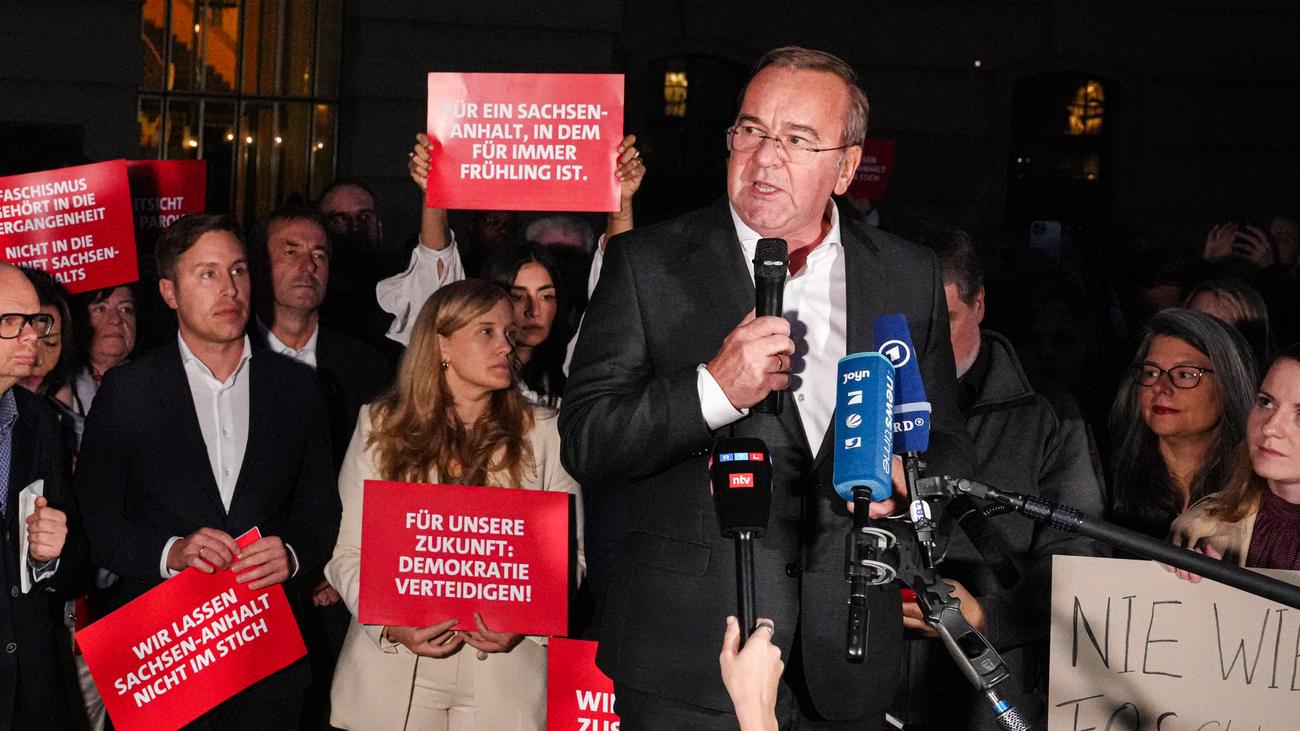
Following the watershed moment in Saxony-Anhalt, the Defense Minister finds the right words at the right time—and sends a signal that many have long been waiting for.
In politics, there are always those moments of clarity—moments when things fall into place, and when you can see who has grasped the gravity of the situation, and who hasn’t.
Tuesday saw just such a moment. At midday in Magdeburg, the first parliamentary president from a far-right party was elected. Tobias Rausch, the AfD member, received votes not only from the AfD and the BSW but—as investigations by Die Zeit suggest—presumably also from CDU lawmakers. Yet, shortly before, parliamentary group leader Sven Schulze had announced that his group would abstain en bloc. In the end, however, with 14 CDU lawmakers present, there were only five abstentions. Rausch received 48 votes—four more than the combined total of BSW and AfD lawmakers. Later, Hans-Thomas Tillschneider was elected as a vice-president of the parliament. Tillschneider is the chief ideologue of the völkisch (ethno-nationalist) wing of the AfD. The BSW had announced it would not vote for him. Nevertheless, he secured a majority of 44 votes; here, too, supporters likely came from the Union parties. After all, the AfD itself holds only 39 seats. Following that afternoon, there was strong evidence that forces describing themselves as "bourgeois" or mainstream-conservative had once again helped the radical right in Germany gain power.
At a moment like this, there is a crucial question: Does this country possess a political elite that recognizes the situation? One that absorbs the full force of the moment—both rhetorically and symbolically?
Those who recognized the moment—and those who didn't
There are people like that—we saw that yesterday—and they are the ones we should talk about.
But first, we should talk about those who missed the moment—whether out of ideological stubbornness or opportunism. Serap Güler is one such example of the latter. Güler is a Minister of State at the Federal Foreign Office; she previously served as State Secretary for Integration in North Rhine-Westphalia and is considered one of the liberal voices within the Union. Yesterday, she articulated perhaps the most distressing remarks regarding the events in Saxony-Anhalt: she characterized the voting behavior of her fellow party members there as a form of political self-defense. She argued that, through their coalition talks in Berlin, the Greens and the SPD had effectively forced the CDU to vote alongside the AfD. "You Greens have been fueling this mess ever since the Berlin election. If you have no problem joining forces with extremists, you shouldn't be surprised by developments like today's," she wrote.
Güler’s post was disheartening because it reflected the utter helplessness of the CDU’s liberal wing. Quite evidently, they no longer possess the strength or courage to criticize the conduct of their own ranks, resorting instead merely to justifying it. They attempt to lecture the SPD and the Greens because, within their own party, there is quite obviously no one—truly no one—left with the authority to call their own people to order when necessary. And in the very party that loves to preach personal responsibility—such as when discussing the welfare state—the prevailing motto has now become: "It’s the others' fault that we’re acting this way!"
A mainstream conservative politician may despise the Left and fight against it. But twisting the "horseshoe theory" to the point where Elif Eralp somehow equates to Hans-Thomas Tillschneider is not merely ignorant; it is a sign of the profound intellectual and moral crisis into which Christian Democracy has maneuvered itself.
However, there are also politicians who recognize the historic moment—and seize it. Foremost among them—and surprisingly so—was Boris Pistorius. As Stern reported, Pistorius spoke up during the SPD parliamentary group meeting. He quoted the famous remark made by the painter Max Liebermann in January 1933: "I cannot eat as much as I would like to vomit." He then urged his parliamentary group to walk to Bebelplatz—the site of the book burning—where he ultimately stood on a crate of drinks and found exactly the right words for the moment.
It was not a day for sadness or dismay, but a "day of anger." Democratic forces had acted as enablers for right-wing extremists. They had sinned against democracy. After this watershed moment, there could be no return to business as usual.
One might find this kitschy or folkloric. One might also smugly point out that the SPD is, after all, governing alongside the Union. Or—equally smugly—ask what the consequences are supposed to be. One could, like some Left Party MPs, write mocking tweets. One could call it "cringe." One could make fun of the fact that Pistorius struck up the national anthem at the end and the SPD parliamentary group joined in.
All of that is certainly possible. However, those practiced, sneering reactions from the Left are just as petty as Serap Güler’s remarks. Boris Pistorius found the right words at a historic moment. He spoke with a sense of republican pathos. He was the first SPD politician in a very, very long time to succeed in connecting with people on an emotional level—appealing to their emotions rather than merely speaking in technocratic terms.
"Come on, let's go to Bebelplatz now."
Great politicians have a feel for the moment. They can be spontaneous and improvise. They can surprise people—and win them over precisely by doing so.
Yes, Pistorius’s speech was merely symbolic. But what were Ulrich Siegmund’s "Simson" rides? What, for that matter, was the AfD’s entire "anything-is-possible" election campaign? It was about stoking hopes, emotions, and projections. Politics is not merely "problem-solving," as is often claimed; it is also symbolic communication—recognizing and addressing people’s hopes and fears. One of the major problems facing the political Left is that it has forgotten this visceral dimension of politics. Anyone who waits until a finished five-point plan is ready in the drawer before speaking up is almost certainly speaking too late.
What scenario might now be emerging
It is too early to say whether this moment will amount to anything more than a good speech delivered from atop a crate of drinks. Yet, it is worth considering the scenario that might be taking shape: the CDU is suffering a progressive loss of authority. Lawmakers in Saxony-Anhalt are doing as they please; party discipline is a concept from a bygone era. A Hessian state premier is positioning himself as a potential replacement for Merz and advising his party to stop shunning the AfD. It is hard to say which will fall faster: Friedrich Merz or the "firewall" against the far right?
It does not take much imagination to see that, in such a situation, an SPD led by Pistorius could stand to gain a great deal. Admittedly, the SPD is also in the midst of a deep crisis, with fundamental questions regarding its platform largely unresolved. Yet, the combination of a sensible, centrist policy agenda, unequivocal anti-fascism, and a down-to-earth, Lower Saxon authenticity might well be enough to win over large numbers of centrist voters.
None of the so-called "centrist parties" currently offers a compelling platform or a captivating vision. That makes the individuals involved all the more important—politicians who possess situational savvy; who can recognize a historic moment and say, at just the right time: "Come on, let's head to Bebelplatz."
Posted by IHateTrains123
1 Comment
He is still stalling on key economic reforms needed.