
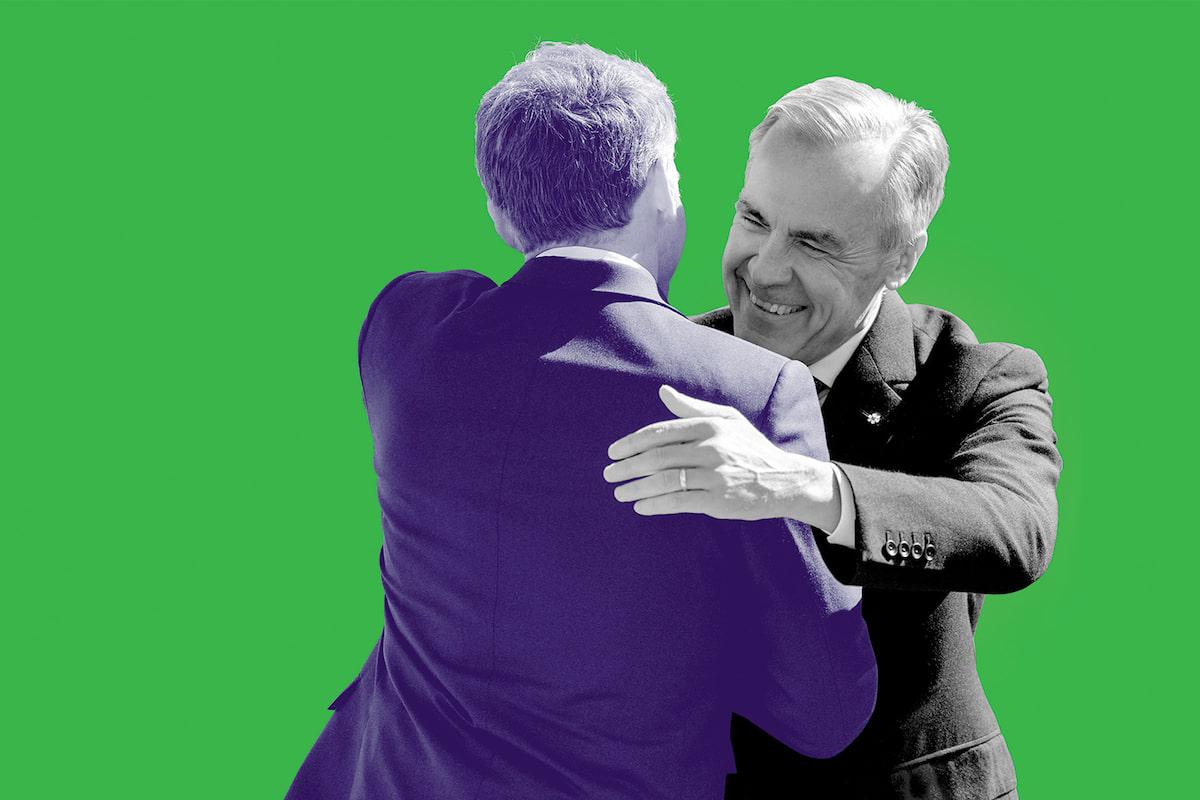
Unless a core group of allies, who are committed to each other because of their shared values, finds a way to hang together, they will surely hang separately
Chrystia Freeland is Canada’s former Deputy Prime Minister, Foreign Minister, and Minister of Finance. She is the author of numerous books, most recently Unreliable Boyfriend: An Insider’s View of Dealing with a Chaotic Superpower, Plutocrats, and Other Complicated People, from which the following essay has been adapted.
Globalization’s fans argue that populist movements of the left and the right use global trade as a whipping boy for the other big challenge liberal democracies confront, and one which is a lot harder to address: how to enjoy the economic growth that capitalism delivers while also distributing the fruits of that growth beyond the 1 per cent. How can you encourage innovation while also ensuring that what they create delivers widely shared prosperity?
It is certainly a lot easier to blame globalization – which can serve as fancy shorthand for foreigners – for the stagnation of middle-class wages than to propose a credible way to both grow and share. But peak globalization itself was flawed. It is one of the reasons the Western world has begun to find it so hard to deliver inclusive prosperity. And therefore one of the reasons liberal democracy is so politically fragile in the countries that created it.
That’s why it’s important to acknowledge the faults of peak globalization, and to propose a way to address them. Friendshoring is an outline of how we might do that.
It is about more than just fixing what was broken. Friendshoring is also a proposal for how, in the 21st century, we can thrive – for how, in an utterly changed geopolitical landscape, we can enjoy the prosperity and the peace which the post–Second World War generation recognized could best be delivered by an economic and military alliance among the world’s democracies.
Ideally, friendshoring could offer something better than the postwar Pax Americana it should replace. President Donald Trump’s hostility toward America’s long-time partners and his coziness with dictators has harmed us all. But one consequence of the extreme unreliability of our erstwhile boyfriend has been that the rest of us have been raising our game. As a result, friendshoring has the potential to become more of a genuine partnership – in which everyone pulls her weight, and everyone has a say – than the imbalanced alliance that preceded it.
This essay is a compass and a destination, not a road map or a blueprint. It makes a case for where we should be headed, but it doesn’t lay out exactly how we should get there. That’s for two reasons.
First, having actually done trade deals, with complicated partners, I know that both Tim Geithner and Mike Tyson are smart. Mr. Geithner, as secretary of the treasury during the 2008 global financial crisis, asserted that plan beats no plan. And Mr. Tyson knew that everyone has a plan until they get hit in the mouth.
We need a plan for friendshoring. We also need to recognize that we will get hit in the mouth, which is why the final plan can only be fully elaborated in meetings between leaders, representing voters, and in the international accords those many meetings will produce.
At least at first, friendshoring will be a piecemeal set of plurilateral, overlapping agreements, touching different issues, with varying members and a complicated geometry. Friendshoring will be about a network of bilateral and plurilateral trade deals. Friendshoring will be about a tax agreement between a core group of countries. Friendshoring will be a plurilateral supply-chain pact. Friendshoring will need dispute settlement and enforcement provisions.
All of that builds on agreements we already have and know how to negotiate. These are deals about how willing parties treat each other.
To really work, friendshoring will also need something entirely novel – a commitment to defend each other against external trade aggression. Just as NATO allies are pledged to support one another in the event of military attack, members of the friendshoring alliance need to be prepared to back one another up in the event of trade hostility from the outside. The only way the friends can each avoid being divided and conquered by an external trade predator is if they are prepared to stand together.
One of the trickiest challenges of translating friendshoring from destination to deal will be to decide who the friends are. In a world where democracies are facing such fierce challenges from within, deciding who qualifies as a friend won’t be obvious. A good place to start is with the current security allies – NATO, along with Japan, South Korea, Australia, and New Zealand. This group already works closely together, in NATO, the Five Eyes, and military partnerships in the Indo-Pacific. Add the non-NATO EU members and close partners, like Ireland, Austria, and Switzerland. Together, this club of democracies accounts for roughly 60 per cent of the global economy. Comfortably big enough to create a trading zone with the economic scale to make all its members richer, and the economic muscle to meaningfully shape the entire global economy.
The friendshoring door should also be wide open to democracies outside the security alliance: to the other democracies of Asia and to the democracies of Latin America and Africa.
The only way the friends can each avoid being divided and conquered by an external trade predator is if they are prepared to stand together.
Even within the core security partnership, of course, there are edge cases: Turkey, and, until recently, Hungary. And there is the tricky question of other democracies that are not perfectly democratic. My bias would be to build a very wide door, and to hold it as open as possible, at least for the core plurilateral trade agreements – something that bringing together the EU, its customs union partners, and CPTPP would largely accomplish in one fell swoop.
Add India, Indonesia, South Korea, Brazil, the smaller democracies of Latin America and the Caribbean, and the African democracies and you found a formidable group.
Friendshoring should also learn the lesson former Hungarian prime minister Viktor Orbán has taught the EU. Cockroach-motel alliances – where you can get in, but there is no way out – risk being destroyed by the changing character of their members. As well as figuring out who is admitted, the friends need to devise a mechanism for kicking a country out. That is more important today than ever. The early lesson of my life was that dictatorships can become democracies – and then that fledgling democracies can become authoritarian regimes.
That brings us to the second reason why it is impossible right now to draw a precise blueprint of friendshoring. The world’s biggest democracy is openly and energetically flirting with fascism. Today’s Washington would not be welcome in a friendshoring alliance and tomorrow’s America could well be its chief adversary.
Clearly, the big unknown about friendshoring is whether post-Trump America will choose democracy at home, and partnership with the world’s democracies abroad. A friendshoring alliance is possible without the United States – and we should certainly try to build one. But with Washington trying to undermine it from the outside, it will be harder to create; and without the might of DC on the inside, it is less likely to be effective.
That is obviously a very big question mark – probably the biggest one in the world today. And it is a reason some may be tempted to dismiss friendshoring as an idealistic plan, fit only for a bygone era. I don’t deny that friendshoring will be hard to achieve, and that the success or failure of the idea depends a lot on America’s choice.
But the alternative to a new alliance of democracies is not some consensual, milquetoast, middle-power nirvana. Unless a core group of allies, committed to each other because of their shared values and not simply their current regime’s definition of the national interest, finds a way to hang together, they will surely hang separately – the easy prey of the world’s superpower bullies.
Mr. Trump’s Washington doesn’t have allies. It has only satraps, enemies, and equals – the latter a singular group that includes just China and on some days, perhaps, Russia. As for America’s erstwhile friends, the demand is that they forget about a relationship governed by treaties and rules. Instead, they must accept vassalage, and being subject to Washington fiat. Forget about like-minded democracies; think Delcy Rodriguez. And if they don’t agree to vassalage, they risk reprisal.
For Canada, there’s a further threat – pay up, or become the 51st state. One of the most blatant versions of this offer came in May, 2025, when Mr. Trump explained on Truth Social: “I told Canada, which very much wants to be part of our fabulous Golden Dome System, that it will cost $61 Billion Dollars if they remain a separate, but unequal, Nation, but will cost ZERO DOLLARS if they become our cherished 51st State.”
Bob Rae, at the time Canada’s ambassador to the UN, shot back with a pithy explanation of what was going on. “In another context, this would be called a ‘protection racket,’” he posted on X. “Both Canada and the United States signed the UN Charter in 1945. Article 2 of the Charter states clearly ‘The Organization is based on the sovereign equality of all nations.’ Threats to sovereign integrity also prohibited.”
Two months earlier, when my friend Doug Ford, the premier of Ontario, threatened to impose a surcharge on Canadian electricity exports to the U.S., in retaliation against U.S. tariffs, Commerce Secretary Howard Lutnick publicly accused Canada of acting like Ukraine (in my view, a compliment, of course).
He said the American President “needed to break some guy in Ontario who said he was going to tax American energy 25 per cent” and that the Canadians needed to “just say thank you.” In a private conversation that a Canadian business leader recounted to me, Mr. Lutnick threatened to send U.S. troops across the border by sunset unless Canada backed down. (Mr. Lutnick has no military authority.)
In one respect, the Trumpian approach to trade marks a return to what we figured out after the Second World War and then forgot after the collapse of the Soviet Union: Trade and security, money and war actually are intimately connected.
But Mr. Trump’s approach has been to turn the postwar understanding of this relationship upside down. From Eisenhower onward, American presidents believed allies made the U.S. stronger, and that rich allies were better allies. It sought to strengthen its allies through trade, and strengthen its partnerships with its allies through closer economic ties.
Mr. Trump takes an entirely different view.
Now, America’s military allies in NATO and in Asia are discovering that their security relationship with the U.S. actually makes them more, rather than less, vulnerable to trade blackmail.
This apparent quid pro quo is very explicit. As Stephen Miran, then chair of the White House Council of Economic Advisers, put it blandly in the fall of 2025: U.S. defence commitments to countries that imposed retaliatory tariffs could become “less binding or reliable.”
Meanwhile, non-aligned countries are finding the U.S. is using its economic strength – particularly, but not only, trade – to reward partisan allies and to punish partisan opponents.
Washington is trying to use tariffs to force Brazil’s left-wing government to drop its legal proceedings against the right-wing populist former president, Jair Bolsonaro. At the same time, it has offered a US$20-billion credit-swap facility to the government of Argentina’s anarcho-capitalist Javier Milei.
The White House has been entirely explicit about its political objectives. Mr. Trump began his July 9, 2025, letter to Brazil’s President Luiz Inácio Lula da Silva announcing 50-per-cent tariffs by explaining and insisting: “I knew and dealt with former President Jair Bolsonaro, and respected him greatly, as did most other Leaders of Countries. The way that Brazil has treated former President Bolsonaro, a Highly Respected Leader throughout the World during his Term, including by the United States, is an international disgrace. This Trial should not be taking place. It is a Witch Hunt that should end IMMEDIATELY!”
With Argentina, the political deal has been even more direct. “If he doesn’t win, we are gone,” Mr. Trump said about U.S. support for Mr. Milei and Argentina’s upcoming election. “If he loses, we are not going to be generous with Argentina.”
It was the sort of threat that has become sadly familiar to U.S. military allies like Europe and Canada. And Argentines used language you could have heard from a Canadian to describe what was going on. As Lucas Romero, a Buenos Aires pollster, put it: “What could have been interpreted as help, the way Trump phrased it ended up sounding more like extortion.”
Trade comes with a price tag – in the form of tariffs or in the form of trials or in the form of electing Trump-friendly leaders. Here’s how Michael Beckley, an American political scientist and China specialist who is a fellow at the conservative American Enterprise Institute, describes what is happening: “U.S. strategy is shedding values and historical memory, narrowing its focus to money and homeland defence. Allies are discovering what unvarnished unilateralism feels like, as security guarantees become protection rackets and trade deals are enforced with tariffs. This is the same logic of raw power that helped spur two world wars, and the consequences are already visible. Multilateral institutions are paralyzed, arms control regimes are collapsing, and economic nationalism has surged.”
Underpinning this approach is a conviction that trade – unless it is in a few things the U.S. believes it absolutely needs to import, like Chinese rare earths or Canadian electricity – is not actually good for the United States. That America has instead been harmed by trade and will benefit – and not only through the fees it collects – from closing its economic borders.
This is a radical break from the bipartisan agreement in the U.S., from the Great Depression onward, that trade, basically, works.
As the writer David Frum explained to a Canadian audience in October, 2025: “He does not believe in mutual benefit … that’s why he can’t accept the idea of free trade. If you believe in markets, if you believe in trade, you believe in mutual benefit, but Donald Trump’s whole theory is life is about I win you lose, every deal has a winner and a loser.”
Here’s the thing. Asserting that something is true doesn’t automatically make it so. Tariff wars are one fight where you can lose by winning. Tariff Man’s approach won’t actually help the U.S. economy. And it won’t win him any friends.
Mr. Trump’s zero-sum paradigm for America’s relationship with its allies is actually a lose-lose proposition. The alternative is friendshoring, and in an age where the world’s authoritarian regimes are playing offence, that is a win-win proposition for the world’s democracies.
Posted by IHateTrains123