
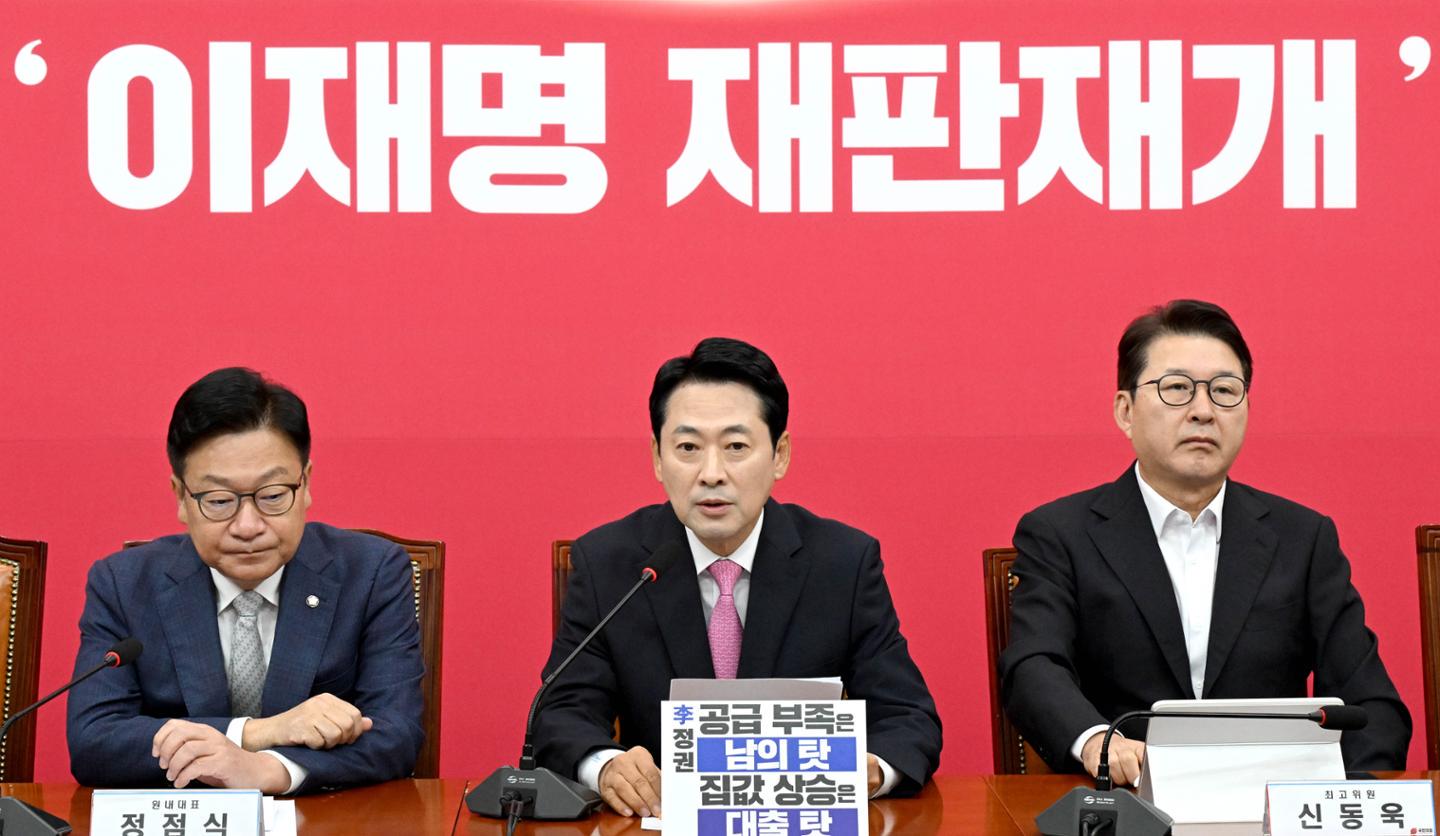
A survey has found that the proportion of voters who support neither the Democratic Party of Korea (DPK) nor the People Power Party (PPP) has exceeded 30% for the first time in a year. Despite the government and ruling party struggling with foreign policy and national security issues, as well as controversial personnel appointments, the opposition PPP has failed to capitalize on these difficulties. Instead, the proportion of voters unaffiliated with any political party has increased, while the PPP’s approval rating has declined. Critics argue that the PPP has focused too heavily on its hardline conservative supporters while failing to present credible alternatives on issues affecting people’s livelihoods.
According to a party support survey conducted by Gallup Korea among 1,000 voters aged 18 and older nationwide from October 6 to 8, the Democratic Party recorded 35% support, while the People Power Party stood at 26%. The proportion of voters supporting no political party reached 31%. Compared with the previous survey conducted three weeks earlier, support for the DPK and PPP fell by 5 percentage points and 1 percentage point, respectively, while the proportion of unaffiliated voters rose by 6 percentage points. The share of unaffiliated voters, which had remained in the 20% range, surpassed 30% for the first time since the fourth week of September last year.
A similar trend emerges when compared with the survey conducted in the first week of September, immediately after President Lee Jae-myung announced his second Cabinet reshuffle, which sparked controversy over alleged failures in personnel appointments. At that time, the DPK recorded 38% support, the PPP 30%, and unaffiliated voters 25%. Over the past month, support for the DPK and PPP declined by 3 and 4 percentage points, respectively, while the share of unaffiliated voters increased by 6 percentage points.
Within the PPP, criticism has emerged that the party has used a series of controversies involving the government and ruling party—including the failed nominations of Kim Seung-won and Yong Hye-in, a landmine explosion in the Demilitarized Zone (DMZ), and divisions over the appointment of the head of the Serious Crimes Investigation Agency—primarily as justification for mobilizing its hardline supporters in street protests.
Four-term lawmaker Kim Tae-ho criticized the party leadership in a Facebook post on October 11, stating, “The voices of hardliners cannot represent the entire party membership, let alone speak for the will of the people.” He added, “Can a structure that merely amplifies the applause of hardline supporters truly open the way to a future for conservatism?” His remarks suggest that the party’s approach, including a street rally held in central Seoul on October 3 under the leadership of PPP Chairman Jang Dong-hyeok, has been insufficient to attract centrist voters.
Others argue that the PPP has failed to offer concrete policy alternatives that would demonstrate its readiness to govern. Although the National Assembly’s annual parliamentary audit began on October 6, critics maintain that the party must go beyond criticizing and scrutinizing the government and ruling party and present credible alternatives if it hopes to recover public support.
One first-term lawmaker emphasized, “Rather than becoming consumed by factional conflicts, we should compete with the ruling party on issues affecting people’s livelihoods and on policy. What matters more is earning the public’s trust in the People Power Party, rather than simply making ourselves the choice for voters who dislike the Democratic Party.”
Posted by Freewhale98
2 Comments
Is there a chance for a third political party to fill the void in SK then?
Here I was wondering what the hell the US Democratic Party had to do with national Purchasing Power Parity.