
In Berlin, a coalition consisting of the Left Party, the Greens, and the SPD is becoming increasingly likely. CSU leader Markus Söder and others within the Union are seething, and criticism is also mounting within the SPD at the federal level. The federal government now has one more problem to deal with.
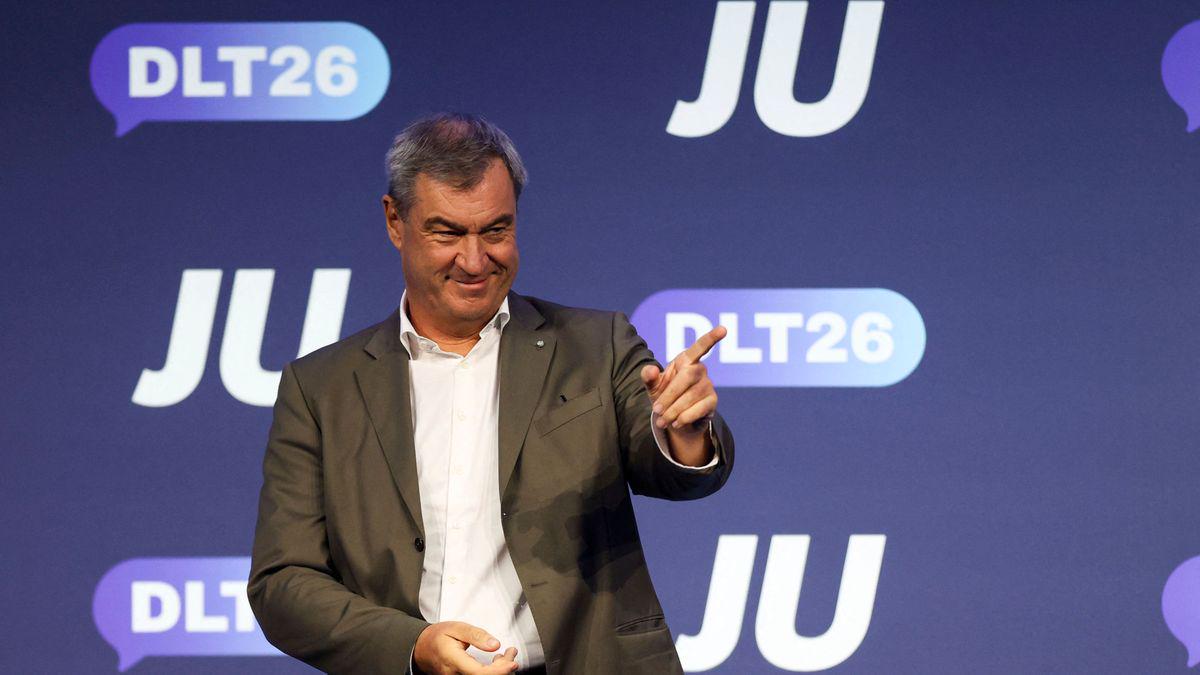
For Markus Söder, the conditions could hardly be better. As the CSU leader takes the stage on Sunday morning at the Junge Union’s "Deutschlandtag" (Germany Day) event, the dominant topic among the delegates is the potential left-wing coalition in Berlin. Following the release of an exploratory paper by The Left, the Greens, and the SPD in the capital the previous day (read more about that here), the outrage among the youth wing of the Union parties is immense. And Söder is enough of a political pro to harness that anger to his advantage. He knows that nothing unites parties quite like a common opponent.
"The red front is standing firm," the CSU leader rails. He warns that a red-green-red coalition intends to carry out expropriations—"and on a massive scale, at that." He calls it "Honecker 2.0." Expropriating housing corporations would cost 16 billion euros, "but, of course, someone else is expected to foot the bill"—Bavaria, for instance, via the fiscal equalization scheme between the German states.
Söder then turns his attention to the federal SPD. "We must now pass a law as quickly as possible that puts an end to these absurd fantasies about expropriation." He notes that this had been agreed upon, and adds that if the SPD refuses to follow through, it demonstrates that they support the expropriation plans put forward by those involved in the 'red-green-red' exploratory talks.
Söder is also calling on his coalition partner to take action regarding migration policy. He argues that it is unacceptable for the capital to undermine the hardline migration stance established by CSU Interior Minister Alexander Dobrindt. He insists that plans for new state-level admission programs must be blocked through federal legislation.
Furthermore, Söder suggests that the SPD and its popular Defense Minister, Boris Pistorius, should head to the Rotes Rathaus—Berlin’s city hall—because, according to a preliminary policy document, the cooperation between the Berlin Senate Department for Education and the German Armed Forces (Bundeswehr) is set to be terminated. This would mean that soldiers would no longer be permitted to speak in schools.
The Chancellor is powerless
Söder’s statements are well received by the young politicians of the CDU and CSU. Time and again, he draws loud, rhythmic applause. The atmosphere during his appearance on Sunday morning is more relaxed than it was during Friedrich Merz’s speech the previous day.
While the latter also issued a stern warning against a left-wing coalition in Berlin, Merz faced two challenges during his address. First, the delegates primarily wanted to hear how he intended to push through pension reform against the SPD’s opposition and resolve the CDU’s internal crisis. Second, the exploratory paper for the Berlin coalition had not yet been released at the time of his speech. Unlike Söder, Merz could not engage with specific policy points; he could only make appeals. "This is unacceptable! Stop it!" he exclaimed, directing his remarks at the SPD and the Greens. Shortly thereafter, those parties unveiled their plans for the capital.
The formation of a government in Berlin is becoming an additional burden for the already beleaguered federal coalition. Thorsten Frei, leader of the Union’s parliamentary group, describes it as "an unnecessary game with fire." He argues that antisemitism and fantasies about the socialization of assets have no place in the capital. "Anyone who recklessly engages with the political fringes is shaking the very foundations of our country. Berlin deserves better," says Frei.
Junge Union seeks to ostracize left-wing state government
On Sunday, the Junge Union demonstrated a fierce determination not to simply accept this development. The delegates unanimously passed a motion that harshly criticizes a potential left-wing coalition. The document was initiated by JU leader Johannes Winkel and Johannes Volkmann.
The exploratory paper from the red-green-red coalition contains "a great deal that goes beyond the limits of what is tolerable and beyond the boundaries of our constitution," says Winkel. Volkmann describes the agreement as a "shameful low point—a rupture in our culture—for which the SPD and the Greens must be held accountable." The motion from the JU (Young Union) includes four demands:
- a "political and social ostracism" of a potential coalition in Berlin between The Left Party, the Greens, and the SPD;
- the exclusion of the state [of Berlin] from the information systems used by security agencies;
- a federal law prohibiting the socialization [of assets/property]—a measure the coalition committee had agreed upon in the summer. This ban must now be implemented, "if necessary, by invoking the Federal Chancellor’s authority to set policy guidelines";
- a body tasked with documenting potential legal violations in Berlin.
Resistance from the SPD parliamentary group
The SPD leadership has remained largely silent so far. Only Defense Minister Pistorius has spoken out, calling it "completely incomprehensible" that the prospective coalition partners in Berlin intend to terminate the cooperation agreement with the Bundeswehr—an agreement that was only concluded in June of this year. "Ending the cooperation agreement in Berlin would send a signal against the Bundeswehr and its vital mission," Pistorius warned. "Such a signal must not come from Berlin."
Within the SPD’s parliamentary group, however, discontent is brewing. As early as last week, a number of lawmakers—led by interior policy spokesperson Sebastian Fiedler and digital policy spokesperson Johannes Schätzl—expressed their dissatisfaction in a statement and began gathering signatures from across the party’s various factions. They did not quite finish the process, partly because deliberations on the legislation to reform the intelligence services demanded a great deal of attention. But now, they are no longer willing to wait.
"Our compass of values is never up for negotiation," reads the headline of a statement obtained by Der Spiegel. "In our view, the recurring conflicts regarding antisemitism within the Berlin branch of The Left party—along with documented contacts with the Rammo clan’s circle and individuals from extremist milieus, as well as the disputes over how these matters have been handled—raise significant doubts about the political reliability of this state branch," the 20 signatories write.
In addition to Fiedler, the signatories include other interior policy experts such as Daniel Baldy, Helge Lindh, and Ingo Vogel, as well as leading representatives from various internal party factions. Esra Limbacher and Claudia Moll, spokespersons for the "Seeheimer Kreis," have endorsed the statement, as have Lina Seitzl—a spokesperson for the "Berlin Network"—and board member Markus Töns. Former Interior Minister Nancy Faeser is also among the signatories, as is Johann Saathoff, Parliamentary State Secretary at the Federal Ministry for Economic Cooperation and Development.
"Antisemitism is not a peripheral issue that can be resolved with a joint statement," the SPD lawmakers write. The protection of Jewish life, they assert, is "non-negotiable." They further note that even a well-founded suspicion that individuals linked to organized crime or terrorist organizations could gain political access undermines trust. "This makes our support for the police and security agencies all the more important."
While the signatories acknowledge the decision-making authority of the Berlin state branch of the party, they also point to their own "responsibility for the credibility of shared social democratic principles." "For this reason, under the current circumstances, we strongly oppose the initiation of coalition negotiations with the Berlin Left Party," they write.
Within the Union, such voices are likely being noted with approval, yet those issuing these warnings do nothing to alter the fundamental problem. "The SPD needs to explain, once again and in precise terms, what is happening here and how it plays out in reality," demands Markus Söder, just before departing the Junge Union’s "Deutschlandtag" (Germany Day) event. After all, he notes, it "naturally" places a strain on the government’s overall functioning.
Posted by IHateTrains123