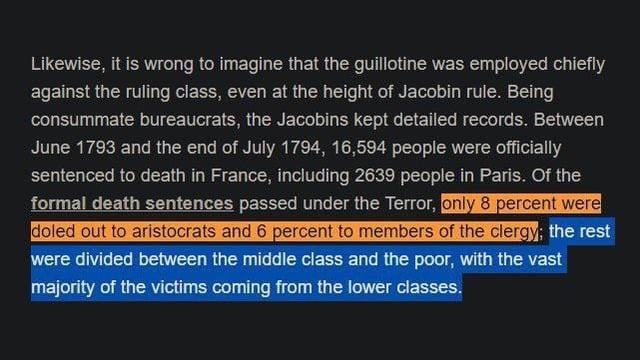
Historically, the guillotine has been used on revolutionaries to air their grievances far more often than “upper class”. During the French Revolution, 16,594 people were officially sentenced to death in Paris. 8% were nobility, 6% were clergy. Everyone else was just a commoner.
Many of the victims were, of course, the revolutionaries themselves. The OG revolutionaries – the Girondins – got the chop in October 1793, the Hébertists who replaced them were executed in March 1794, followed a week later by the Dantonists, and finally, the Robespierrists in Thermidor (July 1794). Of the 749 original members of the National Convention (the legislative body established by the Revolutionaries), over 600 were put to death – not by Royalists – but by each other. The guillotine is more a symbol of leftist infighting than anything else.
Tl;dr – the French Revolution killed a few nobles, a ton of peasants, and nearly all the revolutionaries themselves, and ended up with an Emperor, then the restoration of the King.
hibikir_40k on
We don’t even have to go back that far. You can look at, say, the Spanish Civil War. You’d see a different army take control of a town, and then find people happy to point at some of their neighbors as opponents of said army to be shot. Not because they actually were, but because then they could take their stuff. And you’d see this regardless of which army it was. Being able to execute people who you don’t like with minimal oversight leads to a lot of problems.
CheeseburgFreedomMan on
Literally the most explicit bourgeois revolution in world history and succs still try to use it as a rallying cry against the “elites”


3 Comments
Historically, the guillotine has been used on revolutionaries to air their grievances far more often than “upper class”. During the French Revolution, 16,594 people were officially sentenced to death in Paris. 8% were nobility, 6% were clergy. Everyone else was just a commoner.
Many of the victims were, of course, the revolutionaries themselves. The OG revolutionaries – the Girondins – got the chop in October 1793, the Hébertists who replaced them were executed in March 1794, followed a week later by the Dantonists, and finally, the Robespierrists in Thermidor (July 1794). Of the 749 original members of the National Convention (the legislative body established by the Revolutionaries), over 600 were put to death – not by Royalists – but by each other. The guillotine is more a symbol of leftist infighting than anything else.
Tl;dr – the French Revolution killed a few nobles, a ton of peasants, and nearly all the revolutionaries themselves, and ended up with an Emperor, then the restoration of the King.
We don’t even have to go back that far. You can look at, say, the Spanish Civil War. You’d see a different army take control of a town, and then find people happy to point at some of their neighbors as opponents of said army to be shot. Not because they actually were, but because then they could take their stuff. And you’d see this regardless of which army it was. Being able to execute people who you don’t like with minimal oversight leads to a lot of problems.
Literally the most explicit bourgeois revolution in world history and succs still try to use it as a rallying cry against the “elites”