
The Polish Experiment in Military Advising: Improving the European Union Training Mission to Ukraine
Posted by IHateTrains123
The Polish Experiment in Military Advising: Improving the European Union Training Mission to Ukraine
Posted by IHateTrains123
1 Comment
Summary:
Reports from frontline Ukrainian commanders are in line with observations from British military trainers we interviewed in early 2023, who told us that among Ukrainian troops who graduated from their three-week basic training course, attrition rates were about 70 to 90 percent within two to four weeks of arriving at the front lines. Such heavy losses led the British military to increase the training program to five weeks, with an “emphasis on tactics that would help Ukrainians survive the first two weeks in the trenches, which is also the most critical learning period for becoming experienced.”
As training takes on a heightened level of importance for Ukraine’s ability to continue fighting in war, on par with other critical elements of international support like military equipment and economic assistance, many Western militaries are emphasizing programs of instruction. Based on our recent visits to training bases, we highlight how training of Ukrainian forces is adapting alongside the realities of this “cyberpunk war” and shifting tactical innovations by Ukrainian and Russian forces.
**Filling a Crucial Gap through International Training**
Ukraine’s international partners provide basic training for new recruits, as well as additional training to help experienced units fight together better as a cohesive whole. Despite popular perceptions that the United States provides the majority of the support to Ukraine, European partners are actually the primary providers of training. As of the end of summer 2024, the European Union (EU) has trained over sixty thousand Ukrainian troops, with thirteen thousand trained in Poland, and is working toward training another fifteen thousand by the end of the year.
[…]
Collectively, since 2022, Ukraine’s international supporters have been responsible for training over 120,000 Ukrainians (more than one and a half times the size of the British Army) at eighty locations around the world. For context, the number of Ukrainians trained represents around 20 percent of the six hundred thousand soldiers Ukraine had fighting in the Ukrainian Ground Forces in 2023. It also represents, according to some estimates, over a year’s worth of replacements for Ukrainian military losses. Another coordination body for multilateral and bilateral training since November of 2022 is the US-led Security Assistance Group–Ukraine (SAG-U) in Wiesbaden, Germany. NATO leadership has committed to taking over SAG-U, and it is anticipated that by the end of 2024, NATO Security Assistance and Training for Ukraine (NSATU) will be operationally capable with seven hundred personnel. While NATO has the doctrine and experience to provide overall coordination for international training efforts, it is not currently in that role; EUMAM, Interflex, and SAG-U (soon to be NSATU) are all technically on the same level and coordinate with each other as equals.
[…]
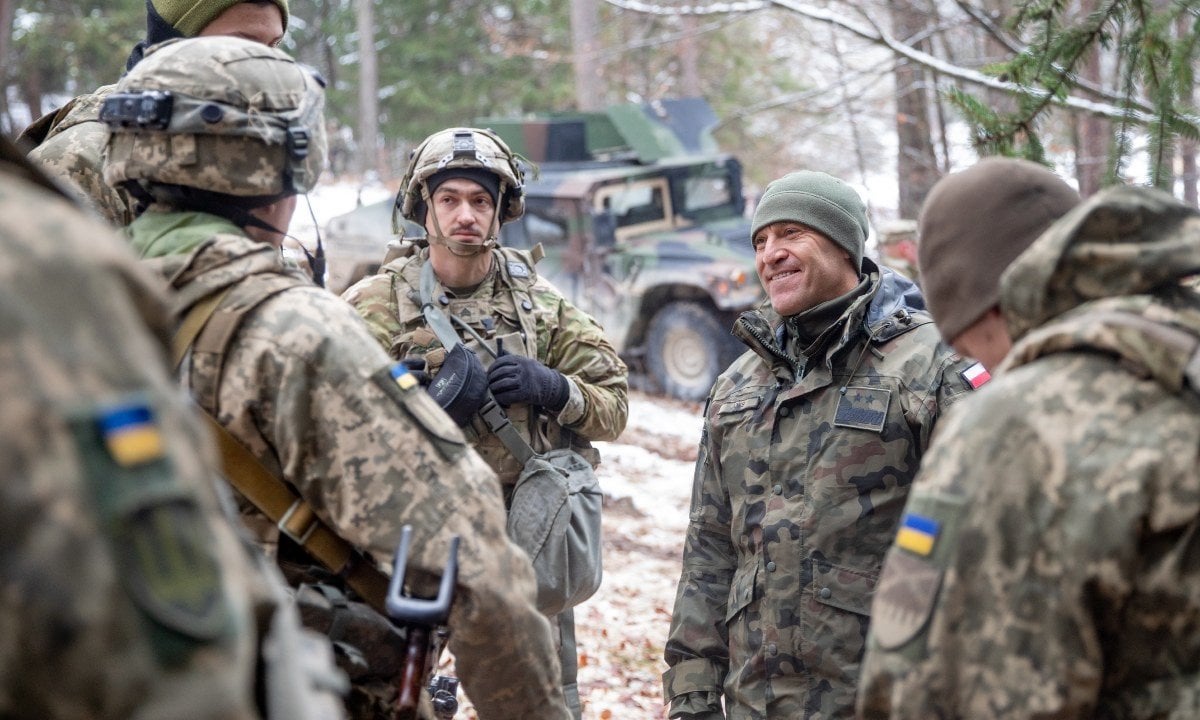
Coordinating training under a multinational body like the European Union, however, does not guarantee that the training each nation provides will be the same. Our research team has observed the German approach to training Ukrainians, and after this recent trip, we identified comparative advantages in how the Polish train Ukrainian troops. In addition, underneath each training command, individual countries provide trainer contributions, which may operate according to their own national requirements. For instance, numerous Ukrainians have commented to us that Finnish trainers are the best at teaching them how to use AK-47s for infantry tactics. Contrarily, even though we visited the CAT-C on an official visit, French trainers did not allow us to observe a portion of the training, nor did they allow us to talk to Ukrainian trainees. Belgian trainers, on the other hand, were under no such restrictions when we visited. Overall, we view the differences in national approaches across the EUMAM mission as a strength that allows for innovation to find what works best for Ukrainian trainees. The Polish CAT-C and their troops are particularly flexible.
**The Polish Way: Listening and Staying Connected**
The Polish approach to training visiting Ukrainian forces starts the first day as they do what they call “research” on each individual Ukrainian soldier that has battlefield experience, which they immediately use to improve their training and program of instruction. During this initial screening process, Polish training officers identify those with combat experience, interview them about what tactics are (or are not) working, and use that information to immediately update and refine the program of instruction. Our interviews indicate that this initial “research” is a critical step as EUMAM leadership struggles to get advance knowledge about visiting units and does not get feedback or debriefs about how Ukrainian troops trained at the CAT-C perform on the front lines, except through informal contacts that trainers maintain with graduated trainees on the front.
The Polish CAT-C headquarters recognizes that training must meet the realities of the war Ukraine is currently fighting—a kind of war that the Polish military has not experienced. A senior Polish officer at the CAT-C headquarters described to us the challenges of training Ukrainians. “Without air dominance, the Ukrainians have to fight like it’s World War One,” he said, adding that training must be focused on the “must haves” for training requirements rather than the “nice to haves.”
[…]
The flexibility of the Polish approach was apparent when we observed the training provided at the CAT-C for brigade headquarters. In a war that is continuously causing losses in experienced personnel, the development of leaders at the company, battalion, and brigade levels is critical for Ukraine’s military to fight at its best—and brigade headquarters must learn how to fight together. We observed headquarters training at one of the Polish sites. Officers from different sections of the brigade, like intelligence, drones, and operations, sat in front of screens displaying drone feeds and used Kropyva software to indicate and control friendly forces and identify enemy positions. Brigade staff were trained using realistic scenarios from actual Ukrainian brigades. The headquarters training we observed, unlike other portions of the training, was run by two highly experienced Ukrainian trainers. These two officers were instructing the unit on a modified version of the military decision-making process, one of the five such Ukrainian variants on the NATO-standard process that they teach. Interestingly, they noted that what made their version of the military decision-making process the most unique was that their “concept of operations” step is different from the NATO standard. Mission command was not taught, since the brigade staff would not be using it in combat, especially with inexperienced troops. As a Ukrainian officer told us, “We can’t train for something we don’t use in the war.”
The Polish CAT-C has also worked hard to incorporate Ukrainian requests for realistic training. Among the realistic features of training were efforts to make trainees more psychologically resilient and prepared for combat, like the incorporation of blood and animal parts into the training for medics. One Ukrainian request was particularly widespread: “The Ukrainians keep asking us to integrate drones into their training,” said one Polish military officer, a demand also described to us by numerous other Polish military advisors at training sites across western Poland. At the CAT-C, reconnaissance drones and bomber drones with fake grenades have been incorporated into the training.