
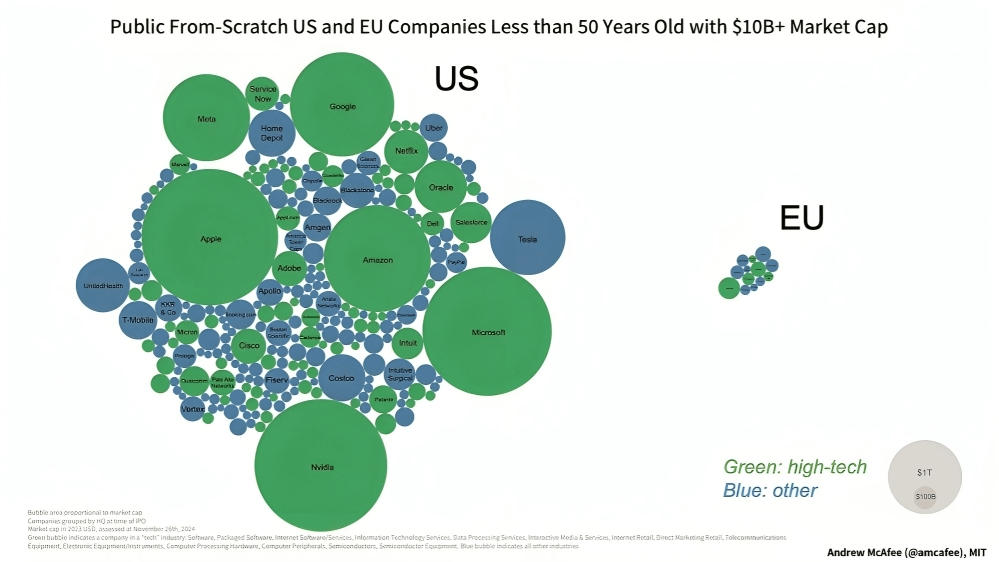
I don't know why the author added T mobile in the american section. I think t mobile is a subsidiary of a german company. Other than that I think the chart is accurate.
Posted by CauseLong
I don't know why the author added T mobile in the american section. I think t mobile is a subsidiary of a german company. Other than that I think the chart is accurate.
Posted by CauseLong
9 Comments
>high-tech
>costco
Is this chart accurate? If so pertinent to a lot of current debates.
Got link? Got more pixels?
What even are the EU companies?
Half of these are based on Ireland, so you might want to redo the graph
let’s just make a completely arbitrary distinction lmao
Even Costco and Home Depot blow them out of the water
[deleted]
One thing I found really fascinating about all of this is *WHY*.
It seems to mainly be a cultural thing. While the US has the “American Dream” culture; starting a new business, competing, and winning the game, The EU can more often look down on this idea as selfish and greedy, and are less prone to start new businesses and attempt to take market share from them as well.
Its one thing that has driven the idea in my head that Culture is more important than Policy. Culture IS a policy in itself. Its one of the most difficult things to navigate when economists are studying things, as its much harder to measure than raw numbers.
If you included Canada in this map, it would have a green circle (Spotify) bigger than any in the EU.