TLDR: Politano writes about absolute and relative changes in poverty and inequality. While poverty, measured by how many people earn less than 2.15 or 3.65 or 6.85 intl. dollars (different cutoffs for different depth of poverty), has mostly been declining since data has been collected, it has increased during Covid era and stagnated/ declined slower by 2022 (latest data).
In 2022 greater share of world’s population has been living with less than 2.15 intl. dollars a day than in 2019., a warning sign for the world.
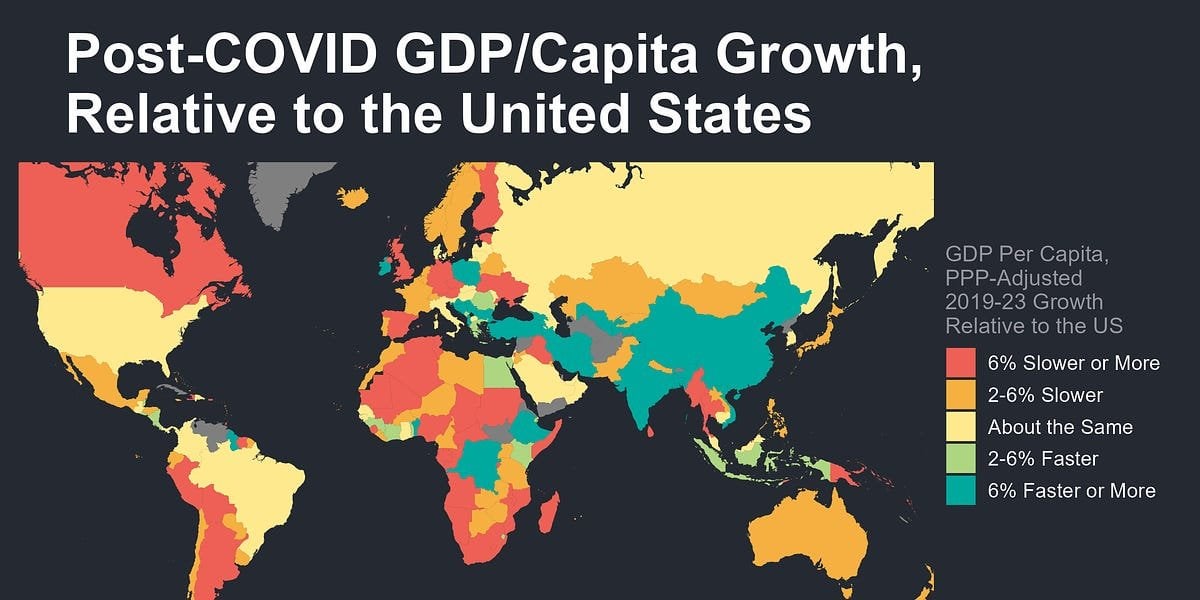
Politano takes US as a example of frontier economy (economy that employs best technologies and know how) and compares economic performance of middle and low income countries with it. In theory, non frontier countries should converge because it’s easier to apply existing technologies and know-how rather than invent a new one.
One the one side there are China and India and few other countries who’ve been converging with the US, but in 2019-2023 period that convergence has slowed compared to the decades before. On the other side there are vast population economies in SEA, Africa and LatAm who’ve lost pace or stagnated compared to US.
Politano posits that greater fiscal capacity of rich countries has allowed them to weather Covid era better, compared to fiscally vulnerable developing countries. Post COVID spike in energy and food prices which low income countries are more vulnerable to contributed as well. Intensifying geopolitical conflict and tensions that disrupt economic activity either by displacement or by hindering market forces (tariffs, non-tariff barriers) also play a role.
neolthrowaway on
This is my biggest fear with the development of AI as technology. There are very few ways I see that would distribute the gains from it to the poorer countries.
We are practically at the mercy of people in charge like Trump/Musk/Altman/Nadella. and they don’t seem to keen on distributing those gains.
Americans will benefit by being shareholders but that’s not something accessible to most of the world.
And there is a lot of hype around the technology but a lot of the hype is not unfounded. AI at this point is only limited by hardware and ability to mass produce the hardware and robots. By the time we have those factories, the software and research side of things would have made so many leaps. The potential of using it for accelerating scientific knowledge is immense.
Google has a little bit of history of distributing some of its gains worldwide by just making a lot of its products free but i don’t think that’s feasible for AI because its compute costs are pretty high. And by the time those costs come down, the gap would have widened so much more.
There’s potential for the need of cheap intellectual labor to be completely eliminated and eventually even cheap physical labor.
How then do we bridge this gap at all? What are the mechanisms that could make it happen?
Fire_Snatcher on
At least with Mexico, it isn’t so much falling behind or even struggling to match as it is happily choosing to stay back. Mexico bucked global trends as their incumbent party absolutely demolished the “competition”, one of the least fierce presidential elections since the PRI years many decades ago, and sky high approval rating. According to the INEGI, the poor have had enormous growth in their income, the working class moderate growth, the middle class basically stagnated and upper class declined substantially. And they’re happier for it. It’s a hard thing to square with a more growth oriented mindset, and we’ll see how another 6 years may change societal ambitions from redistribution (or not).
justsomen0ob on
This already happened before covid. The financial times had an [article](https://www.ft.com/content/e7e95688-e5f7-45e8-8333-9f11c8958fb7) about the end of convergence between rich and poor countries since the mid 2010s.
I think it’s going to get much worse over the next years for multiple reasons. China is facing a significant slowdown which will have big implications for many developing countries, as China is the big driver of commodity demand growth. A lot of developing countries are facing debt problems and the move towards friendshoring and supply chain security along with geopolitics will prevent developing countries from getting to the high value parts of production chains. AI, automation and robotics will disproportionally benefit rich countries because they rely and cheap capital and access to skilled lebor and will erode the big advantage poor countries have, which is cheap labor.

4 Comments
TLDR: Politano writes about absolute and relative changes in poverty and inequality. While poverty, measured by how many people earn less than 2.15 or 3.65 or 6.85 intl. dollars (different cutoffs for different depth of poverty), has mostly been declining since data has been collected, it has increased during Covid era and stagnated/ declined slower by 2022 (latest data).
In 2022 greater share of world’s population has been living with less than 2.15 intl. dollars a day than in 2019., a warning sign for the world.
Politano takes US as a example of frontier economy (economy that employs best technologies and know how) and compares economic performance of middle and low income countries with it. In theory, non frontier countries should converge because it’s easier to apply existing technologies and know-how rather than invent a new one.
One the one side there are China and India and few other countries who’ve been converging with the US, but in 2019-2023 period that convergence has slowed compared to the decades before. On the other side there are vast population economies in SEA, Africa and LatAm who’ve lost pace or stagnated compared to US.
Politano posits that greater fiscal capacity of rich countries has allowed them to weather Covid era better, compared to fiscally vulnerable developing countries. Post COVID spike in energy and food prices which low income countries are more vulnerable to contributed as well. Intensifying geopolitical conflict and tensions that disrupt economic activity either by displacement or by hindering market forces (tariffs, non-tariff barriers) also play a role.
This is my biggest fear with the development of AI as technology. There are very few ways I see that would distribute the gains from it to the poorer countries.
We are practically at the mercy of people in charge like Trump/Musk/Altman/Nadella. and they don’t seem to keen on distributing those gains.
Americans will benefit by being shareholders but that’s not something accessible to most of the world.
And there is a lot of hype around the technology but a lot of the hype is not unfounded. AI at this point is only limited by hardware and ability to mass produce the hardware and robots. By the time we have those factories, the software and research side of things would have made so many leaps. The potential of using it for accelerating scientific knowledge is immense.
Google has a little bit of history of distributing some of its gains worldwide by just making a lot of its products free but i don’t think that’s feasible for AI because its compute costs are pretty high. And by the time those costs come down, the gap would have widened so much more.
There’s potential for the need of cheap intellectual labor to be completely eliminated and eventually even cheap physical labor.
How then do we bridge this gap at all? What are the mechanisms that could make it happen?
At least with Mexico, it isn’t so much falling behind or even struggling to match as it is happily choosing to stay back. Mexico bucked global trends as their incumbent party absolutely demolished the “competition”, one of the least fierce presidential elections since the PRI years many decades ago, and sky high approval rating. According to the INEGI, the poor have had enormous growth in their income, the working class moderate growth, the middle class basically stagnated and upper class declined substantially. And they’re happier for it. It’s a hard thing to square with a more growth oriented mindset, and we’ll see how another 6 years may change societal ambitions from redistribution (or not).
This already happened before covid. The financial times had an [article](https://www.ft.com/content/e7e95688-e5f7-45e8-8333-9f11c8958fb7) about the end of convergence between rich and poor countries since the mid 2010s.
I think it’s going to get much worse over the next years for multiple reasons. China is facing a significant slowdown which will have big implications for many developing countries, as China is the big driver of commodity demand growth. A lot of developing countries are facing debt problems and the move towards friendshoring and supply chain security along with geopolitics will prevent developing countries from getting to the high value parts of production chains. AI, automation and robotics will disproportionally benefit rich countries because they rely and cheap capital and access to skilled lebor and will erode the big advantage poor countries have, which is cheap labor.