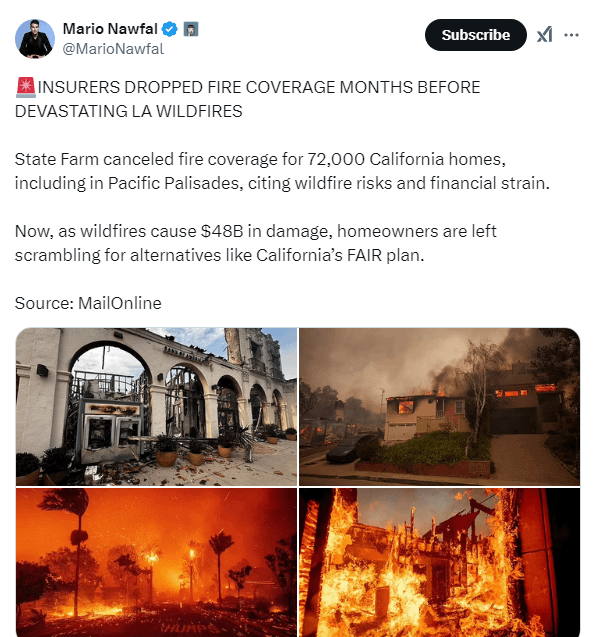
Insurers dropped fire coverage months before devaatating LA WILDFIRES. What causes insurance companies to withdraw?
Posted by MainBrief2189

Insurers dropped fire coverage months before devaatating LA WILDFIRES. What causes insurance companies to withdraw?
Posted by MainBrief2189
8 Comments
Risk, simple as that. It’s happening all over the world for all kinds of things. In my country they are starting to end flood protections, as plenty of towns have areas built where they shouldn’t be, and the risk is too high. Some parts of the world are starting to see coverage change for coastal areas that get frequent storm damage.
Whether the fires are intentional or not, they are frequent enough that insurance companies would have been thinking about dropping coverage for these areas for years. If they pay out more for a certain area than they bring in, it no longer makes financial sense to cover it.
Are local governments refusing to take any necessary steps to remove flammable materials from forests leading to increased fire risks?
They’ve been dropping coverage every year since the pg&e fire. This isn’t the first time, and it’s been a very public situation for years.
The insurance industry’s been backing out of home insurance in places that face frequent natural disasters for a couple years now. I bet you don’t want to hear this, but it is climate change. The 100-year floods and fires that used to happen every hundred years are happening a lot more often these days, and it’s completely throwing off the actuarial tables that insurance companies rely on to price their products. Not only can they not be sure of the current likelihood of disasters, since conditions are unprecedented, in flux, and getting worse, but even when they can calculate risks well enough to properly price insurance, many states have limits on either the total rates that can be charged for home insurance, or the year to year increases allowed for individual policies. You can’t make a profit selling insurance if the events you’re insuring against are happening more frequently and at greater extent than anyone involved in the industry has planned for.
The most mainstream reporting on this phenomenon has come out of Florida, as the hurricane situation there is the worst, and there are some other issues with the Florida regulatory scheme that have made it harder to ignore the problem quite as long as elsewhere. Worth looking into yourself if you want more info from a variety of perspectives, but its prohibitively difficult to get a new home insurance policy in Florida these days.
As to why this is happening now, its downstream from the reinsurance market. Insurance payouts have been trending up for over a decade, but it came to a head a couple years ago when several major insurance companies had to renew their own reinsurance policies after bad hurricane seasons, and thus had to admit (at least within the internal insurance industry world) how badly their natural disaster damage projections were off. Once they had to lock in much higher reinsurance rates, they’ve been recalculating their pricing overall as a result, and though it takes some time to filter down to the customer level they’ve been stopping new (or when they can, old) policies in the worst areas for a little while now. Wildfire-prone southern California is a natural target for that sort of industry recalibration, but it won’t be the last. You’ll see a lot more of this in the future, especially if there’s still a massive insurance payout after these fires despite some cancelled policies.
Insurance companies predicted an increasing fire risk due to the state of CA’s mismanagement of resources which required them to raise rates to stay in business. However, the state of CA would not allow them to raise rates so they had no option but to withdraw. No company is going to operate in a market where you are guaranteed to go bankrupt.
Insurance is a product designed to generate profit for the insurance company. I’m not sure why people find this so hard to understand. It’s not some public service or civil right. It’s a product sold for profit.
Foreknowledge
Because insurance pays close attention to disaster and climate trends because they ability to maximise profits depends on being able to predict those tends best they can. They see which way the wind is blowing and adjust to reduce losses.
It’s not just with fires. You see companies doing the same in florida with storm and flood cover. They’ve done the leg work and predicted it’ll get worse.
Home insurance companies are a perfect barometer for climate change because they have a direct financial interest in predicting what’s coming.