> Most discussions of the pending New York City congestion pricing program assume that auto tolls will be in the $13 to $15 (round-trip) range, with a lesser toll, perhaps as low as $4 or $5, for off-peak trips. That’s according to Streetsblog contributor Charles Komanoff, who has been researching and modeling congestion tolling since the early part of this century, and believes a $13 toll would be the bare minimum for the state to reach its legislatively mandated $1 billion annual revenue requirement.
> That $13 coincides with tolls currently charged by the Metropolitan Transportation Authority on its six major bridges and tunnels. And, because the $13-$15 range has dominated congestion pricing discourse for years, it has created its own sense of political inevitability. Considerably higher car tolls are easily dismissed as politically infeasible.
> A $13 or $15 congestion toll might be all the politicians think they can achieve, but such a low fee will fail to maximize the net societal benefit conferred by congestion pricing. In fact, the toll needs to be much, much higher.
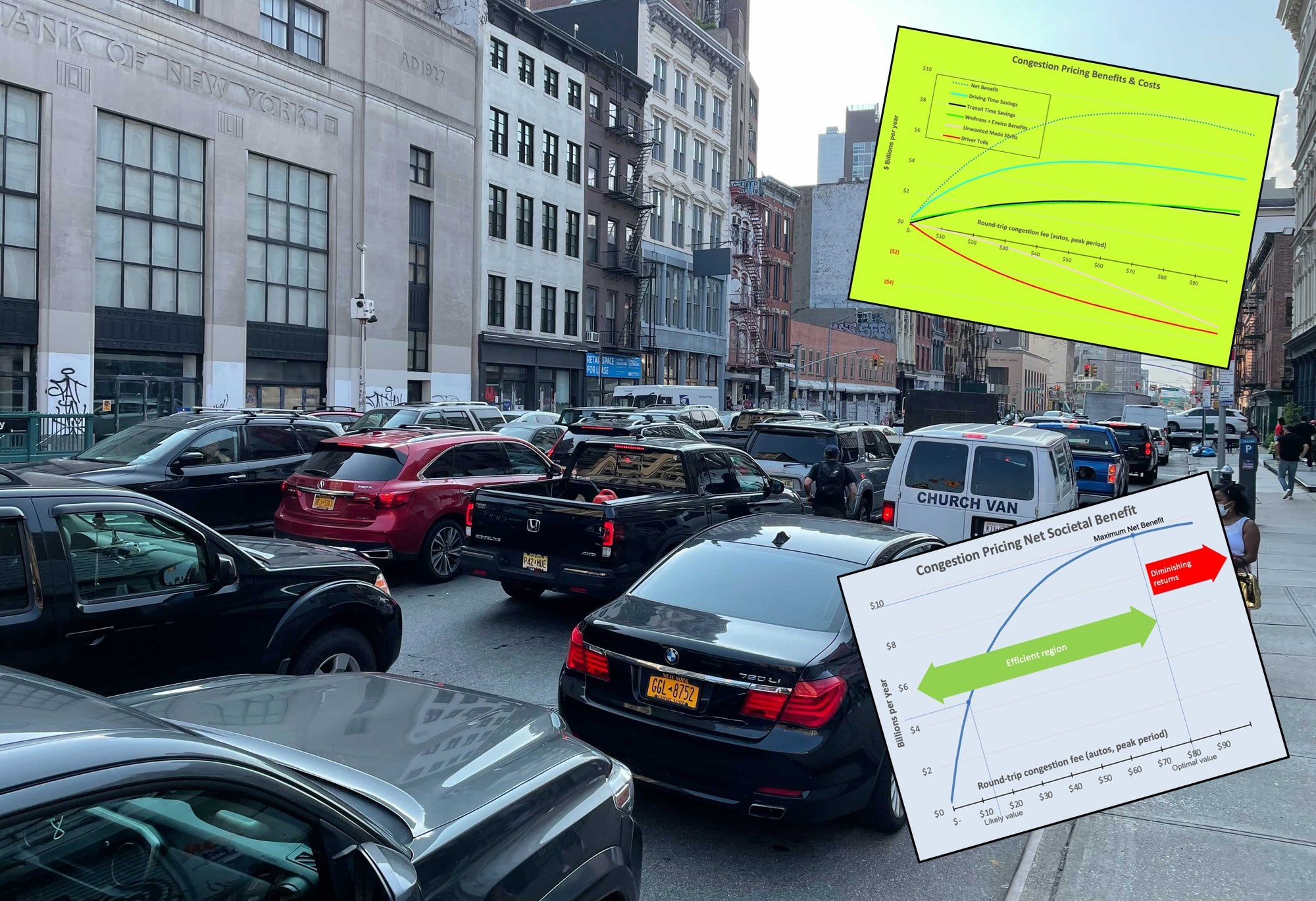
> As we can see in the second chart, the congestion fee that maximizes the net benefit is $80, which is nearly six times greater than the likely congestion fee of $13-$15. At the optimal toll level of $80, the net societal benefit is nearly $10 billion per year.
> The region to the left of the optimal point is the efficient region, where the time savings and environmental benefits grow faster than the costs. Beyond that point, we enter the region of diminishing returns, where the costs — the higher tolls paid by motorists, along with drivers’ lost amenity from car trips they give up on account of the toll — grow faster than the benefits.
> The efficient region in the graph is where tolling delivers the biggest bang for the buck: A $14 congestion toll hits drivers with just 17.5 percent of the optimal toll cost while extracting 45 percent of the maximum net social benefits. That’s efficiency in action!
> **I’m not advocating charging a congestion fee in the optimal range, but clearly we would do well to stay on the higher side of the likely $13-$15 range.** Indeed, examining our second chart closely, one can see that the difference in net societal benefit in going just from a $13 congestion fee to $15 is nearly half a billion dollars per year, an 11-percent increase.

1 Comment
> Most discussions of the pending New York City congestion pricing program assume that auto tolls will be in the $13 to $15 (round-trip) range, with a lesser toll, perhaps as low as $4 or $5, for off-peak trips. That’s according to Streetsblog contributor Charles Komanoff, who has been researching and modeling congestion tolling since the early part of this century, and believes a $13 toll would be the bare minimum for the state to reach its legislatively mandated $1 billion annual revenue requirement.
> That $13 coincides with tolls currently charged by the Metropolitan Transportation Authority on its six major bridges and tunnels. And, because the $13-$15 range has dominated congestion pricing discourse for years, it has created its own sense of political inevitability. Considerably higher car tolls are easily dismissed as politically infeasible.
> A $13 or $15 congestion toll might be all the politicians think they can achieve, but such a low fee will fail to maximize the net societal benefit conferred by congestion pricing. In fact, the toll needs to be much, much higher.
> As we can see in the second chart, the congestion fee that maximizes the net benefit is $80, which is nearly six times greater than the likely congestion fee of $13-$15. At the optimal toll level of $80, the net societal benefit is nearly $10 billion per year.
> The region to the left of the optimal point is the efficient region, where the time savings and environmental benefits grow faster than the costs. Beyond that point, we enter the region of diminishing returns, where the costs — the higher tolls paid by motorists, along with drivers’ lost amenity from car trips they give up on account of the toll — grow faster than the benefits.
> The efficient region in the graph is where tolling delivers the biggest bang for the buck: A $14 congestion toll hits drivers with just 17.5 percent of the optimal toll cost while extracting 45 percent of the maximum net social benefits. That’s efficiency in action!
> **I’m not advocating charging a congestion fee in the optimal range, but clearly we would do well to stay on the higher side of the likely $13-$15 range.** Indeed, examining our second chart closely, one can see that the difference in net societal benefit in going just from a $13 congestion fee to $15 is nearly half a billion dollars per year, an 11-percent increase.
!ping YIMBY&USA-NYC&TRANSIT