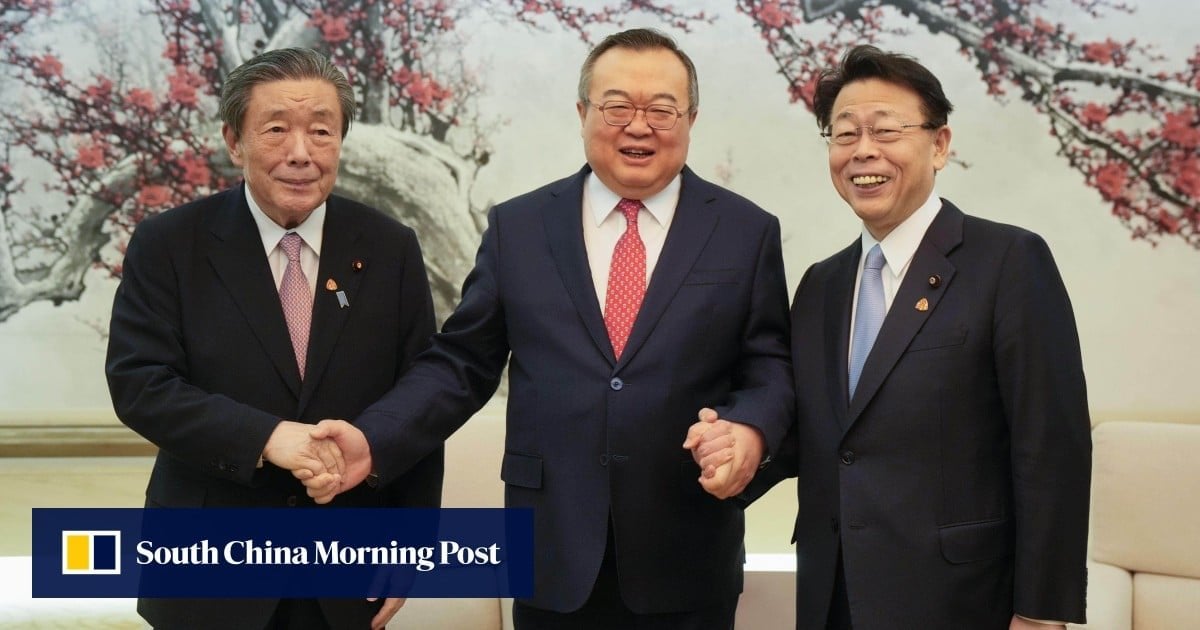
The governing parties of China and Japan held their first dialogue in over six years on Tuesday, agreeing to step up exchanges and promote strategic and mutually beneficial ties.
At the dialogue in Beijing between China’s ruling Communist Party and politicians from Japan’s Liberal Democratic Party (LDP) and its coalition partner Komeito, the two sides said they would maintain close communication “regardless of the situation of China-Japan relations”.
“[Both sides will] step up exchanges between political parties, dignitaries and young politicians, enhance mutual understanding and trust, and strengthen the political foundation for the improvement and development of China-Japan relations,” the Communist Party’s International Department said in a statement.
There have been signs of thawing China-Japan relations since Japanese Prime Minister Shigeru Ishiba came to power in October. The two countries have attempted to mend ties as geopolitical uncertainty grows, and especially as Donald Trump prepares to return to the White House next week.
Liu Jianchao, head of the International Department, which serves as the Communist Party’s diplomatic arm, said the ruling parties of the two countries should strengthen dialogue and communication and take concrete action to promote the sound and stable development of China-Japan relations.
Li Shulei, head of the Publicity Department of the Central Committee of the Communist Party, said on Monday that China was willing to work with Japan to foster a more favourable public perception of the two nations among each other’s citizens.
The Japanese delegation, led by LDP secretary general Hiroshi Moriyama and his Komeito counterpart Makoto Nishida, arrived in the Chinese capital on Monday for a three-day visit.
“The Chinese Communist Party is willing to work with the ruling coalition of Japan to … strengthen political dialogue, promote people-to-people exchanges and create a healthy and rational public opinion environment for China-Japan relations,” Li said, according to Chinese state news agency Xinhua.
The Japanese lawmakers also held talks with Wang Huning, the Communist Party’s No 4 official, on Tuesday, according to China’s foreign ministry.
Japanese Foreign Minister Takeshi Iwaya visited Beijing last month. During his visit, the two sides revived a cultural exchange dialogue, and Japan agreed to relax visa requirements for Chinese visitors. The two countries also agreed to step up exchanges between media outlets and think tanks to help improve public opinion about each other.
Before the delegation of lawmakers left for China, Ishiba met Moriyama and Nishida and expressed his hope for “continuing exchanges between Japan and China at various levels”.
During the meeting, Ishiba reiterated his desire to visit China soon.
Wang, the Chinese foreign minister, is understood to be planning a trip to Japan in February.
A poll released last month indicated that Japanese and Chinese public sentiment towards each other was very low, with nearly 90 per cent of those surveyed expressing a negative view of their neighbouring country.The fatal stabbing of a Japanese boy in Shenzhen in southern China in September contributed to the worsening public sentiment. The tragedy happened less than three months after a Chinese woman was killed while defending a Japanese mother and child during a knife attack in the eastern city of Suzhou.
These incidents have heightened security fears among Japanese living in China and fuelled anti-Chinese sentiment within Japan.
During the Tuesday dialogue, the two sides exchanged views on Japan’s release of waste water from the Fukushima nuclear plant and China’s imports of Japanese fishery products. They agreed to step up communication to “appropriately address their respective concerns”, according to the International Department.
Beijing imposed import restrictions on Japanese seafood in 2023 after Japan began releasing treated radioactive water from Fukushima into the sea.
In September, Japan agreed to an international monitoring framework allowing other parties, including China, to engage in independent sampling and monitoring activities, while Beijing said it would “gradually restore” imports of some Japanese aquatic products.
The two Asian powers are also deepening their defence exchanges.
A group of senior Japan Self-Defence Forces personnel made a nine-day visit to China late last year for exchanges with the People’s Liberation Army.
China’s defence ministry said on Monday that a delegation from the PLA’s Eastern Theatre Command would visit Japan later this month and meet leaders of the Japanese Ministry of Defence and the Joint Staff of the Self-Defence Forces.
animealt46 on
Keeping in mind it’s the usual SCMP shit stirring, well overall this was inevitable. Kinda shocked it happened so quickly though.
Maximilianne on
> enhance mutual understanding and trust, and strengthen the political foundation for the improvement and development of China-Japan relations
hmm sounds like they are forming an east asia co prosperity sphere

3 Comments
The governing parties of China and Japan held their first dialogue in over six years on Tuesday, agreeing to step up exchanges and promote strategic and mutually beneficial ties.
At the dialogue in Beijing between China’s ruling Communist Party and politicians from Japan’s Liberal Democratic Party (LDP) and its coalition partner Komeito, the two sides said they would maintain close communication “regardless of the situation of China-Japan relations”.
“[Both sides will] step up exchanges between political parties, dignitaries and young politicians, enhance mutual understanding and trust, and strengthen the political foundation for the improvement and development of China-Japan relations,” the Communist Party’s International Department said in a statement.
There have been signs of thawing China-Japan relations since Japanese Prime Minister Shigeru Ishiba came to power in October. The two countries have attempted to mend ties as geopolitical uncertainty grows, and especially as Donald Trump prepares to return to the White House next week.
Liu Jianchao, head of the International Department, which serves as the Communist Party’s diplomatic arm, said the ruling parties of the two countries should strengthen dialogue and communication and take concrete action to promote the sound and stable development of China-Japan relations.
Li Shulei, head of the Publicity Department of the Central Committee of the Communist Party, said on Monday that China was willing to work with Japan to foster a more favourable public perception of the two nations among each other’s citizens.
The Japanese delegation, led by LDP secretary general Hiroshi Moriyama and his Komeito counterpart Makoto Nishida, arrived in the Chinese capital on Monday for a three-day visit.
“The Chinese Communist Party is willing to work with the ruling coalition of Japan to … strengthen political dialogue, promote people-to-people exchanges and create a healthy and rational public opinion environment for China-Japan relations,” Li said, according to Chinese state news agency Xinhua.
The Japanese lawmakers also held talks with Wang Huning, the Communist Party’s No 4 official, on Tuesday, according to China’s foreign ministry.
Japanese Foreign Minister Takeshi Iwaya visited Beijing last month. During his visit, the two sides revived a cultural exchange dialogue, and Japan agreed to relax visa requirements for Chinese visitors. The two countries also agreed to step up exchanges between media outlets and think tanks to help improve public opinion about each other.
Before the delegation of lawmakers left for China, Ishiba met Moriyama and Nishida and expressed his hope for “continuing exchanges between Japan and China at various levels”.
During the meeting, Ishiba reiterated his desire to visit China soon.
Wang, the Chinese foreign minister, is understood to be planning a trip to Japan in February.
A poll released last month indicated that Japanese and Chinese public sentiment towards each other was very low, with nearly 90 per cent of those surveyed expressing a negative view of their neighbouring country.The fatal stabbing of a Japanese boy in Shenzhen in southern China in September contributed to the worsening public sentiment. The tragedy happened less than three months after a Chinese woman was killed while defending a Japanese mother and child during a knife attack in the eastern city of Suzhou.
These incidents have heightened security fears among Japanese living in China and fuelled anti-Chinese sentiment within Japan.
During the Tuesday dialogue, the two sides exchanged views on Japan’s release of waste water from the Fukushima nuclear plant and China’s imports of Japanese fishery products. They agreed to step up communication to “appropriately address their respective concerns”, according to the International Department.
Beijing imposed import restrictions on Japanese seafood in 2023 after Japan began releasing treated radioactive water from Fukushima into the sea.
In September, Japan agreed to an international monitoring framework allowing other parties, including China, to engage in independent sampling and monitoring activities, while Beijing said it would “gradually restore” imports of some Japanese aquatic products.
The two Asian powers are also deepening their defence exchanges.
A group of senior Japan Self-Defence Forces personnel made a nine-day visit to China late last year for exchanges with the People’s Liberation Army.
China’s defence ministry said on Monday that a delegation from the PLA’s Eastern Theatre Command would visit Japan later this month and meet leaders of the Japanese Ministry of Defence and the Joint Staff of the Self-Defence Forces.
Keeping in mind it’s the usual SCMP shit stirring, well overall this was inevitable. Kinda shocked it happened so quickly though.
> enhance mutual understanding and trust, and strengthen the political foundation for the improvement and development of China-Japan relations
hmm sounds like they are forming an east asia co prosperity sphere