>Last spring, pupils at National Chia-Yi Girls’ Senior High School in southern Taiwan were set an unusual topic for their annual essay exam: “How to negotiate with a dictator”.
>The students had to choose the best survival strategy for a small country facing a powerful neighbour — prevent war at all costs, or deter through strength? The exam paper mentioned Russia’s assault on Ukraine, but the unspoken parallels with China’s threat to their own country were obvious.
>Teachers say they were stunned when they got the scripts back: nearly all the teenagers argued that Taiwan must do everything to avoid provoking China into attacking it. “Almost without exception, they wrote that, being small and weak, Taiwan must avoid appearing as a threat to China,” says Chu Yi-chun, who teaches Mandarin. “No matter how they harass us, we must tolerate it.”
>Such submissive sentiments are in sharp contrast to those held in Taiwan’s society at large — and young people have traditionally been among the most passionately patriotic and pro-independence citizens in the country.
>According to data published by the Taiwanese Public Opinion Foundation polling organisation last year, people between 20 and 24 are no longer the age group who feel their Taiwanese identity the strongest, bucking a long-established pattern. And there are indications that, among young people, Taiwan’s decades-old trend towards ever stronger support for independence might also be going into reverse.
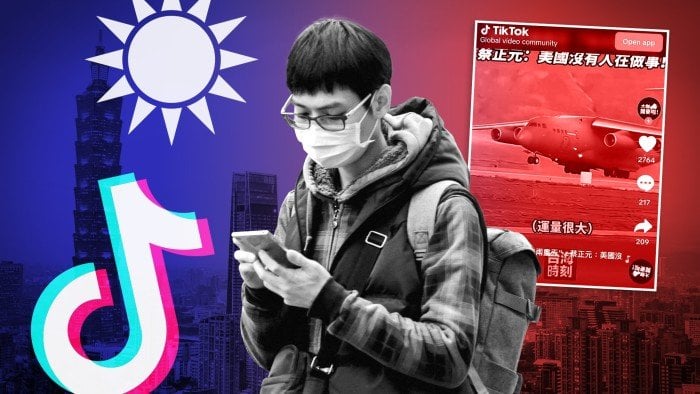
>There are many potential reasons for these changes. But for a number of Taiwanese social scientists and ruling party politicians, one of the main causes is TikTok, the controversial Chinese social media app that has amassed more than 1bn monthly active users worldwide.
>The app “cannot necessarily make Taiwanese youth identify with the Chinese nation or agree to unification with China”, says Eric Hsu, a researcher at the Taiwanese think-tank Doublethink Lab who is working on the first systematic survey of TikTok’s impact on Taiwanese society. “But it can probably lower their apprehension towards China and their will to resist.”
>[…]
>Officials and researchers in other countries, especially western ones, have raised many concerns about the app, ranging from its addictive effects on children to the ways in which it could be used to sow disinformation.
>But nowhere is the question of whether TikTok is a tool of Chinese political influence as vital as in Taiwan. Beijing claims the island, home to some 23mn people and the world’s largest producer of advanced semiconductors, as part of its territory and misses no opportunity to reiterate its determination to bring it under control — a scenario that the vast majority of Taiwanese people vigorously reject. Ever since the country democratised in the 1990s, its identity separate from China and the determination to preserve its independence has grown more deep-rooted.
>Taiwanese educators and researchers fear that the ever greater numbers of children using the app risk being exposed to content that seems innocent, but causes them to look more favourably upon the People’s Republic and feel more negative towards their own nation — something they suspect is a deliberate strategy by Beijing.
>[…]
>The country’s high school and university students, the first generation of TikTok users, are less politically engaged than earlier generations, says Lin Thung-hong, a research fellow at the institute of sociology at Taiwan’s top research institution Academia Sinica. “Over the past few years, young adults are much less willing to vote,” he says. “We worry that they might turn cold on politics and retreat, and that would have an immense impact on Taiwan’s political future.”
>“They are not prepared to fight against China,” says Chu, the teacher. “They don’t feel that we must protect this land.”
>**At first glance,** TikTok seems an unlikely threat. According to the 2024 Taiwan Internet Report, an annual independent survey, just under 22 per cent of the population use the app, either in its international form, branded as TikTok, or the original version available in China, called Douyin.
>That is the second-lowest proportion in Asia after Japan and little more than a quarter of the percentage in Malaysia, where TikTok has a dominant position. It is also markedly lower than in western countries like the US, Spain, France or the UK.
>But, among young people, the picture changes radically. According to the government-backed Taiwan Communication Survey, 44 per cent of primary school pupils in Taiwan use TikTok, and among junior high school students (typically aged 13-15) usage is close to 60 per cent. The figure levels off only slightly among senior high school students.
>While a majority of Taiwanese TikTok users are male, among schoolchildren girls are massively heavier users. For many of them, dance is the way in. Yi-an, a 14-year-old from Shih-ting near Taipei, started watching self-recorded dance videos on the platform about two years ago.
>[…]
>Initial work done by the Doublethink study suggests this seemingly innocuous content can act as a gateway to less anodyne material. Researchers who set up TikTok accounts imitating Taiwanese schoolgirls discovered that, after a few days of them being served dance video clips, the app’s algorithm started to suggest soft political content. Some were street interviews conducted in Taipei’s trendy Ximending district in which Taiwanese teenagers were prompted to compare Chinese “democracy” with the weaknesses of their own political system.
>A study conducted by Universiti Tunku Abdul Rahman in Malaysia spotted a similar pattern on RedNote, also known as Xiaohongshu, another rapidly spreading Chinese social media app, on which users test and recommend make-up, restaurants and travel destinations or teach cooking and other skills. Xiaohongshu did not respond to a request for comment.
>The findings also echo international research on TikTok. A series of studies conducted last year and led by Lee Jussim, a social psychologist at Rutgers University in the US, found that, when compared to other platforms such as Instagram or YouTube, TikTok offered a “disproportionately high ratio” of content favourable to China’s Communist party. Their results indicated that people who used TikTok heavily viewed China’s human rights record in a significantly better light and felt more positive about visiting China.
>As in many countries, observers worry that, because of the way the algorithm works, TikTok users increasingly inhabit echo chambers — but in Taiwan this has an added political charge. “Among our students, TikTok has the effect that everyone retreats into their bubble and is increasingly unable and unwilling to hear what others think,” says Chu.
>It may influence teenage behaviour in other ways. Smaller-scale studies have found that many Chinese slang words have entered Taiwan’s youth lexicon in the past three years. The northern Chinese term “niu” (meaning “awesome”) was unheard of in Taiwan until recently, but now appears commonly on teenagers’ social media feeds and in real life. Other Chinese-influenced memes and games have become commonplace, teachers say.
>Cashbox, one of Taiwan’s largest chains of Karaoke lounges, now offers a large and growing “TikTok songs” category. Kemusan, a twist-like dance set to an electronic version of a traditional Chinese tune that went viral on TikTok last year, triggered a huge craze in Taiwan.
>All this seems a long way from politics, but seemingly harmless content can have political undertones, say researchers. “There are a lot of people selling agricultural products on Douyin who display their lifestyle of honest, hard work,” says Hsu, adding that young Taiwanese people “think when they see this that, while the Chinese government may not be good, the Chinese people are simple and kind, so I don’t need to feel animosity [towards Beijing].”
>Teenagers the FT spoke to acknowledge that the app has an effect on them, but dismiss any suggestion that they are being influenced politically. Several admit that, after using TikTok, they had trouble concentrating and finishing longer assignments. “I know I spend too much time on there, it kind of sucks you in,” says Yi-an with a laugh.
>But she and several friends said it was “nonsense” that they might become more China-friendly.

1 Comment
Archived version: https://archive.fo/116Vh.
Summary:
>Last spring, pupils at National Chia-Yi Girls’ Senior High School in southern Taiwan were set an unusual topic for their annual essay exam: “How to negotiate with a dictator”.
>The students had to choose the best survival strategy for a small country facing a powerful neighbour — prevent war at all costs, or deter through strength? The exam paper mentioned Russia’s assault on Ukraine, but the unspoken parallels with China’s threat to their own country were obvious.
>Teachers say they were stunned when they got the scripts back: nearly all the teenagers argued that Taiwan must do everything to avoid provoking China into attacking it. “Almost without exception, they wrote that, being small and weak, Taiwan must avoid appearing as a threat to China,” says Chu Yi-chun, who teaches Mandarin. “No matter how they harass us, we must tolerate it.”
>Such submissive sentiments are in sharp contrast to those held in Taiwan’s society at large — and young people have traditionally been among the most passionately patriotic and pro-independence citizens in the country.
>According to data published by the Taiwanese Public Opinion Foundation polling organisation last year, people between 20 and 24 are no longer the age group who feel their Taiwanese identity the strongest, bucking a long-established pattern. And there are indications that, among young people, Taiwan’s decades-old trend towards ever stronger support for independence might also be going into reverse.
>There are many potential reasons for these changes. But for a number of Taiwanese social scientists and ruling party politicians, one of the main causes is TikTok, the controversial Chinese social media app that has amassed more than 1bn monthly active users worldwide.
>The app “cannot necessarily make Taiwanese youth identify with the Chinese nation or agree to unification with China”, says Eric Hsu, a researcher at the Taiwanese think-tank Doublethink Lab who is working on the first systematic survey of TikTok’s impact on Taiwanese society. “But it can probably lower their apprehension towards China and their will to resist.”
>[…]
>Officials and researchers in other countries, especially western ones, have raised many concerns about the app, ranging from its addictive effects on children to the ways in which it could be used to sow disinformation.
>But nowhere is the question of whether TikTok is a tool of Chinese political influence as vital as in Taiwan. Beijing claims the island, home to some 23mn people and the world’s largest producer of advanced semiconductors, as part of its territory and misses no opportunity to reiterate its determination to bring it under control — a scenario that the vast majority of Taiwanese people vigorously reject. Ever since the country democratised in the 1990s, its identity separate from China and the determination to preserve its independence has grown more deep-rooted.
>Taiwanese educators and researchers fear that the ever greater numbers of children using the app risk being exposed to content that seems innocent, but causes them to look more favourably upon the People’s Republic and feel more negative towards their own nation — something they suspect is a deliberate strategy by Beijing.
>[…]
>The country’s high school and university students, the first generation of TikTok users, are less politically engaged than earlier generations, says Lin Thung-hong, a research fellow at the institute of sociology at Taiwan’s top research institution Academia Sinica. “Over the past few years, young adults are much less willing to vote,” he says. “We worry that they might turn cold on politics and retreat, and that would have an immense impact on Taiwan’s political future.”
>“They are not prepared to fight against China,” says Chu, the teacher. “They don’t feel that we must protect this land.”
>**At first glance,** TikTok seems an unlikely threat. According to the 2024 Taiwan Internet Report, an annual independent survey, just under 22 per cent of the population use the app, either in its international form, branded as TikTok, or the original version available in China, called Douyin.
>That is the second-lowest proportion in Asia after Japan and little more than a quarter of the percentage in Malaysia, where TikTok has a dominant position. It is also markedly lower than in western countries like the US, Spain, France or the UK.
>But, among young people, the picture changes radically. According to the government-backed Taiwan Communication Survey, 44 per cent of primary school pupils in Taiwan use TikTok, and among junior high school students (typically aged 13-15) usage is close to 60 per cent. The figure levels off only slightly among senior high school students.
>While a majority of Taiwanese TikTok users are male, among schoolchildren girls are massively heavier users. For many of them, dance is the way in. Yi-an, a 14-year-old from Shih-ting near Taipei, started watching self-recorded dance videos on the platform about two years ago.
>[…]
>Initial work done by the Doublethink study suggests this seemingly innocuous content can act as a gateway to less anodyne material. Researchers who set up TikTok accounts imitating Taiwanese schoolgirls discovered that, after a few days of them being served dance video clips, the app’s algorithm started to suggest soft political content. Some were street interviews conducted in Taipei’s trendy Ximending district in which Taiwanese teenagers were prompted to compare Chinese “democracy” with the weaknesses of their own political system.
>A study conducted by Universiti Tunku Abdul Rahman in Malaysia spotted a similar pattern on RedNote, also known as Xiaohongshu, another rapidly spreading Chinese social media app, on which users test and recommend make-up, restaurants and travel destinations or teach cooking and other skills. Xiaohongshu did not respond to a request for comment.
>The findings also echo international research on TikTok. A series of studies conducted last year and led by Lee Jussim, a social psychologist at Rutgers University in the US, found that, when compared to other platforms such as Instagram or YouTube, TikTok offered a “disproportionately high ratio” of content favourable to China’s Communist party. Their results indicated that people who used TikTok heavily viewed China’s human rights record in a significantly better light and felt more positive about visiting China.
>As in many countries, observers worry that, because of the way the algorithm works, TikTok users increasingly inhabit echo chambers — but in Taiwan this has an added political charge. “Among our students, TikTok has the effect that everyone retreats into their bubble and is increasingly unable and unwilling to hear what others think,” says Chu.
>It may influence teenage behaviour in other ways. Smaller-scale studies have found that many Chinese slang words have entered Taiwan’s youth lexicon in the past three years. The northern Chinese term “niu” (meaning “awesome”) was unheard of in Taiwan until recently, but now appears commonly on teenagers’ social media feeds and in real life. Other Chinese-influenced memes and games have become commonplace, teachers say.
>Cashbox, one of Taiwan’s largest chains of Karaoke lounges, now offers a large and growing “TikTok songs” category. Kemusan, a twist-like dance set to an electronic version of a traditional Chinese tune that went viral on TikTok last year, triggered a huge craze in Taiwan.
>All this seems a long way from politics, but seemingly harmless content can have political undertones, say researchers. “There are a lot of people selling agricultural products on Douyin who display their lifestyle of honest, hard work,” says Hsu, adding that young Taiwanese people “think when they see this that, while the Chinese government may not be good, the Chinese people are simple and kind, so I don’t need to feel animosity [towards Beijing].”
>Teenagers the FT spoke to acknowledge that the app has an effect on them, but dismiss any suggestion that they are being influenced politically. Several admit that, after using TikTok, they had trouble concentrating and finishing longer assignments. “I know I spend too much time on there, it kind of sucks you in,” says Yi-an with a laugh.
>But she and several friends said it was “nonsense” that they might become more China-friendly.