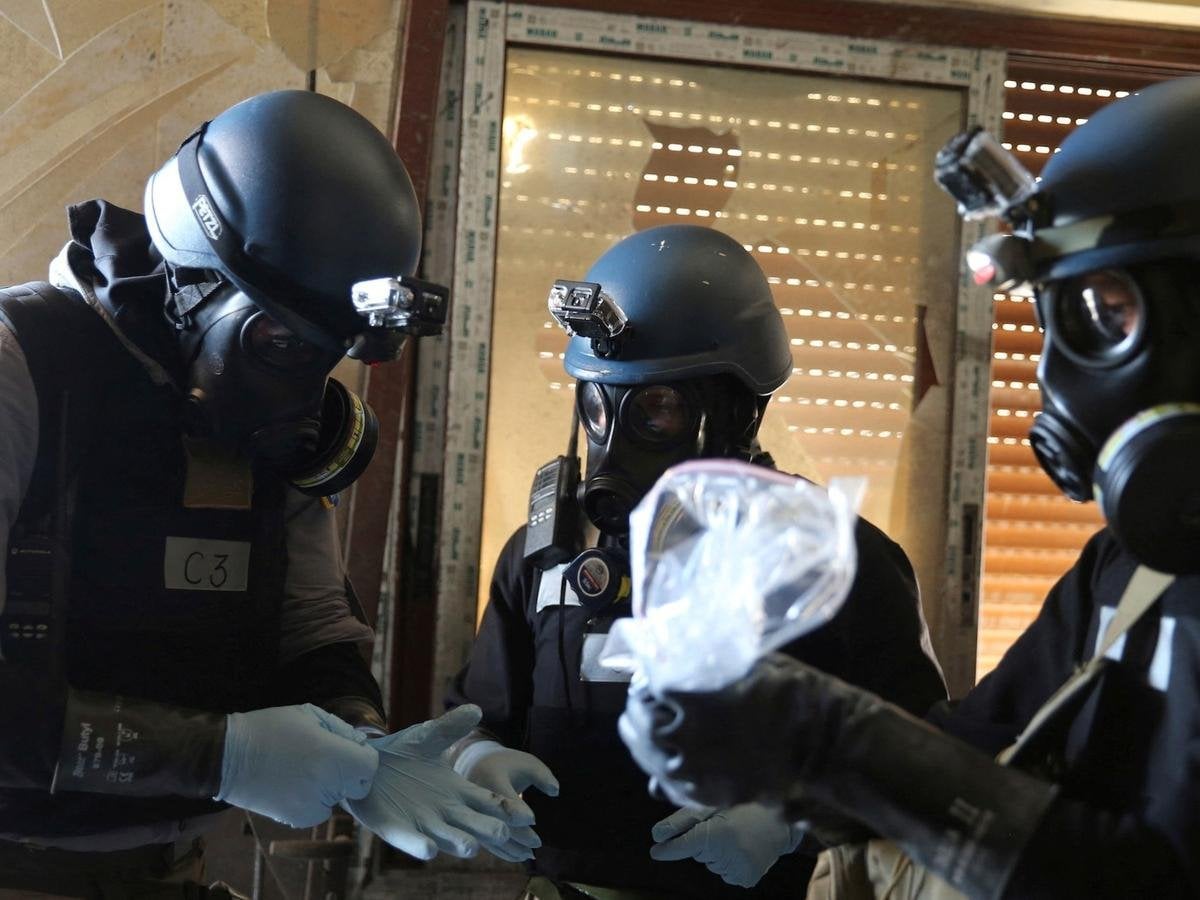
>One of the most remarkable outcomes of the [toppling](https://nationalinterest.org/blog/buzz/after-assad-are-houthis-next-214190) of the regime of Bashar al-Assad in Syria is that Hayat Tahrir al-Sham (HTS), the rebel group leading the coalition now in charge in Damascus, wants international help in safely dismantling the regime’s clandestine chemical weapons program.
>In a [statement](https://x.com/Charles_Lister/status/1865470414450790847) issued December 7 on *X*, HTS called for international assistance in ridding the country of these deadly poisons. As the international community seeks to assist the forces that ousted Assad, responding to the HTS call for help on chemical weapons should be a high priority.
>In its statement, HTS said the “Assad regime has attacked the Syrian people with chemical weapons on dozens of occasions, causing the deaths of thousands…” It goes on to reassure the international community that it has “no intention or desire to use chemical weapons or any weapons of mass destruction” and that it will not allow chemical weapons “to fall into irresponsible hands.”
>The statement expresses a “readiness to cooperate with the international community on all matters related to the monitoring of weapons and sensitive sites.” It goes on to say that HTS “will not allow the tragedies experienced by Syria in the past to be repeated.”
>Rather than claiming religious justification to use any means available to kill others, HTS’s statement argues that it is because of their religious faith that they want to prevent the proliferation of any residual weapons stocks. The HTS statement said its commitment is “rooted in our faith and the teachings of our religion, which emphasizes the sanctity of life and compassion for humanity.”

1 Comment
>One of the most remarkable outcomes of the [toppling](https://nationalinterest.org/blog/buzz/after-assad-are-houthis-next-214190) of the regime of Bashar al-Assad in Syria is that Hayat Tahrir al-Sham (HTS), the rebel group leading the coalition now in charge in Damascus, wants international help in safely dismantling the regime’s clandestine chemical weapons program.
>In a [statement](https://x.com/Charles_Lister/status/1865470414450790847) issued December 7 on *X*, HTS called for international assistance in ridding the country of these deadly poisons. As the international community seeks to assist the forces that ousted Assad, responding to the HTS call for help on chemical weapons should be a high priority.
>What is most astounding about the HTS statement is that it runs counter to conventional wisdom about terrorist groups’ interest in exotic weapons. HTS is designated a terrorist organization by the [United States](https://www.state.gov/foreign-terrorist-organizations/), the [U.N. Security Council](https://news.un.org/en/story/2024/12/1158126), the European Union, and Russia.
>In its statement, HTS said the “Assad regime has attacked the Syrian people with chemical weapons on dozens of occasions, causing the deaths of thousands…” It goes on to reassure the international community that it has “no intention or desire to use chemical weapons or any weapons of mass destruction” and that it will not allow chemical weapons “to fall into irresponsible hands.”
>The statement expresses a “readiness to cooperate with the international community on all matters related to the monitoring of weapons and sensitive sites.” It goes on to say that HTS “will not allow the tragedies experienced by Syria in the past to be repeated.”
>If this remarkable statement can be believed, it should be heralded as an important charge to uphold the international norm against chemical weapons. It stands in contrast to the intentions of other nonstate actors such as the mastermind of the 1993 World Trade Tower bombing [Ramzi Yousef (PDF)](https://www.nonproliferation.org/wp-content/uploads/2016/05/world_trade_center_bombers.pdf) who said he would have released sodium cyanide gas if he could have, or Osama bin Ladin and [al Qaeda](https://jamestown.org/program/al-qaedas-wmd-strategy-prior-to-the-u-s-intervention-in-afghanistan/) who made plans to deploy chemical and biological agents in Afghanistan, or the [Islamic State](https://www.opcw.org/media-centre/news/2024/02/opcw-identifies-isil-perpetrators-2015-chemical-attack-marea-syria) operatives who used low-grade mustard agent in attacks in [Marea](https://www.opcw.org/media-centre/news/2022/01/opcw-issues-fact-finding-mission-report-chemical-weapons-use-allegation), Syria.
>Rather than claiming religious justification to use any means available to kill others, HTS’s statement argues that it is because of their religious faith that they want to prevent the proliferation of any residual weapons stocks. The HTS statement said its commitment is “rooted in our faith and the teachings of our religion, which emphasizes the sanctity of life and compassion for humanity.”
>Among the many attacks that may have influenced the rebels’ aversion to chemical weapons is the 2013 deployment by the regime of [Sarin nerve agent](https://nationalinterest.org/blog/buzz/why-sarin-gas-causes-such-awful-and-pain-filled-death-133812) and chlorine that killed some 1,400 people in the Damascus suburb of [Ghouta](https://news.un.org/en/story/2013/09/449052).