
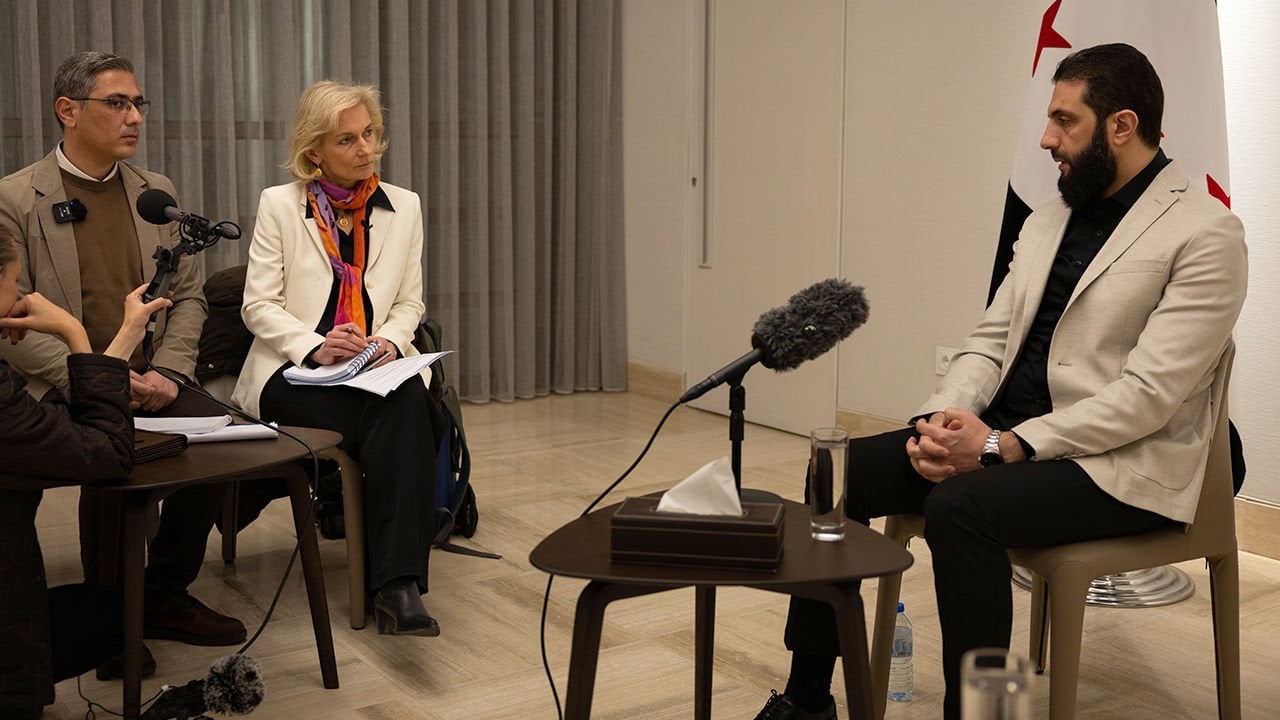
“The Economist” just did an interview with Ahmed al-Sharaa (Jolani), Syria’s new president, on January 31st
Posted by Straight_Ad2258
“The Economist” just did an interview with Ahmed al-Sharaa (Jolani), Syria’s new president, on January 31st
Posted by Straight_Ad2258
7 Comments
text:
Ahmed al-Sharaa, Syria’s president, spoke to *The Economist* on January 31st in Damascus. The conversation has been translated and lightly edited for clarity.
**The Economist:** Maybe you could start by giving me a sense of your vision for Syria. Where do you expect the country to be in five years? Tell me what it will be like.
**Ahmed al-Sharaa:** First of all, Syria was under the control of the previous regime for 54 years. During these 54 years, Syria went through many disasters. Syria has retreated regionally on the level of the development of human resources, the level of economy, and also the level of political relationships with neighbouring countries. Previously Syria was a source of concern for all neighbouring countries. At the same time, it was not fulfilling its basic duties towards the people. The most important thing for the previous regime was to maintain power and to use security methods to remain in power. The security method means torture, as you have seen in Saydnaya prison, and arresting and beating people, and when people revolted against him, he used chemical weapons, explosive bombs, and other methods.At the same time Syria had a kind of social division in the time of the previous regime. The regime depended on a certain group of the people against the other groups, which posed the threat of having a full-scale civil war in Syria.Regarding the economy, all the economic sectors are almost destroyed because the regime did not work on building an economy for the country itself, but it was trying to steal the wealths of the country to collect the money and export it illegally abroad.Therefore, the next phase of five years will revolve around rebuilding the state on new and modern foundations. It is going to promote justice and counseling, and it is going to be based on the participation of all segments of society in running the country. The next five years are going to have several milestones. We hope to overcome all these difficulties and obstacles in a smooth manner, and we are counting on the wisdom of the Syrian people and the forgiveness that is shown by all the sections of the Syrian people.On the political level and regarding external politics, in the time of the previous regime Syria was living in great isolation. On the neighboring level, the regime created many problems inside Lebanon. All significant party leaders and significant figures in Lebanon, who got killed, were killed at the hands of the previous regime in Lebanon. So, its intervention in Lebanon was not right. As a result, when it left Lebanon, it left Hezbollah behind, which controlled Lebanon in a negative manner until things escalated to full-fledged war in Lebanon.As for Jordan, the regime targeted Jordan with exporting drugs directly, and when it comes to Iraq, there was a long estrangement during the time of Saddam Hussein, and after the American presence—the American occupation of Iraq— Syria in the days of the regime, was exporting trouble to Iraq. Turkey, also, had big troubles with the previous regime, and the gulf states were affected by the Iranian presence in Syria. The European countries were affected, as well, by the regime that used to export human beings to them. It was using humans for gaining financial gains; it depended on human trafficking and intentional displacement of people to European countries.As you have heard, there are plenty of issues in Syria that need serious, quick, and effective steps to be taken. The most important of these steps is to have the Syrian people inside the country united. This is the most important capital that we have, and, thank God, this has been achieved today. Although we entered Damascus through a military battle, that battle was mostly characterised with mercy and forgiveness. Hence, the manner in which we entered Damascus played the major role in creating civil peace in Damascus although there are still some violations taking place here and there, but they are minimal.The other thing is that Syria needs to build a strong economy. Today, we are working on rehabilitating the economy in the country. There is also the security challenge to control weapons in the country, and we have come a long way in controlling the weapons in the country, except for the area under the control of the SDF, or the area occupied by the PKK in North-East Syria. We are having negotiations with them, hoping to resolve matters without any confrontation.Meanwhile, we have worked during the past short period on restoring the relationships between Syria and regional and international countries, and, thank God, we have been very successful until now. So, if things go like this in the coming five years, I believe the future is going to be bright during the next five years, and I believe that the two most important things that could increase the suffering of the Syrian people include, first, the American sanctions imposed by the United States of America on the regime because it was killing its people, and these sanctions are still in place. The other thing is the recent Israeli advancement, which needs to be solved. The Israelis need to retreat because their advancement will cause a lot of trouble in the future.
main points
confirmed the need for elections
the Constitution of Syria will be drafted by an electoral commission, and Jolani says he will obey the result, whether the Constitution will be Islamic or not
foreign militaries have to leave the country
regarding Israel :
>**The Economist:** What about the Israelis? They have moved beyond their buffer zone? Is that an illegal presence? And do they need to move back?
>**Ahmed al-Sharaa:** Of course they have to move back.There is an agreement that was made in 1974 between Syria and Israel through the United Nations. On our first day in Damascus, we sent to the UN informing them that we are committed to the 1974 agreement, and we are ready to receive the United Nations’ force that was in the buffer-zone, the UNDOF.
>**A direct communication took place with the UNDOF, and they expressed their readiness to enter the buffer-zone, but the Israeli forces should retreat to the borders where they used to be before the latest advancement so that the UNDOF can enter the area**
>**.As for what we will do, we have all inter**national pressure with us, and all the countries that visited Damascus, along with the ones that did not, have denounced the advancement of the Israeli forces in the area. There is near-unanimous international agreement that this advancement is not right.
Related discussion of the summary article:
https://www.reddit.com/r/neoliberal/comments/1igzt8a/warlord_jihadi_or_nationbuilder_syrias_new/
menswear guy needs to check that fit
I appreciate the tough questions and the pretty reasonable answers. Syria looks like a place to be optimistic about.
obviously it remains to see what actually happens, but at so far their answers seem pretty good, which is probably the best we can hope for right now. Certainly Mr Jolani comes off as alot more reasonable than a certain orange leader and his political party RN
Interesting note:
>In our interview, Mr Sharaa used the word “democracy” publicly for the first time since taking power. “If democracy means that the people decide who will rule them and who represents them in the parliament,” he said, somewhat half-heartedly, “then yes, Syria is going in this direction.”