
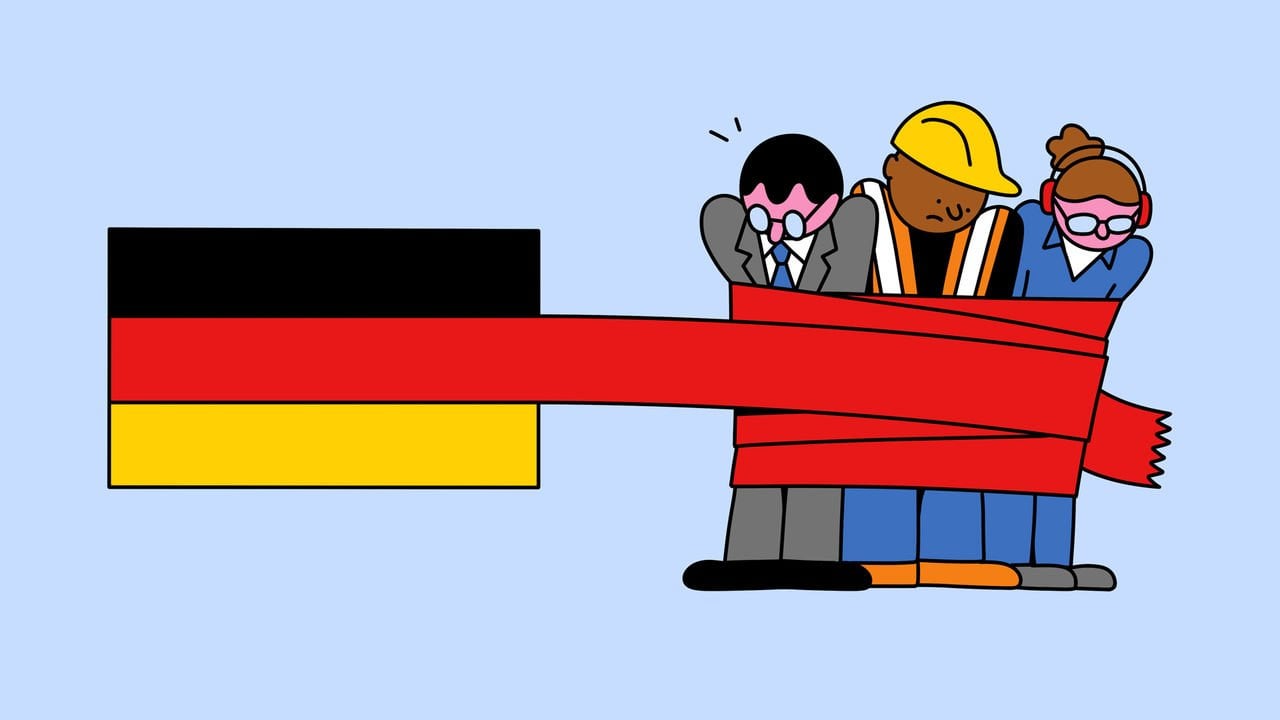
German business is being suffocated by high costs and red tape | Many bosses doubt that the upcoming election will change that
Posted by ONETRILLIONAMERICANS
German business is being suffocated by high costs and red tape | Many bosses doubt that the upcoming election will change that
Posted by ONETRILLIONAMERICANS
1 Comment
> ON A DRIVE around the vast production site of SKW Stickstoffwerke Piesteritz, Germany’s largest producer of ammonia, near Wittenberg, a spokesman for the firm points at a giant yellow valve. “Normally around 2% of Germany’s industrial consumption of natural gas comes out of this thing,” he says. Last month, however, SKW shut one of the two ammonia plants at the site and slashed its production of fertiliser.
> “The Gasumlage is killing us,” says Petr Cingr, the Czech chief executive of SKW, referring to the German government’s gas levy. (The 110-year-old firm is owned by Agrofert, a Czech conglomerate.) The charge, introduced in 2022 to recoup the cost to the government of filling the country’s strategic reserve after Russia’s invasion of Ukraine, was increased at the start of this year by 20%, to €2.99 ($3.10) per megawatt hour. Mr Cingr says his firm is paying ten times more for natural gas than Russian makers of fertiliser, with which it still competes, and seven times more than American rivals—and gas makes up 90% of the production cost. Its price, along with Germany’s high labour costs and the CO2 certificates SKW must purchase to offset its emissions, mean the company can no longer break even.
> Mr Cingr has specific asks of the government that will take over after Germany’s parliamentary elections on February 23rd: abolish the gas levy and press the European Union to reform the system of CO2 certificates. On January 28th the bloc announced a gradual increase in tariffs on fertilisers from Russia and Belarus over the next three years, from 6.5% to about 100%. That is “too little, too late,” says Mr Cingr. If politicians don’t do more, he argues, Europe’s production of fertiliser will collapse and farmers will depend entirely on imports.
> SKW is but one example of the crisis gripping German business. At the annual press conference of the Federation of German Industries (BDI) late last month, Peter Leibinger, its new leader, said that the mood in business circles is “as bad as I have ever seen it”. Many bosses doubt that their biggest handicaps—red tape, high taxes and costly social-security contributions—will improve much following the election, after which Freidrich Merz, leader of the opposition Christian Democratic Union (CDU) party, is expected to become chancellor. Bosses are confident that whatever coalition emerges will be friendlier towards them than the one forged by Olaf Scholz, Germany’s current chancellor. But few believe that reforms will be fast or deep enough.
> Germany’s manufacturing base is shuddering. Industrial output has fallen by about a tenth over the past two years. Giants such as Volkswagen, the world’s biggest carmaker by sales, are scaling back production in the country. Matthias Lapp, chief executive of Lapp, a family-owned maker of cables based near Stuttgart, describes Germany as “our problem child”. On February 3rd his company reported sales of €1.8bn for its most recent financial year, down by 5.3% from the year before. Sales in Germany fell by 15%; in Asia, America and the Middle East business is humming.
> Toralf Haag, boss of Aurubis, a maker of copper based in Hamburg, thinks this will be “a make-or-break year for German industry.” Bertram Kawlath, boss of Schubert & Salzer, a maker of valves, and head of the VDMA, Germany’s association of machinery-makers, agrees that Germany has reached a pivotal moment, though he is less pessimistic than other bosses. “Our mid-size companies will not close down, but they will not invest in Germany if the country doesn’t become more business-friendly,” he says. The VDMA has 3,600 members, most of which are family firms like his. Mr Kawlath’s biggest gripe is red tape, in particular a law that requires firms with more than 1,000 employees in Germany to monitor whether their suppliers around the world meet human-rights and environmental standards.