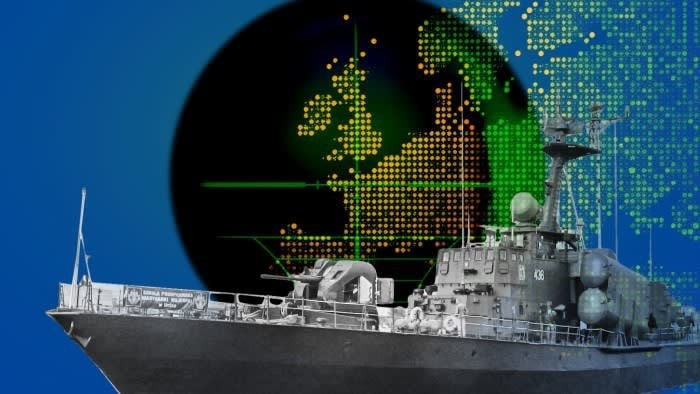
Russia has trained its navy to target sites deep inside Europe with nuclear-capable missiles in a potential conflict with Nato, according to secret files seen by the Financial Times.
Maps of targets as far-flung as the west coast of France and Barrow-in-Furness in the UK are detailed in a presentation for officers that predates the full-scale invasion of Ukraine.
The FT has previously reported from the same cache of 29 secret Russian military files that Moscow had rehearsed using tactical nuclear weapons in the early stages of a conflict with a major world power.
The latest revelations show how Russia envisioned a conflict with the west reaching well beyond its immediate Nato frontier, planning for a series of overwhelming strikes across western Europe. The documents were shown to the FT by western sources.
The files, drawn up between 2008 and 2014, include a target list for missiles that can carry either conventional warheads or tactical nuclear weapons. Russian officers highlight the advantages of using nuclear strikes at an early stage.
The presentation also indicates that Russia has retained the capability to carry nuclear weapons on surface ships, a capacity that experts said carries significant extra risks of escalation or accidents.
The document notes the navy’s “high manoeuvrability” allows it to conduct “sudden and pre-emptive blows” and “massive missile strikes . . . from various directions”. It adds that nuclear weapons are “as a rule” designated for use “in combination with other means of destruction” to achieve Russia’s goals.
Analysts who reviewed the documents said they were consistent with how Nato assessed the threat of long-range missile strikes by the Russian navy and the speed with which Russia would probably resort to nuclear use.
The maps, which were made for presentational purposes rather than operational use, illustrate a sample of 32 Nato targets in Europe for Russia’s naval fleets.
Russia’s Baltic fleet targets are largely in Norway and Germany — including the naval base in Bergen, as well as radar sites and special forces facilities.
Russia’s Northern Fleet would be expected to hit defence industrial targets, such as the submarine shipyard at Barrow-in-Furness in north-west England. A target near Hull may be an industrial site – it is marked with a smokestack.
The presentation also illustrates how its doctrine might apply in possible wars in the Black Sea, the Caspian Sea …
… and the Pacific. The scenarios include wars with current allies, such as China, Iran, Azerbaijan and North Korea.
But William Alberque, a former Nato official now at the Stimson Center, said the sample was a small portion of “hundreds, if not thousands, of targets mapped across Europe . . . including military and critical infrastructure targets”.
Russia’s capacity to strike across Europe means that targets all over the continent would be at risk as soon as its army engaged with Nato forces in frontline countries such as the Baltic states and Poland, said analysts and former officials.
“Their concept of war is total war,” said Jeffrey Lewis, a professor at the Middlebury Institute of International Studies at Monterey who studies arms control.
“They see these things [tactical nuclear warheads] as potentially war-winning weapons,” he added. “They’re going to want to use them, and they’re going to want to use them pretty quickly.”
Tactical nuclear weapons, which can be delivered by land or sea-launched missiles or from aircraft, have a shorter range and are less destructive than the larger “strategic” weapons designed to target the US.
However, they can still release significantly more energy than those dropped on Nagasaki and Hiroshima in 1945.
The presentation also references the option of a so-called demonstration strike — detonating a nuclear weapon in a remote area “in a period of immediate threat of aggression” before an actual conflict to scare western countries. Russia has never acknowledged such strikes are in its doctrine.
Such a strike, the files say, would show “the availability and readiness for use of precision non-strategic nuclear weapons” and the “intention to use nuclear weapons”.
Alberque, a former director of Nato’s Arms Control, Disarmament and WMD Non-Proliferation Centre, said: “They want the fear of Russian nuclear weapon use to be the magic key that unlocks western acquiescence.”
The files said that Russia’s top priority in a conflict with Nato was “weakening the enemy’s military and economic potential”. Analysts said this meant Russia would strike civilian sites and critical infrastructure, as it has done in Ukraine.
Fabian Hoffmann, a doctoral research fellow at the University of Oslo who studies nuclear policy, said that the combination of nuclear and conventional strikes set out in the presentation make up “one package to basically signal to the adversary that right now things are really heating up. And it would be wise for you to start talking to us on how we can settle this.”
According to Nato’s calculations, countries in the alliance have less than 5 per cent of the air defence capacities required to protect the alliance’s eastern flank against a full-scale attack from Russia.
Putin said in June that Europe would be “more or less defenceless” against Russian missile strikes.
Dara Massicot, a senior fellow at the Carnegie Endowment for International Peace, said Russian strategists partly viewed nuclear weapons as central to the early stages of any conflict with Nato because of their military’s inferior conventional resources. “They just don’t have enough missiles,” she said.

2 Comments
article:
Russia has trained its navy to target sites deep inside Europe with nuclear-capable missiles in a potential conflict with Nato, according to secret files seen by the Financial Times.
Maps of targets as far-flung as the west coast of France and Barrow-in-Furness in the UK are detailed in a presentation for officers that predates the full-scale invasion of Ukraine.
The FT has previously reported from the same cache of 29 secret Russian military files that Moscow had rehearsed using tactical nuclear weapons in the early stages of a conflict with a major world power.
The latest revelations show how Russia envisioned a conflict with the west reaching well beyond its immediate Nato frontier, planning for a series of overwhelming strikes across western Europe. The documents were shown to the FT by western sources.
The files, drawn up between 2008 and 2014, include a target list for missiles that can carry either conventional warheads or tactical nuclear weapons. Russian officers highlight the advantages of using nuclear strikes at an early stage.
The presentation also indicates that Russia has retained the capability to carry nuclear weapons on surface ships, a capacity that experts said carries significant extra risks of escalation or accidents.
The document notes the navy’s “high manoeuvrability” allows it to conduct “sudden and pre-emptive blows” and “massive missile strikes . . . from various directions”. It adds that nuclear weapons are “as a rule” designated for use “in combination with other means of destruction” to achieve Russia’s goals.
Analysts who reviewed the documents said they were consistent with how Nato assessed the threat of long-range missile strikes by the Russian navy and the speed with which Russia would probably resort to nuclear use.
The maps, which were made for presentational purposes rather than operational use, illustrate a sample of 32 Nato targets in Europe for Russia’s naval fleets.
Russia’s Baltic fleet targets are largely in Norway and Germany — including the naval base in Bergen, as well as radar sites and special forces facilities.
Russia’s Northern Fleet would be expected to hit defence industrial targets, such as the submarine shipyard at Barrow-in-Furness in north-west England. A target near Hull may be an industrial site – it is marked with a smokestack.
The presentation also illustrates how its doctrine might apply in possible wars in the Black Sea, the Caspian Sea …
… and the Pacific. The scenarios include wars with current allies, such as China, Iran, Azerbaijan and North Korea.
But William Alberque, a former Nato official now at the Stimson Center, said the sample was a small portion of “hundreds, if not thousands, of targets mapped across Europe . . . including military and critical infrastructure targets”.
Russia’s capacity to strike across Europe means that targets all over the continent would be at risk as soon as its army engaged with Nato forces in frontline countries such as the Baltic states and Poland, said analysts and former officials.
“Their concept of war is total war,” said Jeffrey Lewis, a professor at the Middlebury Institute of International Studies at Monterey who studies arms control.
“They see these things [tactical nuclear warheads] as potentially war-winning weapons,” he added. “They’re going to want to use them, and they’re going to want to use them pretty quickly.”
Tactical nuclear weapons, which can be delivered by land or sea-launched missiles or from aircraft, have a shorter range and are less destructive than the larger “strategic” weapons designed to target the US.
However, they can still release significantly more energy than those dropped on Nagasaki and Hiroshima in 1945.
Russian President Vladimir Putin and Admiral Alexander Moiseyev, commander-in-chief of the Russian navy, at the annual Navy Day parade in St Petersburg last month © Vyacheslav Prokofyev/Reuters
Russian President Vladimir Putin has repeatedly turned to threats against Ukraine’s European allies to stave off western military support for Kyiv. “They need to remember they are small, densely populated states,” he said in May.
The presentation also references the option of a so-called demonstration strike — detonating a nuclear weapon in a remote area “in a period of immediate threat of aggression” before an actual conflict to scare western countries. Russia has never acknowledged such strikes are in its doctrine.
Such a strike, the files say, would show “the availability and readiness for use of precision non-strategic nuclear weapons” and the “intention to use nuclear weapons”.
Alberque, a former director of Nato’s Arms Control, Disarmament and WMD Non-Proliferation Centre, said: “They want the fear of Russian nuclear weapon use to be the magic key that unlocks western acquiescence.”
The files said that Russia’s top priority in a conflict with Nato was “weakening the enemy’s military and economic potential”. Analysts said this meant Russia would strike civilian sites and critical infrastructure, as it has done in Ukraine.
Fabian Hoffmann, a doctoral research fellow at the University of Oslo who studies nuclear policy, said that the combination of nuclear and conventional strikes set out in the presentation make up “one package to basically signal to the adversary that right now things are really heating up. And it would be wise for you to start talking to us on how we can settle this.”
According to Nato’s calculations, countries in the alliance have less than 5 per cent of the air defence capacities required to protect the alliance’s eastern flank against a full-scale attack from Russia.
Putin said in June that Europe would be “more or less defenceless” against Russian missile strikes.
Dara Massicot, a senior fellow at the Carnegie Endowment for International Peace, said Russian strategists partly viewed nuclear weapons as central to the early stages of any conflict with Nato because of their military’s inferior conventional resources. “They just don’t have enough missiles,” she said.
I wonder what the US Navy trains for….