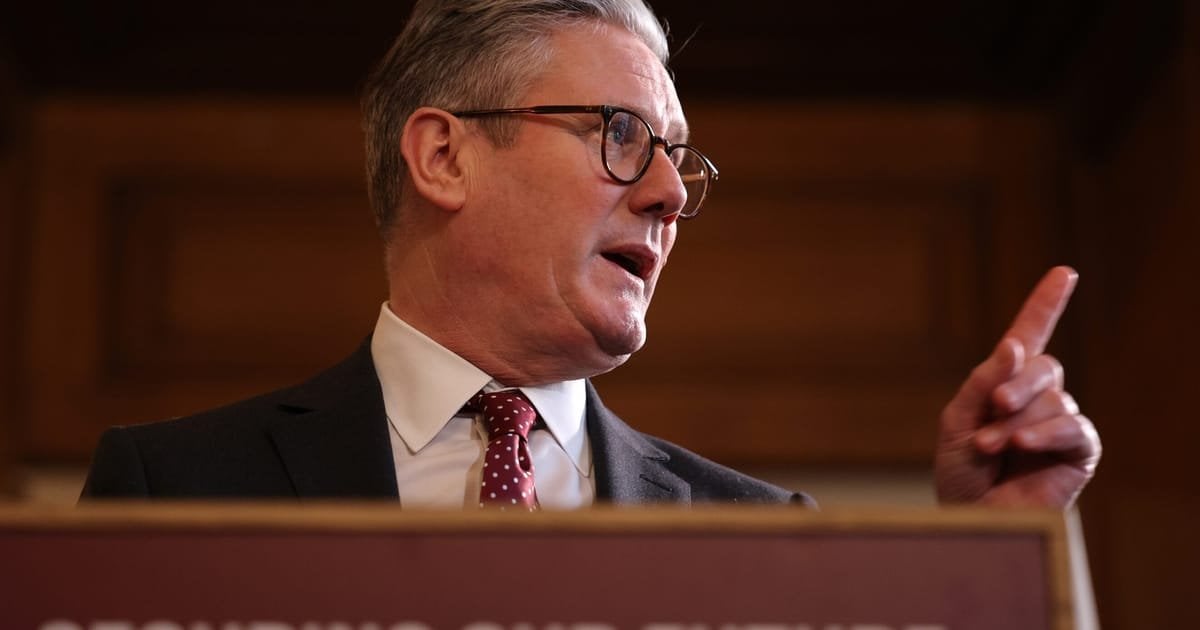
> Keir Starmer is hardly the most obvious wartime envoy — and yet in the weeks since Donald Trump first shocked allies with his stance on Ukraine, the British prime minister has emerged as a leading player in the international response. Starmer’s first seven months in Downing Street have been unsteady to say the least, as he has struggled to set a clear domestic agenda and has taken a hammering in the polls. Since taking office, the unassuming, bespectacled lawyer has fumbled the handling of a scandal over freebies, lost his chief of staff, and introduced an unpopular hit on pensioners’ benefits. His bureaucratic, plodding style has left even his own supporters exasperated at times, and a quest for economic growth has proven fruitless.
> Yet since Trump threatened to turn his back on Ukraine, kicking off talks with Russia last month while sidelining Kyiv, Starmer has played an increasingly visible and assured role in transatlantic diplomacy. Both Labour insiders and European allies are now asking if his moment has arrived. An MP from Starmer’s Labour Party who has worked on national security matters remarked on the change: “All of a sudden, there is a reason. There is a galvanizing purpose.” Like others in this piece, the MP was granted anonymity to speak candidly about diplomatic matters.
> After weeks of meticulous preparation, Starmer’s first visit to the White House went smoothly and actually contained some wins — even if the biggest prize, American security guarantees for a Ukraine peace deal, remained elusive. Starmer’s first meeting with Trump since his election as U.S. president risked coming immediately unstuck Friday in the wake of Trump’s Oval Office meltdown, in which he publicly berated Ukraine’s Volodymyr Zelenskyy. Yet Starmer has so far managed to publicly embrace Zelenskyy, hugging him on the steps of Downing Street, inviting him to a major summit of EU leaders, and ramping up British support for Ukraine — all without provoking the U.S. president’s ire by directly rebuking him.
> The summit of EU leaders convened by Starmer in London at the weekend suggested that the UK has not just been welcomed back into the European fold after years of Brexit bad blood — but that Starmer can convincingly claim to be at the center of it. There’s more to come this week. UK Defense Secretary John Healey will travel to the U.S. to meet his counterpart, Pete Hegseth, as part of a sustained diplomatic push to bridge Europe and the U.S.
> One perennial complaint from Starmer’s critics on his home turf is that he is boring and uninspiring. A recently published book on his rise to power claimed that Starmer’s own top adviser Morgan McSweeney complained that he is an “HR manager, not a leader” — while others have lambasted the former top prosecutor’s lawyerly approach to solving problems. Yet that unshowy nature — in contrast to the style of French President Emmanuel Macron — may have been an advantage in getting into Trump’s good books. Starmer’s voice, sometimes pilloried at home, was even branded a “beautiful accent” by the man in the White House.
> A senior UK official said the US president appeared to like the fact that Starmer was straightforward and without pretensions — something that made it easier for the PM to raise difficult issues with less risk. Claire Ainsley, Starmer’s former policy director who now works at the US-based Progressive Policy Institute think tank, summarized his approach to Trump as “clear, consistent and business-like,” focusing on areas where they could work together.
> Similarly, one of Starmer’s other supposed weaknesses — a lack of ideological conviction — could end up making him a suitable broker between players with wildly different outlooks. It’s something the British leader previously had to navigate as human rights adviser to the fledgling Northern Ireland Police Service in the early 2000s — work in a sectarian arena at a sensitive time in the decades-long conflict there. Hugh Orde, chief constable at the time, told Starmer biographer Tom Baldwin that he had found Starmer to be “completely straight” with “no indication of political bias or ambition.”
> Against this backdrop, some see the pressure as sharpening Starmer’s Downing Street operation as well. One experienced government adviser who had been critical of the PM’s lack of agility in the past confessed they were impressed by how he had responded. Separately, Ainsley said that while Starmer “wouldn’t have chosen the global circumstances that he finds us in,” there was now “a fresh urgency” to his and other leaders’ thinking about long-term questions.
> That sense of urgency was present in the British PM’s decision last week to raise defense spending to 2.5 percent of GDP by 2027, a move he acknowledged had been “accelerated” by the US position on Ukraine. The strategy of tying security at home to international strength is nothing new, having long been a project of McSweeney’s, but it has now been given some convincing momentum. It has a particular resonance on the domestic front as Starmer seeks to attract voters who might be tempted by Nigel Farage’s Reform party. As the same Labour MP quoted above said, it was a chance to be “proud” of Labour’s internationalist tradition in a way that spoke to right-leaning voters.
> The mood music has also shifted in Paris, where a newfound admiration for Starmer has emerged after weeks of doubt over whether the Labour leader, whose party was seen as too close to Joe Biden’s former administration in the U.S., would be able to reboot the special relationship. “[Starmer] is doing a great job,” said a French official. “He was flawless with [Trump in the Oval Office], a very complicated man with polar-opposite values to his, and whose main allies [Elon Musk] were putting pressure and mounted an odious campaign against him.” “And he managed to remain true to himself” in his relations with Trump, the same official added. In the UK House of Commons, Conservative former Foreign Secretary James Cleverly said of Starmer Monday: “Whilst I often take great delight in criticism of the government, I think this weekend he has not really put a foot wrong.”
> Several fundamentals underlying Starmer’s position count in his favor: He is near the start of a possible five-year term with a large House of Commons majority behind him, in contrast to the more delicate political realities faced by Macron and Germany’s newly-elected Friedrich Merz. Barring a surprise shift in those dynamics, he should be in office for the duration of Trump’s second term. Moreover, Britain, along with France, is one of the biggest military powers in Europe, which may count for something in Trump’s new era of realpolitik.
> And while the UK has long left the EU, it is now led by someone who was not responsible for its exit and who has made direct overtures to Brussels for closer ties. Starmer can therefore entertain hope of acting as a “bridge” between Europe and the US — a pitch previous prime ministers tried to make, but less credibly. A second Labour MP, who recently met with lawmakers and ambassadors on a cross-party delegation to two NATO countries, said: “The message from Europe is: ‘We need you.’” While Starmer may be enjoying a boost to his fortunes and fresh international goodwill, there is still plenty of danger ahead for the British prime minister. He and other European leaders must now try to repair the damage caused by Friday’s meltdown in the Oval Office and, more pressingly, make a convincing case for a US role in guaranteeing Ukraine’s security after any peace deal.
> But despite a bump in his own approval ratings, any credit Starmer might gain among the British public for higher defense spending may count for nothing if the British economy takes a fresh battering in Trump’s global trade war. Starmer’s forays on the international stage look likely to remain a second-order concern to those who elected him on a promise to fix Britain’s ailing public services. After all, Boris Johnson’s outspoken support for Ukraine was not enough to save him. Further back, Gordon Brown, the Labour prime minister lauded by fellow leaders for his response to the 2008 financial crisis, was unceremoniously dumped by voters in the next election. Conleth Burns of polling firm More in Common predicted the dividends for Starmer could be limited, noting: “If you can’t demonstrate you can deliver at home, you won’t get the benefit of successes abroad.”
!ping UK
FishUK_Harp on
It’s not totally surprising, in hindsight, that a former Human Rights barrister, Head of the CPS and leader of a “broad church” political party is good at taking charge in complex situations and handling various parties diplomatically.
_Un_Known__ on
It’s genuinely been such a joy to see him take this role.
I haven’t been this proud of the UK in a very long time
ImGoggen on
Both him and Macron have and will be essential in this period. Hopefully Merz can get into the chancellor’s office soon and we’ll have a solid triad of European leaders.
rudigerscat on
Starmers trip to the US was branded in media as a massive win, and then immideately after we got the horrible hounding of Zelenskiy in the White House.
People are expecting someone to be a “Trump-whisperer” and putting their hope on Starmer, but there is no sign he is achieving anything but playing into Trumps pre-existing fondness of the UK.
Vance and Musk has been going after UK very hard, Musk basically called Starmer a pedofile supporter without any pushback from the rest of them. And Vance has explicitly been shitting on the UK again recently
So, sorry, but this reads like cope. Europe needs a strong leader who actually has a will to power, not a soft speaking barrister. That is increasingly the only thing Trump respects.
Jigsawsupport on
Something blackly funny struck me yesterday, it seems like Trump wants to abandon NATO and pass on leadership to the British, and the French.
So in a very real way the future of the west, and perhaps democracy itself, is going to be determined by if the British and the French can get on with each other for a decent period of time.
And then at some point the Germans are going to walk in.
We don’t live in reality this is a Monty python sketch.
Alterus_UA on
Starmer is exactly the kind of political leaders I as a neolib want to see more: boring, competent, non-ideological, incrementalist, and making things done. I have immense respect for him.

7 Comments
> Keir Starmer is hardly the most obvious wartime envoy — and yet in the weeks since Donald Trump first shocked allies with his stance on Ukraine, the British prime minister has emerged as a leading player in the international response. Starmer’s first seven months in Downing Street have been unsteady to say the least, as he has struggled to set a clear domestic agenda and has taken a hammering in the polls. Since taking office, the unassuming, bespectacled lawyer has fumbled the handling of a scandal over freebies, lost his chief of staff, and introduced an unpopular hit on pensioners’ benefits. His bureaucratic, plodding style has left even his own supporters exasperated at times, and a quest for economic growth has proven fruitless.
> Yet since Trump threatened to turn his back on Ukraine, kicking off talks with Russia last month while sidelining Kyiv, Starmer has played an increasingly visible and assured role in transatlantic diplomacy. Both Labour insiders and European allies are now asking if his moment has arrived. An MP from Starmer’s Labour Party who has worked on national security matters remarked on the change: “All of a sudden, there is a reason. There is a galvanizing purpose.” Like others in this piece, the MP was granted anonymity to speak candidly about diplomatic matters.
> After weeks of meticulous preparation, Starmer’s first visit to the White House went smoothly and actually contained some wins — even if the biggest prize, American security guarantees for a Ukraine peace deal, remained elusive. Starmer’s first meeting with Trump since his election as U.S. president risked coming immediately unstuck Friday in the wake of Trump’s Oval Office meltdown, in which he publicly berated Ukraine’s Volodymyr Zelenskyy. Yet Starmer has so far managed to publicly embrace Zelenskyy, hugging him on the steps of Downing Street, inviting him to a major summit of EU leaders, and ramping up British support for Ukraine — all without provoking the U.S. president’s ire by directly rebuking him.
> The summit of EU leaders convened by Starmer in London at the weekend suggested that the UK has not just been welcomed back into the European fold after years of Brexit bad blood — but that Starmer can convincingly claim to be at the center of it. There’s more to come this week. UK Defense Secretary John Healey will travel to the U.S. to meet his counterpart, Pete Hegseth, as part of a sustained diplomatic push to bridge Europe and the U.S.
> One perennial complaint from Starmer’s critics on his home turf is that he is boring and uninspiring. A recently published book on his rise to power claimed that Starmer’s own top adviser Morgan McSweeney complained that he is an “HR manager, not a leader” — while others have lambasted the former top prosecutor’s lawyerly approach to solving problems. Yet that unshowy nature — in contrast to the style of French President Emmanuel Macron — may have been an advantage in getting into Trump’s good books. Starmer’s voice, sometimes pilloried at home, was even branded a “beautiful accent” by the man in the White House.
> A senior UK official said the US president appeared to like the fact that Starmer was straightforward and without pretensions — something that made it easier for the PM to raise difficult issues with less risk. Claire Ainsley, Starmer’s former policy director who now works at the US-based Progressive Policy Institute think tank, summarized his approach to Trump as “clear, consistent and business-like,” focusing on areas where they could work together.
> Similarly, one of Starmer’s other supposed weaknesses — a lack of ideological conviction — could end up making him a suitable broker between players with wildly different outlooks. It’s something the British leader previously had to navigate as human rights adviser to the fledgling Northern Ireland Police Service in the early 2000s — work in a sectarian arena at a sensitive time in the decades-long conflict there. Hugh Orde, chief constable at the time, told Starmer biographer Tom Baldwin that he had found Starmer to be “completely straight” with “no indication of political bias or ambition.”
> Against this backdrop, some see the pressure as sharpening Starmer’s Downing Street operation as well. One experienced government adviser who had been critical of the PM’s lack of agility in the past confessed they were impressed by how he had responded. Separately, Ainsley said that while Starmer “wouldn’t have chosen the global circumstances that he finds us in,” there was now “a fresh urgency” to his and other leaders’ thinking about long-term questions.
> That sense of urgency was present in the British PM’s decision last week to raise defense spending to 2.5 percent of GDP by 2027, a move he acknowledged had been “accelerated” by the US position on Ukraine. The strategy of tying security at home to international strength is nothing new, having long been a project of McSweeney’s, but it has now been given some convincing momentum. It has a particular resonance on the domestic front as Starmer seeks to attract voters who might be tempted by Nigel Farage’s Reform party. As the same Labour MP quoted above said, it was a chance to be “proud” of Labour’s internationalist tradition in a way that spoke to right-leaning voters.
> The mood music has also shifted in Paris, where a newfound admiration for Starmer has emerged after weeks of doubt over whether the Labour leader, whose party was seen as too close to Joe Biden’s former administration in the U.S., would be able to reboot the special relationship. “[Starmer] is doing a great job,” said a French official. “He was flawless with [Trump in the Oval Office], a very complicated man with polar-opposite values to his, and whose main allies [Elon Musk] were putting pressure and mounted an odious campaign against him.” “And he managed to remain true to himself” in his relations with Trump, the same official added. In the UK House of Commons, Conservative former Foreign Secretary James Cleverly said of Starmer Monday: “Whilst I often take great delight in criticism of the government, I think this weekend he has not really put a foot wrong.”
> Several fundamentals underlying Starmer’s position count in his favor: He is near the start of a possible five-year term with a large House of Commons majority behind him, in contrast to the more delicate political realities faced by Macron and Germany’s newly-elected Friedrich Merz. Barring a surprise shift in those dynamics, he should be in office for the duration of Trump’s second term. Moreover, Britain, along with France, is one of the biggest military powers in Europe, which may count for something in Trump’s new era of realpolitik.
> And while the UK has long left the EU, it is now led by someone who was not responsible for its exit and who has made direct overtures to Brussels for closer ties. Starmer can therefore entertain hope of acting as a “bridge” between Europe and the US — a pitch previous prime ministers tried to make, but less credibly. A second Labour MP, who recently met with lawmakers and ambassadors on a cross-party delegation to two NATO countries, said: “The message from Europe is: ‘We need you.’” While Starmer may be enjoying a boost to his fortunes and fresh international goodwill, there is still plenty of danger ahead for the British prime minister. He and other European leaders must now try to repair the damage caused by Friday’s meltdown in the Oval Office and, more pressingly, make a convincing case for a US role in guaranteeing Ukraine’s security after any peace deal.
> But despite a bump in his own approval ratings, any credit Starmer might gain among the British public for higher defense spending may count for nothing if the British economy takes a fresh battering in Trump’s global trade war. Starmer’s forays on the international stage look likely to remain a second-order concern to those who elected him on a promise to fix Britain’s ailing public services. After all, Boris Johnson’s outspoken support for Ukraine was not enough to save him. Further back, Gordon Brown, the Labour prime minister lauded by fellow leaders for his response to the 2008 financial crisis, was unceremoniously dumped by voters in the next election. Conleth Burns of polling firm More in Common predicted the dividends for Starmer could be limited, noting: “If you can’t demonstrate you can deliver at home, you won’t get the benefit of successes abroad.”
!ping UK
It’s not totally surprising, in hindsight, that a former Human Rights barrister, Head of the CPS and leader of a “broad church” political party is good at taking charge in complex situations and handling various parties diplomatically.
It’s genuinely been such a joy to see him take this role.
I haven’t been this proud of the UK in a very long time
Both him and Macron have and will be essential in this period. Hopefully Merz can get into the chancellor’s office soon and we’ll have a solid triad of European leaders.
Starmers trip to the US was branded in media as a massive win, and then immideately after we got the horrible hounding of Zelenskiy in the White House.
People are expecting someone to be a “Trump-whisperer” and putting their hope on Starmer, but there is no sign he is achieving anything but playing into Trumps pre-existing fondness of the UK.
Vance and Musk has been going after UK very hard, Musk basically called Starmer a pedofile supporter without any pushback from the rest of them. And Vance has explicitly been shitting on the UK again recently
So, sorry, but this reads like cope. Europe needs a strong leader who actually has a will to power, not a soft speaking barrister. That is increasingly the only thing Trump respects.
Something blackly funny struck me yesterday, it seems like Trump wants to abandon NATO and pass on leadership to the British, and the French.
So in a very real way the future of the west, and perhaps democracy itself, is going to be determined by if the British and the French can get on with each other for a decent period of time.
And then at some point the Germans are going to walk in.
We don’t live in reality this is a Monty python sketch.
Starmer is exactly the kind of political leaders I as a neolib want to see more: boring, competent, non-ideological, incrementalist, and making things done. I have immense respect for him.