
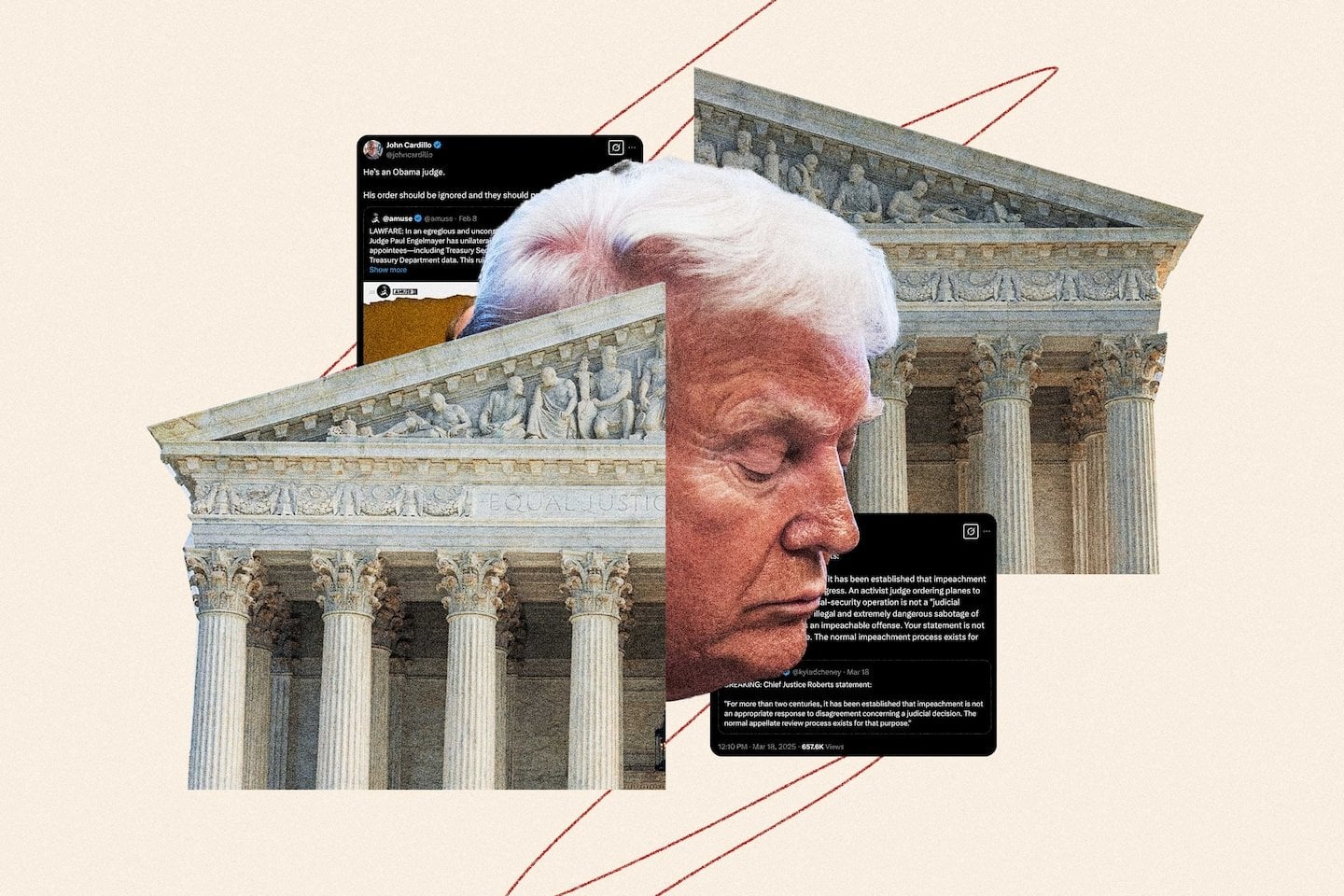
How the campaign to impeach judges took off among Trump allies | “Degrading trust in the courts can be remarkably effective in damaging their power because they lack the capacity to enforce their judgments, other scholars said”
Posted by ONETRILLIONAMERICANS
2 Comments
> Weeks before President Donald Trump called for the impeachment of a federal judge who ruled against his agenda, his supporters around the nation seeded the ground to turn public opinion against the institution that has been the leading check on his administration.
> In early February, after Trump-appointed U.S. District Judge Carl Nichols temporarily blocked the administration from placing thousands of employees at the U.S. Agency for International Development (USAID) on paid leave, the conservative social media account Catturd weighed in on the issue to his 3.6 million followers. “The judge is not the president. Ignore. Fire them all. Keep going,” the influencer posted on X.
> The next day, when a different judge blocked Elon Musk’s Department of Government Efficiency from accessing sensitive Treasury Department records, the conservative account @amuse shared similar sentiments to more than half a million followers about the federal judiciary. The account accused U.S. District Judge Paul A. Engelmayer, an appointee of Barack Obama, of fomenting “a coup by the judiciary against the elected government.”
> The message received 25,000 retweets — including from Musk — and nearly 20 million views.
> “This is an activist posing as a judge,” Musk wrote.
“Ignore this activist pos,” wrote Catturd, using an abbreviation for the vulgar insult “piece of sh–.”
> “The supreme court must intervene. This is judicial activism,” the influential YouTuber Benny Johnson wrote.
> Those posts came nearly seven weeks before the Trump administration began attacking a court order temporarily blocking his administration from deporting Venezuelan migrants without due process under the Alien Enemies Act of 1798, a law previously invoked only during wartime. Some legal experts said this defiance brings the country dangerously close to a constitutional crisis.
> “He’s utterly obligated to follow lower federal courts. That’s not a maybe,” said Amanda Frost, a constitutional scholar and director of the University of Virginia’s Immigration, Migration and Human Rights Program.
> Degrading trust in the courts can be remarkably effective in damaging their power because they lack the capacity to enforce their judgments, other scholars said.
> **“If you change dramatically the cultural expectations of what the executive branch will do to judges when judges issue orders that it doesn’t like, then it’s not obvious what prevents the courts from becoming a body that announces opinions about things and then everybody goes about doing what they want to do anyway,” said Benjamin Wittes, a senior fellow at the Brookings Institution and editor in chief of the Lawfare blog.**
> As the Trump administration presses its maximalist view of executive power, a network of supporters with giant social media followings has been pushing the view — unsupported by any court — that the judges, not the administration, are acting unconstitutionally and need to be removed from their positions. Experts say this unprecedented position has little legal basis but is nevertheless potent because of the way the administration is trying to sell it to the public.
> “The ancient Greeks knew that repetition breeds liking,” said Renee Hobbs, a professor of communication studies at the University of Rhode Island. “Social psychologists proved it in the 1970s: The more you hear a message, the more it seems true.”
!ping LAW
I expected the LATAM strongman path, not a speed run.
Federal Judiciary is specially weak against attacks because the general public doesn’t understand what federal courts do.