
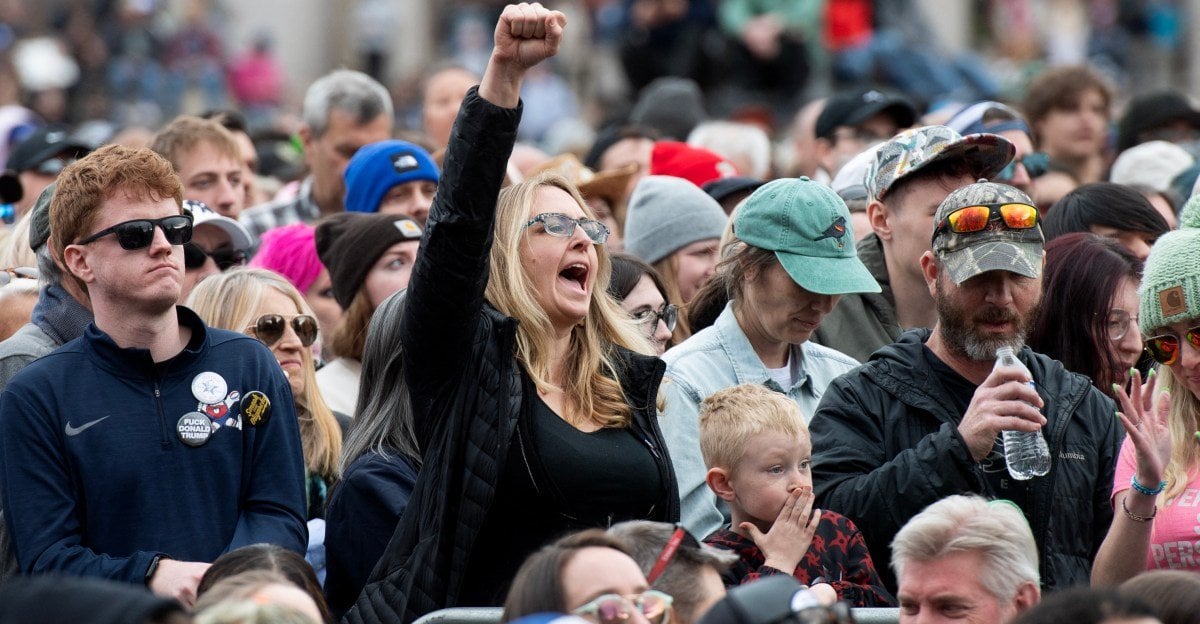
Is this the Democrats’ Tea Party moment? There are early signs that a Democratic revolt is on the horizon. But is it too early to say how it will play out?
Posted by Agonanmous
Is this the Democrats’ Tea Party moment? There are early signs that a Democratic revolt is on the horizon. But is it too early to say how it will play out?
Posted by Agonanmous
2 Comments
> Minnesota Gov. Tim Walz summed up the state of his party well recently, “The Democratic Party is unified — they’re unified in being pissed off at the Democrats.”
>Just 44 percent of Democrats are satisfied with the job Senate Minority Leader Chuck Schumer is doing. About 54 percent are satisfied with House Minority Leader Hakeem Jeffries. And the party’s overall favorability is tanking.
> That rage isn’t going away any time soon. The base looked ready to riot in March after Senate Democrats, led by Schumer, prevented a government shutdown by voting with Republicans to pass a stopgap funding bill. Many in the base saw the showdown as a red line — a wasted opportunity for their congressional representatives to obstruct Republicans and Trump, showing their constituents that they would finally fight back.
>The last time a party base was this mad at its leadership, it was 2009, and movement Republicans were furious at party leaders for losing to former President Barack Obama, bailing out Wall Street, and failing to stop the Affordable Care Act. And what started out as base rage grew into a full-on interparty revolution — the Tea Party reorganized the Republican Party on its own terms.
>But are Democrats about to face their own Tea Party moment? Is the rage that the base is feeling right now going to lead the party down the same path that Republicans went on during the Obama era?
> While early Tea Party activists and leaders argue that they had a sharply defined set of primarily libertarian, conservative beliefs about the role and size of government, their defining characteristic was anger: at the Obama administration, and the Republican Party’s inability to stop Democrats, and at Obama, personally.
> Their original unifying theme was an acronym — “Taxed Enough Already,” a conservative call for less government spending, lower taxation, and strict interpretations of the Constitution. It was a loose network of local activists and groups who showed up to town halls, held protests locally and in DC, and eventually saw upstart individual candidates challenge moderate and establishment Republicans in both safe seats and swing seats.
>They saw two discernible spikes in power and momentum: first in the lead-up to the 2010 midterm elections, when anti-incumbent dissatisfaction boosted congressional Republicans to win 63 House seats and make gains in the Senate. The second was in the 2014 midterms, when Republicans gained even more seats in the House and won back the Senate. In that time, the Tea Party went from GOP fringe to a rival power center that continually vexed its more establishment leadership. The movement was both ideological — as detailed above — and tactical. Tea Party candidates wanted Republicans to take extreme measures to obstruct Obama’s agenda, and they launched primary challenges to a slew of incumbent Republicans who refused to go along.
> Notably, the movement was defined by how decentralized it was at its start — though some national organizations later formed to try to organize and wield populist furor, it was mostly a grassroots movement. That energy sustained itself over more than five years and was strong enough to oust one of the Republican Party’s top leaders in 2014, when college professor Dave Brat beat GOP Majority Leader Eric Cantor. The race was an upset, and is still largely considered the most emblematic Tea Party victory of the period.
>“The populist energy we had back then had a very clear logic to it. It was Madisonian, Adam Smith, decentralization, federalism, taxed enough already, and border security,” Brat told me recently. “When I ran, I was kind of a pre-Trump in a way, right? I ran on those things, and it’s all out there on paper. It was a content-driven race. It wasn’t like I was out for power.”
>Through it all, there was at least some common thread holding the movement together: populist anger.
> What makes 2025 feel like 2009 and 2014 is the level of intra-party anger and the unifying of the party **around a shorthand slogan: “Do Something.”**
> The polling data, for example, does reveal some parallels between 2009, 2014, and today. Self-identified Democrats now view their party about as negatively as Republicans did from 2009 to 2015, the years of the Tea Party’s dominance, according to polling analysis by the election data site Split Ticket. As that site’s co-founder Lakshya Jain said in a recent post, “the Democratic approval data is unlike any in recent history — and it isn’t a case of bitter, disaffected partisans reacting to a loss in the last election.”
>Jain notes that this year is different from the last two times Democrat and Republican bases had to reckon with presidential losses. In 2017, for example, Democrats didn’t turn away from their leaders: approval ratings of congressional Democrats rose from 2017 to 2019, as the base approved of their party’s resistance to Trump and empowered a blue wave in the midterms. In 2021, meanwhile, the Republican base remained largely favorable toward congressional Republicans after Trump’s loss. The numbers suggest this year might be the start of something different from Democrats.
>That anger is showing up online, in the press, and in-person in places like deep-blue California, Massachusetts, and Maryland, where pissed-off constituents are squaring off with elected Democrats — venting to their representatives about how frustrated they are by their leadership’s weak resistance to Trump and Musk. That mirrors some of the town halls and rallies that defined the populist Tea Party insurgency in 2009 and 2010, and which carried over into the second Obama term.
> The polling data, for example, does reveal some parallels between 2009, 2014, and today. Self-identified Democrats now view their party about as negatively as Republicans did from 2009 to 2015, the years of the Tea Party’s dominance, according to polling analysis by the election data site Split Ticket. As that site’s co-founder Lakshya Jain said in a recent post, “the Democratic approval data is unlike any in recent history — and it isn’t a case of bitter, disaffected partisans reacting to a loss in the last election.”
>Jain notes that this year is different from the last two times Democrat and Republican bases had to reckon with presidential losses. In 2017, for example, Democrats didn’t turn away from their leaders: approval ratings of congressional Democrats rose from 2017 to 2019, as the base approved of their party’s resistance to Trump and empowered a blue wave in the midterms. In 2021, meanwhile, the Republican base remained largely favorable toward congressional Republicans after Trump’s loss. The numbers suggest this year might be the start of something different from Democrats.
>**That anger is showing up online, in the press, and in-person in places like deep-blue California, Massachusetts, and Maryland, where pissed-off constituents are squaring off with elected Democrats — venting to their representatives about how frustrated they are by their leadership’s weak resistance to Trump and Musk**. That mirrors some of the town halls and rallies that defined the populist Tea Party insurgency in 2009 and 2010, and which carried over into the second Obama term.
In my opinion it’s inevitable that during the next primaries there are gonna be much more candidates in 2026 and 2028 who are gonna be much more loud and decisive in their criticism and pushback against Trumpism and the GOP.
The voters want a new direction and the current leadership can either ride the wave and try to redirect it into their own policies or be inevitably swept away if people see them as either enablers or as useless opposition.