Death to the NYT ✊🔫, May they succumb to the revolutionary forces of YIMBYs and high density!
Foucault_Please_No on
I do not like the NYT
workingtrot on
Can’t wait for the headline in 25 years: “Texas cities devastated by unsustainable infrastructure costs”
Suburbs don’t generate enough tax revenue to pay for themselves.
In my city they estimate minimum 6 units/ acre, granted, property taxes are not as high here. But higher property taxes in Texas also need to make up for income tax, so not sure where the balance point is.
NaffRespect on
Get in here, let’s all dunk on sprawl
!ping YIMBY
surreptitioussloth on
This really focusses the question
Is the abundance/YIMBY agenda about removing barriers and letting the market build, or is it about a different vision for planning communities
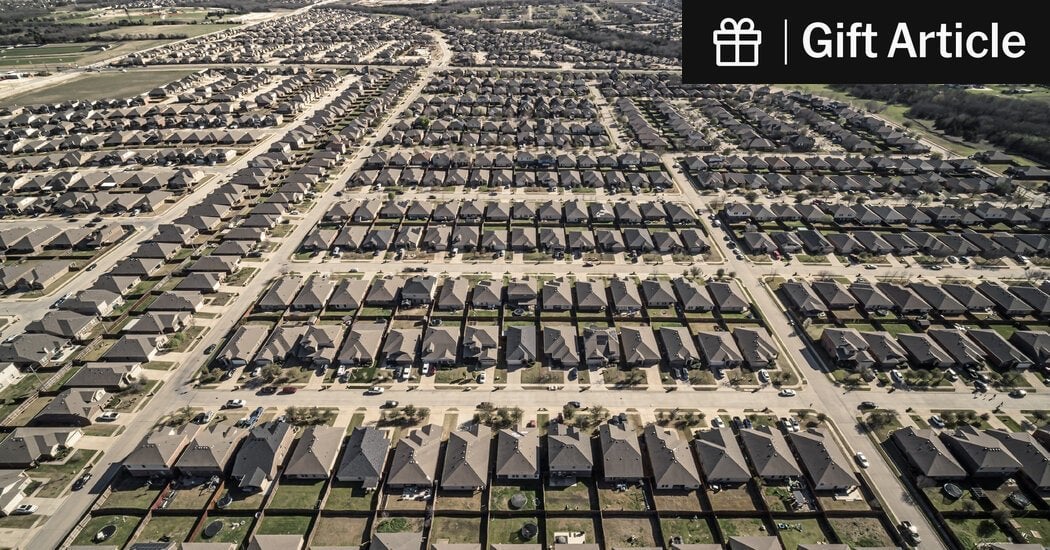
Dallas and Houston haven’t grown as much as they have by building in the city cores, but instead by giving a never ending suburb to people
That’s definitely not the vision most urbanist YIMBY’s have. And of course deregulation of building in NYC or San Francisco will result in different things being built than in texas, but overall, I think saying that we’re ok just letting developers build what they want where they want is going to produce results that many YIMBYs find distasteful
Dapper_Discount7869 on
My priors forbid me from reading
iusedtobekewl on
Wtf is this shit? Sprawl is absolutely terrible urban planning.
Oh, wait, it’s just another garbage article from the NYT. At least once a week I see a shit take from them that justifies me canceling my subscription last year lol.
NeueBruecke_Detektiv on
> Princeton’s godawful traffic and its views of pastures being consumed by tract homes are exactly the sorts of scenes opponents of sprawl have in their heads. But this is how cities are built: through a chaotic and uneven process in which the mix of homes, jobs and infrastructure is constantly shifting and never quite in balance. Instead of endless sprawl, it’s better to think of boomtowns like Princeton as economic nodes in a broader region.
“Just change your mindset to see the sprawling suburbia as a good economic thing; the traffic is just how cities are built!”
The rest of the article is somewhat reasonable despite the inflammatory tittle, but this made me chuckle.
brucebananaray on
At this point, NYT Pitchpot will lose its job because of these types of articles.
CincyAnarchy on
When I’m in a contrarian takes competition and my competition is a New York Times contributor.
I’m more than content with sprawl as long as there is affordable and dependable high speed rail. Which does not seem to be a priority in Texas
hascogrande on
The author himself in the article makes the case for why sprawl is bad because the infrastructure can’t catch up fast enough. Then when it does need to be repaired it’s usually a huge hassle for the subdivisions. Also there’s this comment from the author.
>I agree with much of this. What I’ve come to appreciate is that “sprawl” is really just the first step of growth and will/should fill in over time. In Texas I kept thinking of Frisco, which had about 6K people in 1990 and now has 200K + population along with some really cool new urbanist projects with higher densities/walkability etc. Hard to do that on Day 1. Also, many of today’s exurbs are actually quite a bit denser than 90s suburbs, so in many areas you’re seeing “U-shaped” density where the furthest out developments are denser than closer suburbs.
But, it’s not really that hard to do and you still gotta drive to those areas which defeats the purpose. Frisco is less dense than Houston and is still very clearly car-dependent
LivinAWestLife on
The images in the article made me physcially recoil. And of course it mentions Dallas-Fort Worth as a success story, which I think by this point is my archnemesis.
Speaking as a non-American skyscraper fan, I have an irrational hatred for the whole DFW area. How do you add as many people as Toronto in the past 25 years and any significant urban development you’ve done is just one district (Uptown).

14 Comments
Death to the NYT ✊🔫, May they succumb to the revolutionary forces of YIMBYs and high density!
I do not like the NYT
Can’t wait for the headline in 25 years: “Texas cities devastated by unsustainable infrastructure costs”
Suburbs don’t generate enough tax revenue to pay for themselves.
In my city they estimate minimum 6 units/ acre, granted, property taxes are not as high here. But higher property taxes in Texas also need to make up for income tax, so not sure where the balance point is.
Get in here, let’s all dunk on sprawl
!ping YIMBY
This really focusses the question
Is the abundance/YIMBY agenda about removing barriers and letting the market build, or is it about a different vision for planning communities
Dallas and Houston haven’t grown as much as they have by building in the city cores, but instead by giving a never ending suburb to people
That’s definitely not the vision most urbanist YIMBY’s have. And of course deregulation of building in NYC or San Francisco will result in different things being built than in texas, but overall, I think saying that we’re ok just letting developers build what they want where they want is going to produce results that many YIMBYs find distasteful
My priors forbid me from reading
Wtf is this shit? Sprawl is absolutely terrible urban planning.
Oh, wait, it’s just another garbage article from the NYT. At least once a week I see a shit take from them that justifies me canceling my subscription last year lol.
> Princeton’s godawful traffic and its views of pastures being consumed by tract homes are exactly the sorts of scenes opponents of sprawl have in their heads. But this is how cities are built: through a chaotic and uneven process in which the mix of homes, jobs and infrastructure is constantly shifting and never quite in balance. Instead of endless sprawl, it’s better to think of boomtowns like Princeton as economic nodes in a broader region.
“Just change your mindset to see the sprawling suburbia as a good economic thing; the traffic is just how cities are built!”
The rest of the article is somewhat reasonable despite the inflammatory tittle, but this made me chuckle.
At this point, NYT Pitchpot will lose its job because of these types of articles.
When I’m in a contrarian takes competition and my competition is a New York Times contributor.
https://preview.redd.it/havilv2rj8ue1.png?width=733&format=png&auto=webp&s=441583dd927afaad820549ec0c729df1b0923211
I’m more than content with sprawl as long as there is affordable and dependable high speed rail. Which does not seem to be a priority in Texas
The author himself in the article makes the case for why sprawl is bad because the infrastructure can’t catch up fast enough. Then when it does need to be repaired it’s usually a huge hassle for the subdivisions. Also there’s this comment from the author.
>I agree with much of this. What I’ve come to appreciate is that “sprawl” is really just the first step of growth and will/should fill in over time. In Texas I kept thinking of Frisco, which had about 6K people in 1990 and now has 200K + population along with some really cool new urbanist projects with higher densities/walkability etc. Hard to do that on Day 1. Also, many of today’s exurbs are actually quite a bit denser than 90s suburbs, so in many areas you’re seeing “U-shaped” density where the furthest out developments are denser than closer suburbs.
But, it’s not really that hard to do and you still gotta drive to those areas which defeats the purpose. Frisco is less dense than Houston and is still very clearly car-dependent
The images in the article made me physcially recoil. And of course it mentions Dallas-Fort Worth as a success story, which I think by this point is my archnemesis.
Speaking as a non-American skyscraper fan, I have an irrational hatred for the whole DFW area. How do you add as many people as Toronto in the past 25 years and any significant urban development you’ve done is just one district (Uptown).
Yes in my backyard!
No not like that!