> Look closely at the floor plan of an Irish home up for sale and you’ll often see a nook labeled with the letters “HP.” These initials mark the location of a clever piece of domestic equipment that is little known outside of Ireland (and somewhat on the wane at home). It’s called a hot press, and it deserves to be appreciated, and possibly even loved, across the world.
>That name is somewhat confusing, because a hot press isn’t very hot and doesn’t press anything. What it is, in fact, is a warm enclosed space that sits usefully on the boundary between a clothes dryer and a regular closet — a space often referred to as a press in Ireland.
> Once considered essential household amenities, these closets are fitted with a hanging rail or shelves that stand above a water heater. (The example featured below gives the idea, but has a somewhat taller tank than the average.) The warmth radiating from the tank below can be used for drying (slightly) damp laundry, keeping towels toasty, and preventing moisture from settling into stored sheets and linens.
> There’s a close English and Welsh relation, the airing cupboard (which in turn begat the American-style linen closet), but the Irish hot press (which can also found in Scotland) is typically larger. As such, it’s more like a pocket-sized low-tech sibling of yokushitsu kansouki — the room-sized clothes-drying feature embedded in Japanese bathrooms.
> What all these solutions share is a common foundation in laundry cultures that spurn the mechanical dryers that have long dominated North America. While 84% of US households tumble-dry their clothes, much of the rest of the world relies on various forms of air drying — a fact that can be a source of great wonderment for American visitors.
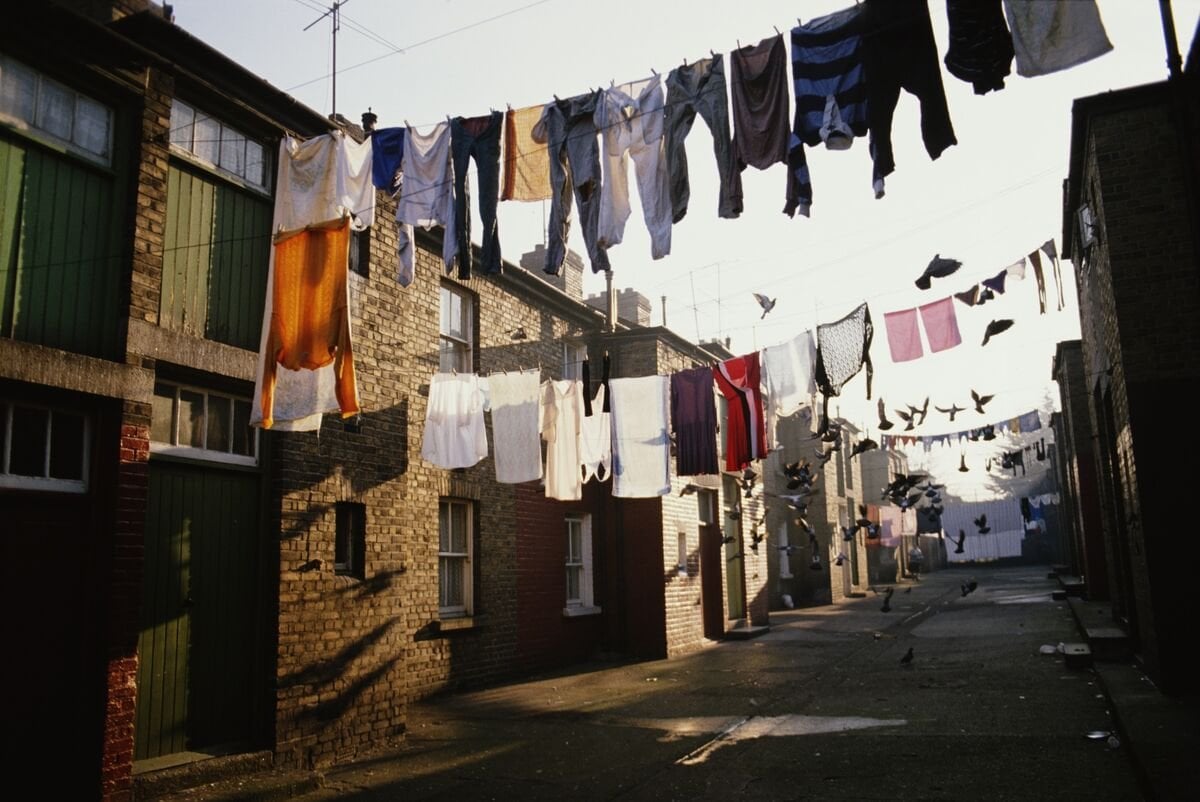
> Hot presses are normally last-mile devices for wet laundry, rather than something intended to take it all the way. You hang your clothes up on a line outside to dry, then move them into this cozy little box. In keeping with the rest of Europe, many Irish households still prefer to hang their clothes and sheets outdoors rather than use mechanical dryers, which are widely viewed as energy hogs that will destroy your clothes.
>Depending on outdoor laundry lines might seem ludicrous in a country with a reputation for perpetual drizzle, but Ireland’s climate isn’t really that wet. Dublin, on the drier east coast, has the same annual rainfall as San Antonio, Texas (30 inches/760 mm), and drastically less than New York City (which gets 49 inches/1,245 mm).
>Irish weather is, however, changeable, and it is not uncommon to have to bring washing in from off the line to save it from passing showers. When fully warm, a hot press will dry out laundry even if it is left folded on shelves, and much more quickly if hung. The press also costs nothing to run, because it relies on waste heat rising from another standard piece of Irish domestic equipment: the immersion heater. These are small electric devices inserted into water tanks to supply hot water during the hours when a home’s main boiler (usually oil or gas) is off, as it generally is outside of the morning and evening heating shifts standard in Ireland.
> This isn’t a set-up that everyone might adopt with enthusiasm. For those accustomed to just hopping in the shower and experiencing instant hot water, immersion heaters demand a bit of advance planning, and even if insulated with something that looks like a down jacket, they don’t always hold their heat very well. Their energy costs can also be a source of domestic tension, with leaving the immersion on cited as proof of the younger generation’s wasteful ways.
> Such attitudes are seen as grimly old-fashioned today, especially among younger people. Improvements in appliance technology have brought innovations like tankless water heaters that supply hot water only when needed, as well as regular water heaters with better insulation, so the spare warmth the presses were set up to capture is no longer as easy to harvest. Clothes dryers have also made inroads with Irish consumers: 65% of households reported having a machine in the 2019 census.
>Hot presses persist nonetheless (not least as the name of a longstanding Irish music magazine), along with tips on how to get the best from them. Even today, you’ll find them not just in modest one-floor row homes but in grand multimillion-euro mansions. Residents of these houses, after all, are less likely to need the extra space and may still enjoy performing traditional domesticity by piling their immaculate press with crisp linens and lavender bags to keep the moths off.
>Some people who have ditched their old-fashioned immersions are finding ways to keep their hot presses alive by adding a tiny electric heater at the bottom of the closet from which the tank has been removed. This might be neither high-tech nor especially elegant, but it still uses less energy than a tumble dryer and maintains the essential virtues of the hot press model — proving that some pragmatic solutions for a world of wiser energy use may be hiding, unnoticed, behind a closet door.
Maximilianne on
We can’t even get Americans to adopt the bidet, we ain’t getting the Irish press lol

2 Comments
> Look closely at the floor plan of an Irish home up for sale and you’ll often see a nook labeled with the letters “HP.” These initials mark the location of a clever piece of domestic equipment that is little known outside of Ireland (and somewhat on the wane at home). It’s called a hot press, and it deserves to be appreciated, and possibly even loved, across the world.
>That name is somewhat confusing, because a hot press isn’t very hot and doesn’t press anything. What it is, in fact, is a warm enclosed space that sits usefully on the boundary between a clothes dryer and a regular closet — a space often referred to as a press in Ireland.
> Once considered essential household amenities, these closets are fitted with a hanging rail or shelves that stand above a water heater. (The example featured below gives the idea, but has a somewhat taller tank than the average.) The warmth radiating from the tank below can be used for drying (slightly) damp laundry, keeping towels toasty, and preventing moisture from settling into stored sheets and linens.
> There’s a close English and Welsh relation, the airing cupboard (which in turn begat the American-style linen closet), but the Irish hot press (which can also found in Scotland) is typically larger. As such, it’s more like a pocket-sized low-tech sibling of yokushitsu kansouki — the room-sized clothes-drying feature embedded in Japanese bathrooms.
> What all these solutions share is a common foundation in laundry cultures that spurn the mechanical dryers that have long dominated North America. While 84% of US households tumble-dry their clothes, much of the rest of the world relies on various forms of air drying — a fact that can be a source of great wonderment for American visitors.
> Hot presses are normally last-mile devices for wet laundry, rather than something intended to take it all the way. You hang your clothes up on a line outside to dry, then move them into this cozy little box. In keeping with the rest of Europe, many Irish households still prefer to hang their clothes and sheets outdoors rather than use mechanical dryers, which are widely viewed as energy hogs that will destroy your clothes.
>Depending on outdoor laundry lines might seem ludicrous in a country with a reputation for perpetual drizzle, but Ireland’s climate isn’t really that wet. Dublin, on the drier east coast, has the same annual rainfall as San Antonio, Texas (30 inches/760 mm), and drastically less than New York City (which gets 49 inches/1,245 mm).
>Irish weather is, however, changeable, and it is not uncommon to have to bring washing in from off the line to save it from passing showers. When fully warm, a hot press will dry out laundry even if it is left folded on shelves, and much more quickly if hung. The press also costs nothing to run, because it relies on waste heat rising from another standard piece of Irish domestic equipment: the immersion heater. These are small electric devices inserted into water tanks to supply hot water during the hours when a home’s main boiler (usually oil or gas) is off, as it generally is outside of the morning and evening heating shifts standard in Ireland.
> This isn’t a set-up that everyone might adopt with enthusiasm. For those accustomed to just hopping in the shower and experiencing instant hot water, immersion heaters demand a bit of advance planning, and even if insulated with something that looks like a down jacket, they don’t always hold their heat very well. Their energy costs can also be a source of domestic tension, with leaving the immersion on cited as proof of the younger generation’s wasteful ways.
> Such attitudes are seen as grimly old-fashioned today, especially among younger people. Improvements in appliance technology have brought innovations like tankless water heaters that supply hot water only when needed, as well as regular water heaters with better insulation, so the spare warmth the presses were set up to capture is no longer as easy to harvest. Clothes dryers have also made inroads with Irish consumers: 65% of households reported having a machine in the 2019 census.
>Hot presses persist nonetheless (not least as the name of a longstanding Irish music magazine), along with tips on how to get the best from them. Even today, you’ll find them not just in modest one-floor row homes but in grand multimillion-euro mansions. Residents of these houses, after all, are less likely to need the extra space and may still enjoy performing traditional domesticity by piling their immaculate press with crisp linens and lavender bags to keep the moths off.
>Some people who have ditched their old-fashioned immersions are finding ways to keep their hot presses alive by adding a tiny electric heater at the bottom of the closet from which the tank has been removed. This might be neither high-tech nor especially elegant, but it still uses less energy than a tumble dryer and maintains the essential virtues of the hot press model — proving that some pragmatic solutions for a world of wiser energy use may be hiding, unnoticed, behind a closet door.
We can’t even get Americans to adopt the bidet, we ain’t getting the Irish press lol