
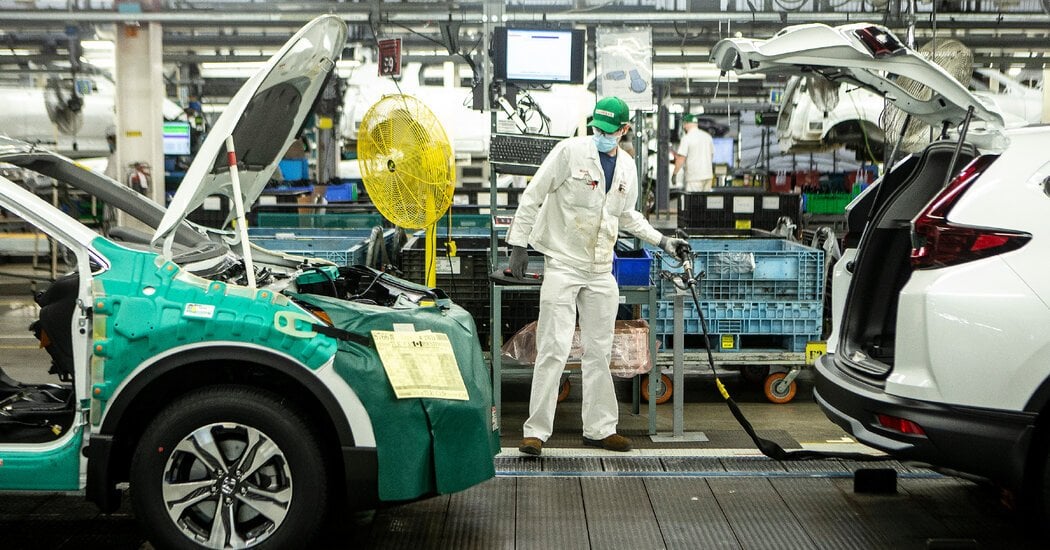
In a partial roll back of its retaliation against U.S. tariffs, Canada’s finance minister said on Tuesday that the government would let automakers import vehicles assembled in the United States duty-free provided that they continued to build cars in Canada and continued with previously announced expansions.
Last week, Canada began charging 25 percent tariffs on vehicles imported from the United States in response to President Trump’s levies of the same amount on cars.
Auto trade between the United States and Canada has become tightly integrated since the two countries signed a trade deal 60 years ago that eased the flow of vehicles and related goods across the border. The resulting trade has been generally balanced between the two nations, though there have been occasional, slight surpluses in the United States’ favor.
François-Philippe Champagne, Canada’s finance minister, did not specify in his statement exactly how many U.S.-made cars and trucks each of the five major automakers would be allowed to import without tariffs.
But his statement suggested that those numbers would be linked to Canadian manufacturing: “The number of tariff-free vehicles a company is permitted to import will be reduced if there are reductions in Canadian production or investment.”
A spokeswoman for Canada’s Department of Finance was unable to immediately provide further details. Stellantis, one of the major automakers, declined to comment on the announcement. Ken Chiu, a spokesman for Honda, said the company’s factories in Alliston, Ontario, would continue to produce as many vehicles as it could. The other three companies did not respond to questions.
Only Toyota and Honda, which account for about two-thirds of Canadian auto production, are currently operating at or near full capacity in Canada.
Posted by John3262005
2 Comments
!ping can
Probably smart. If this strategy works, there will be new EV/Battery plants made from Honda and Volkswagen. Also means suddenly the shuttered GM and Stellantis plants are cheaper to operate than their US equivalents