
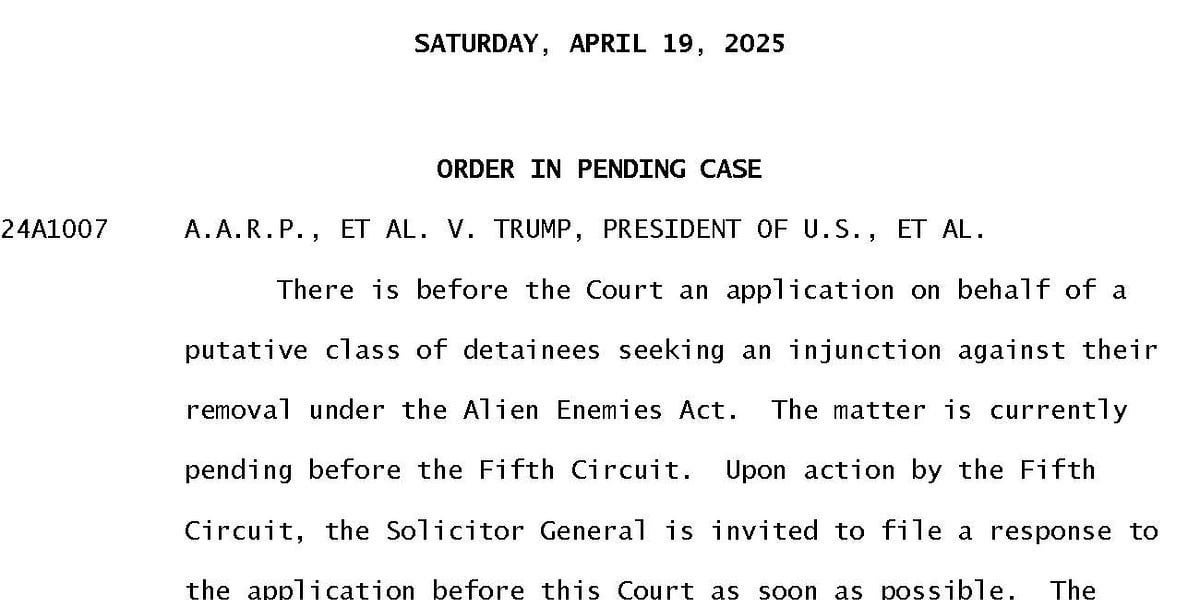
The Supreme Court’s late-night Alien Enemy Act intervention | Just before 1:00 a.m., the justices (aggressively) stepped back into the Alien Enemy Act litigation—in a decision suggesting that a majority understands that these are no longer normal circumstances
Posted by ONETRILLIONAMERICANS
1 Comment
> Obviously, there’s still a lot we don’t know. But at least initially, this strikes me as a massively important—and revealing—intervention by the Supreme Court, for at least three reasons:
> First, the full Court didn’t wait for the Fifth Circuit—or act through the individual Circuit Justice (Justice Alito).2 Even in other fast-moving emergency applications, the Court has often made a show out of at least appearing to wait for the lower courts to rule before intervening—even if that ruling might not have influenced the outcome. Here, though, the Court didn’t wait at all; indeed, the order specifically invites the government to respond once the Fifth Circuit weighed in—acknowledging that the Fifth Circuit hadn’t ruled (and, indeed, that the government hadn’t responded to the application in the Supreme Court) yet. This may seem like a technical point, but it underscores how seriously the Court, or at least a majority of it, took the urgency of the matter. (More on that in a moment.)
> Second, the Court didn’t hide behind any procedural technicalities. One of the real themes of the Court’s interventions in Trump-related emergency applications to date has been using procedural technicalities to justify siding with the federal government—including in J.G.G. itself (the first AEA ruling). One could’ve imagined similar procedural objections to such a speedy intervention, on a class-wide basis, in last night’s ruling. (Indeed, I suspect some of those objections are forthcoming in Justice Alito’s impending dissenting opinion.) Here, though, the Court jumped right to the substantive relief the applicants sought—again, reinforcing not just the urgency of the issue, but its gravity.
> Third, and perhaps most significantly, the Court seemed to not be content with relying upon representations by the government’s lawyers. In the hearing before Chief Judge Boasberg, Drew Ensign had specifically stated, on behalf of the government, that “no planes” would be leaving either Friday or Saturday. True, the government hasn’t formally responded in the Supreme Court, but the justices (or at least their clerks) would have been well aware of the exchange—indeed, some of the clerks were likely listening to the hearing as it happened. In a world in which a majority of the justices were willing to take these kinds of representations at face value, there might’ve been no need to intervene overnight Friday evening; the justices could’ve taken at least all day Saturday to try to sort things out before handing down their decision.
> But this case arose only because of the Trump administration’s attempt to play Calvinball with detainees it’s seeking to remove under the Alien Enemy Act. The Court appears to be finally getting the message—and, in turn, handing down rulings with none of the wiggle room we saw in the J.G.G. and Abrego Garcia decisions last week. That’s a massively significant development unto itself—especially if it turns out to be more than a one-off.
> We’re going through all of this rigmarole because no court has yet to rule on whether the government even has the power to use the Alien Enemy Act this way in the first place. As folks know, I think there are very strong arguments that it doesn’t—and a court so holding would provide a substantive impediment to any of the procedural games the government is trying to play. In that sense, it seems a little weird that we’re going through all of this effort to require process before the government can use a substantive authority it probably doesn’t have. Maybe the reason the justices are focusing on the procedures is because they’re not sure what they think of the merits. But the sooner the merits are resolved, it seems to me, the better.
!ping LAW&IMMIGRATION