There is a special thrill to landing in a new city. The view you get before the plane touches down reveals a lot about a place. You can tell whether locals live packed together in tall towers or spread out in low buildings. You can gauge whether there is a dense centre or a sparse urban sprawl. A new study reveals that low-rise cityscapes may, one day, be a thing of the past. Increasingly, cities are growing upwards rather than outwards.
Cities expand as businesses thrive, jobs are created and people pour in. This happens in three ways. There is a process of “infilling”, whereby pockets of vacant land within a city are built on. There is lateral development, where buildings spread out onto land outside the urban centre. And there is upward development, where low-rise buildings are replaced by taller ones.
A new paper, published in Nature Cities by Steve Frolking and colleagues based in America and Germany, used satellite data to measure the world’s cities in three dimensions. Previous research has used satellite images to assess infilling and lateral growth, but the authors of this study added a clever technique to gauge upward development too. They applied their method to more than 1,550 cities from around 1993 to 2020.
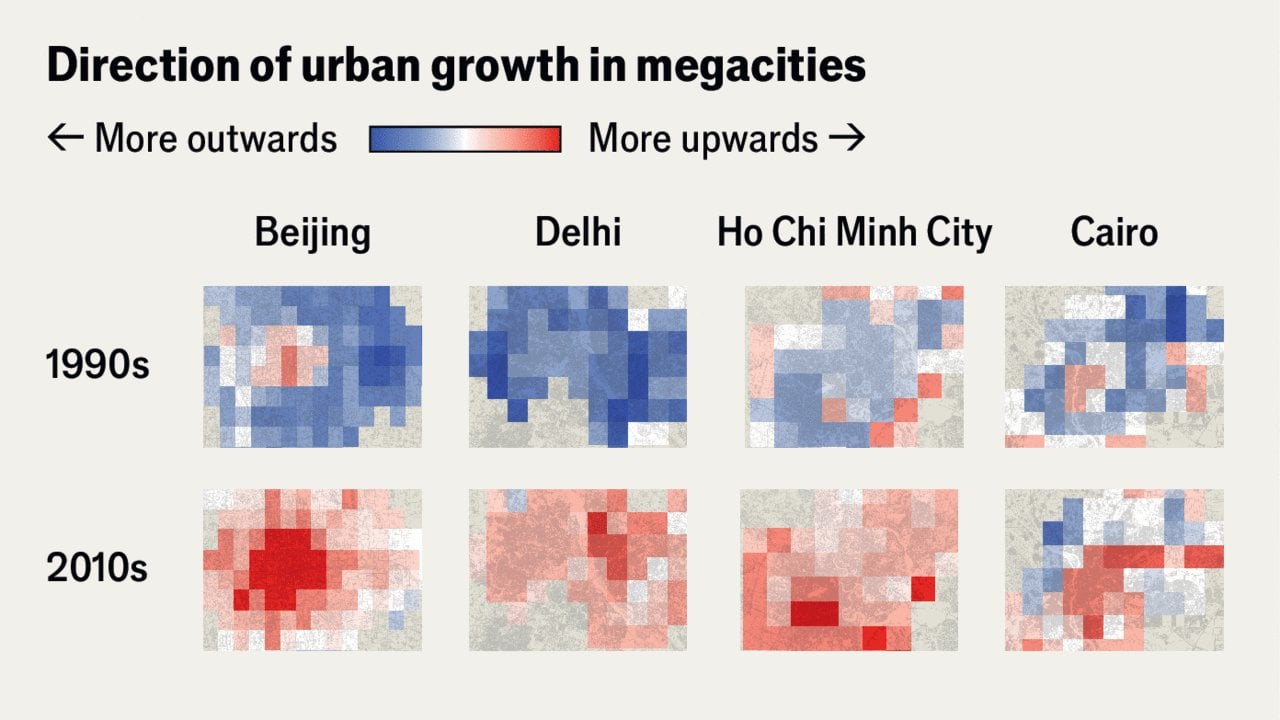
Many growing cities have transitioned from expanding outwards to stretching upwards (see chart 1). In the 1990s some 80% of urban areas that were growing quickly were doing so mostly by spreading. By the 2010s that figure was just 28%. In megacities (with more than 10m inhabitants), the authors found that growth tends to follow a pattern: the transition from out to up first occurs in the centre and then surrounding areas follow. That has happened in India’s capital, Delhi, and in Egypt’s, Cairo, for example. In middle-income countries that are urbanising fast, informal settlements often pop up on a city’s fringes to house migrants from rural areas. Gradually these become part of the city proper.
The pace at which urban areas are expanding also differs dramatically across the world (see chart 2). In Africa, which includes some of the world’s poorest and least developed cities, upward growth was slow in the 1990s and 2000s, but has accelerated in the past decade. In more developed emerging markets, like China and the Middle East, upward growth spurts began in the 2000s. Perhaps unsurprisingly, urban growth in the most developed regions—Europe and North America—has been relatively slow in both directions over the past 30 years.
All this matters for people and the planet. Dense cities tend to have higher productivity and produce more innovations than dispersed urban areas do. Residents have shorter commutes and better access to entertainment and public services. Tall cities also tend to have lower carbon emissions per person, as locals make fewer journeys by car. And growing upwards instead of outwards means that green space surrounding the city can remain untouched. But there are downsides, too. High-rise housing tends to be more expensive to build, which can increase inequality, and inner-city congestion means higher levels of pollution. That provides plenty to think about next time you gaze out of an aeroplane window at a towering metropolis.

1 Comment
!ping YIMBY
Article:
There is a special thrill to landing in a new city. The view you get before the plane touches down reveals a lot about a place. You can tell whether locals live packed together in tall towers or spread out in low buildings. You can gauge whether there is a dense centre or a sparse urban sprawl. A new study reveals that low-rise cityscapes may, one day, be a thing of the past. Increasingly, cities are growing upwards rather than outwards.
Cities expand as businesses thrive, jobs are created and people pour in. This happens in three ways. There is a process of “infilling”, whereby pockets of vacant land within a city are built on. There is lateral development, where buildings spread out onto land outside the urban centre. And there is upward development, where low-rise buildings are replaced by taller ones.
A new paper, published in Nature Cities by Steve Frolking and colleagues based in America and Germany, used satellite data to measure the world’s cities in three dimensions. Previous research has used satellite images to assess infilling and lateral growth, but the authors of this study added a clever technique to gauge upward development too. They applied their method to more than 1,550 cities from around 1993 to 2020.
Many growing cities have transitioned from expanding outwards to stretching upwards (see chart 1). In the 1990s some 80% of urban areas that were growing quickly were doing so mostly by spreading. By the 2010s that figure was just 28%. In megacities (with more than 10m inhabitants), the authors found that growth tends to follow a pattern: the transition from out to up first occurs in the centre and then surrounding areas follow. That has happened in India’s capital, Delhi, and in Egypt’s, Cairo, for example. In middle-income countries that are urbanising fast, informal settlements often pop up on a city’s fringes to house migrants from rural areas. Gradually these become part of the city proper.
The pace at which urban areas are expanding also differs dramatically across the world (see chart 2). In Africa, which includes some of the world’s poorest and least developed cities, upward growth was slow in the 1990s and 2000s, but has accelerated in the past decade. In more developed emerging markets, like China and the Middle East, upward growth spurts began in the 2000s. Perhaps unsurprisingly, urban growth in the most developed regions—Europe and North America—has been relatively slow in both directions over the past 30 years.
All this matters for people and the planet. Dense cities tend to have higher productivity and produce more innovations than dispersed urban areas do. Residents have shorter commutes and better access to entertainment and public services. Tall cities also tend to have lower carbon emissions per person, as locals make fewer journeys by car. And growing upwards instead of outwards means that green space surrounding the city can remain untouched. But there are downsides, too. High-rise housing tends to be more expensive to build, which can increase inequality, and inner-city congestion means higher levels of pollution. That provides plenty to think about next time you gaze out of an aeroplane window at a towering metropolis.