> It was just before rush hour on a Thursday afternoon, and all of the trains between Philadelphia and New Haven, Conn., were at a standstill. But the alert Amtrak sent out did little to calm seething commuters: All it said was that service was suspended because of an “overhead power outage.”
> What it did not mention was that a giant circuit breaker — a critical piece of Amtrak’s system for powering trains along the nation’s busiest stretch of passenger railroad tracks — had blown up a few miles from Midtown Manhattan, causing catastrophic damage to an electrical substation and wreaking havoc up and down the Northeast Corridor.
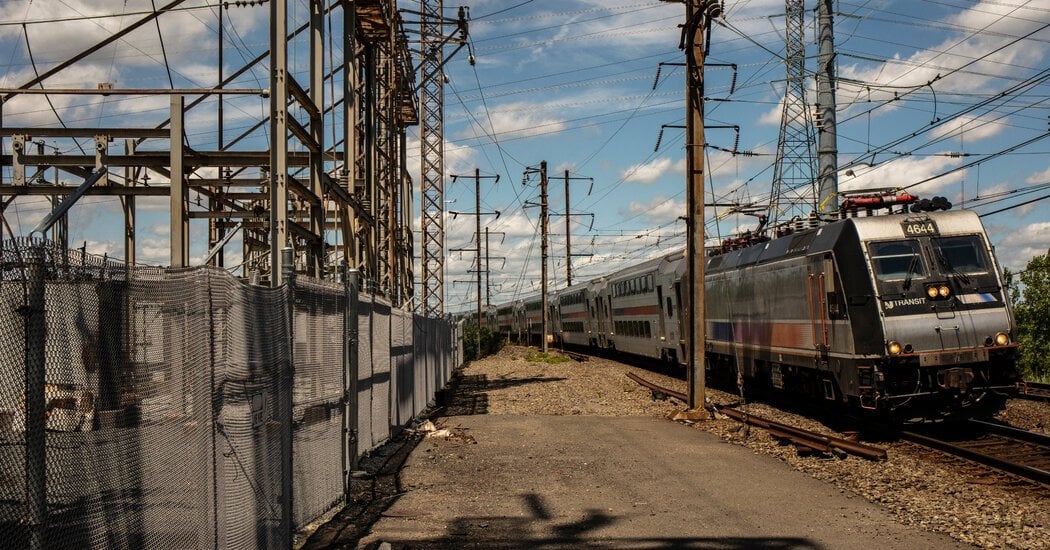
> Long stretches of that system are unchanged from when the defunct Pennsylvania Railroad first electrified it a century ago, The New York Times has found. And any wholesale modernization effort would come at tremendous cost and take more than a decade.
> “It’s staggering, it’s just staggering that we’re still having antique technology controlling our rails,” said John Goglia, a former member of the National Transportation Safety Board whose duties included overseeing railroad investigations from 1995 to 2004. “That’s last century’s technology.”
> Between Washington and New York City, rather than adopting the modern, nearly universal standard of 60 cycles per second, or 60 hertz, Amtrak has patched together an electrical network that runs on the outdated standard of 25 cycles per second, or 25 hertz. Amtrak maintains equipment that dates to when the Pennsy first electrified the line in the 1920s and ’30s.
> Madison Feinberg, who has studied Amtrak’s infrastructure as director of electric traction and technical planning for the Effective Transit Alliance, an advocacy group, said: “They’ve upgraded bits and pieces of the system — fundamentally making minor fixes to a design that’s from the ’30s. It’s just effectively playing Whac-a-Mole, which Amtrak’s team is very good at.”

1 Comment
> It was just before rush hour on a Thursday afternoon, and all of the trains between Philadelphia and New Haven, Conn., were at a standstill. But the alert Amtrak sent out did little to calm seething commuters: All it said was that service was suspended because of an “overhead power outage.”
> What it did not mention was that a giant circuit breaker — a critical piece of Amtrak’s system for powering trains along the nation’s busiest stretch of passenger railroad tracks — had blown up a few miles from Midtown Manhattan, causing catastrophic damage to an electrical substation and wreaking havoc up and down the Northeast Corridor.
> Long stretches of that system are unchanged from when the defunct Pennsylvania Railroad first electrified it a century ago, The New York Times has found. And any wholesale modernization effort would come at tremendous cost and take more than a decade.
> “It’s staggering, it’s just staggering that we’re still having antique technology controlling our rails,” said John Goglia, a former member of the National Transportation Safety Board whose duties included overseeing railroad investigations from 1995 to 2004. “That’s last century’s technology.”
> Between Washington and New York City, rather than adopting the modern, nearly universal standard of 60 cycles per second, or 60 hertz, Amtrak has patched together an electrical network that runs on the outdated standard of 25 cycles per second, or 25 hertz. Amtrak maintains equipment that dates to when the Pennsy first electrified the line in the 1920s and ’30s.
> Madison Feinberg, who has studied Amtrak’s infrastructure as director of electric traction and technical planning for the Effective Transit Alliance, an advocacy group, said: “They’ve upgraded bits and pieces of the system — fundamentally making minor fixes to a design that’s from the ’30s. It’s just effectively playing Whac-a-Mole, which Amtrak’s team is very good at.”
!ping TRANSIT&USA-NYC&USA-DMV