
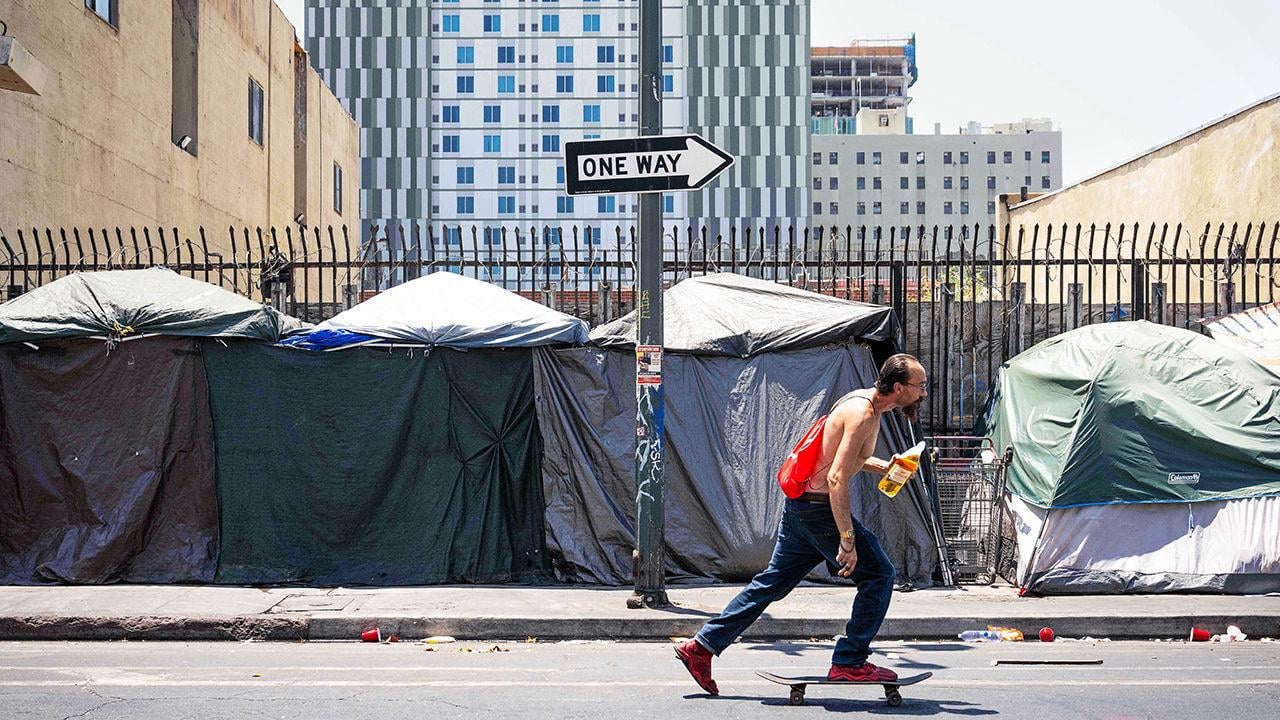
American cities are criminalising homelessness. Will that help? | How a Supreme Court decision paved the way for more punitive policies
Posted by ONETRILLIONAMERICANS
American cities are criminalising homelessness. Will that help? | How a Supreme Court decision paved the way for more punitive policies
Posted by ONETRILLIONAMERICANS
4 Comments
> Roughly 771,000 Americans were homeless last year, more than any other year on record and an 18% increase from 2023. A national housing shortage is by far the biggest culprit, but the end of pandemic rental assistance, an increase in migration and natural disasters that displaced people also contributed to the surge. Only about 35% of homeless people in America sleep outdoors rather than in shelters or in temporary housing, but that is a higher proportion than most other places tracked by the OECD, a club of mostly rich countries. Rough sleepers are more likely than their sheltered peers to be homeless for long stretches of time. Many of them struggle openly with drug addiction and mental-health issues, which can make tent camps look and feel unsafe.
> The entrenchment of homeless encampments has frustrated voters who wonder where the billions of dollars poured into fixing homelessness have gone, and politicians whose careers may ride on fixing the problem. A backlash is well under way. Last June the Supreme Court ruled in Grants Pass v Johnson that punishing homeless people for sleeping outside when they have nowhere else to go was not a cruel and unusual punishment, which is banned by the Eighth Amendment. At least 163 municipalities have passed camping restrictions since then, according to the National Homelessness Law Centre, an advocacy group. Almost a third of those bans are in California, which has both more homeless people than any other state and the highest proportion of rough sleepers. The result is a country that, city by city, is trying to end unsheltered homelessness by force.
> To understand how these bans are being implemented, consider Fresno, where there are more homeless people in the region than there are beds. Residents report encampments they want cleaned up to the city via an app. A special team of police officers and sanitation workers investigate these spots and make arrests. Sergeant Steven Jaquez, who runs the team, argues that the camping ban gives his officers leverage. Violators can face up to $1,000 in fines—an astronomical amount for someone living on the street—or one year in jail. But in lieu of punishment they can ask police to take them to a shelter where they can inquire about housing or treatment. If they complete a rehab programme, their citation goes away. But if, like Ms Valenzuela, they refuse the offer, tickets can accrue. As of April 25th the city attorney’s office had filed charges in 266 cases. Only 33 of them were resolved because the person charged had accepted services. How harshly people will be punished is still unknown: the first case to make it to trial was dismissed by the judge for taking too long.
> Fresno’s leaders consider the camping ban a success, and insist that unsheltered homelessness is declining. But the most recent official statistics are two years old. Dez Martinez was once homeless and now advocates for her “street family” in Fresno. She reckons people are just hiding from the cops by moving under highway overpasses and tying their belongings to trees. Jerry Dyer, Fresno’s Republican mayor and its former police chief, doesn’t mind if that is true. “I’m sure there are people that have now chosen places that are less visible publicly, which is not a bad thing” for businesses, he offers, though he says he would prefer that people seek help. Yet if homeless people go into hiding it becomes hard to know how many of them there are. The city can claim success, but the problem may persist in the shadows.
> Mr Dyer contends that it is more compassionate to coerce homeless Fresnans to accept housing or treatment than allow them to suffer on the streets. Despite their different political parties, he sounds remarkably like Gavin Newsom, California’s Democratic governor, who argued that lower court rulings previously limiting enforcement against camps had “tied the hands” of officials. The Cicero Institute, a conservative think-tank in Austin, Texas, started by Joe Lonsdale, a tech billionaire, pushes a similar argument as it works to pass state camping bans. “We have a deep discomfort with forcing people to do things,” admits Devon Kurtz, who studies homelessness at Cicero. But, he asks fairly, “Is it okay to let them die out there?”
> That so many Republicans and Democrats are on the same side illustrates how frustration with the status quo has scrambled the politics of homelessness. Many on the left were once leery of clearing encampments for fear that breaking up communities and trashing people’s belongings could be traumatic for them. That argument is little-heard these days. The risk is that these camping bans prove to be too big a stick, and eventually follow the same pattern as anti-vagrancy laws passed during the 19th century, filling jails and prisons with people whose crime is having nowhere to live. “There’s a very sordid history of moving from criminalising people who are destitute, to then institutionalising them,” says Dennis Culhane of the University of Pennsylvania.
!ping YIMBY
The answer to a question in a headline is always no
I would build more housing and institute mandatory drug treatment programs and/or mental health treatment.
But people would rather do nothing and then complain about problems than pay a cent more in taxes or build an apartment building in the historical parking lot.
I’ve never read a public discussion about homeless people that suggested to me that Americans believe homeless people are humans.