
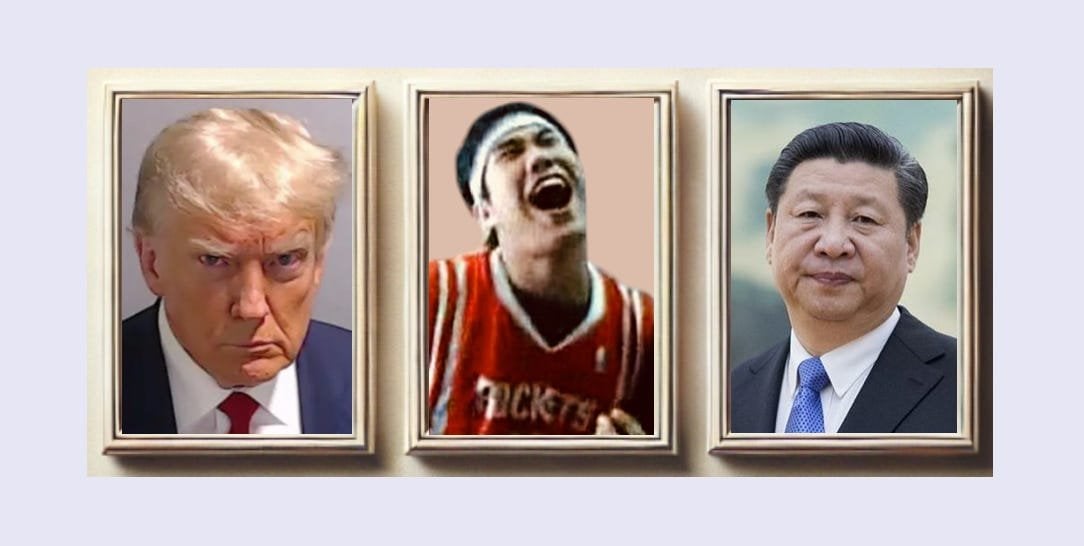
Growing up, America’s silence on the Opium Wars spoke louder to me than the actual events that took place. Like a bully from distant memory, what’s more relevant is often not the past but rather the present attitude. Yet as I dug into the history, I learned that America had been more of a follower during the conflicts, and it was one of the more principled actors in an era where the strong preying on the weak reflected the norm. The US may also have played an important role—out of fear of missing out on its fair share of the Middle Kingdom pie—in preventing China from being permanently carved up among colonial powers. It could certainly be argued that American missionaries did quite a bit of good in China too, building infrastructures such as hospitals and universities, and replacing backward traditions with modern thinking—in the same way that the Chinese government may claim of its activities in Tibet or Xinjiang in the present. The situation is further complicated by the CCP’s campaign to accentuate America’s involvement, as well as recent tensions between the US and China, such that it may not be as simple as acknowledging an injustice from one and half century ago (though maybe it is). Rather, the focus shifts to how do you reconcile a relationship with uneven starting points? What are the implications for Chinese and American worldviews?
While, unquestionably, the Opium Wars are not excuses for human rights abuses in China, they are sources of mistrust when Western nations raise moral high ground to justify anti-China policies. They are sources of irony when America blames China for its recent opioid crisis without a nod to the past. And they are sources of indignation when American politicians suggest that prosperity in China is only possible because of the mercy the West extended to China by granting its entrance into the World Trade Organization.
As China grew stronger through generations of hard work, resilience, and IP thefts (more on this later), the Opium Wars offered a different perspective—not how China had suffered, but how powerful China once had been. The rise and fall of dynasties has long been ingrained in the Chinese’s understanding, accepted as a part of life as natural as sunrises and sunsets. However, China’s latest ascendancy propels it toward a potential clash with America—not only because of America’s professed belief in linear progress, but also because the same belief implicitly assumes perpetual American leadership.
Since President Xi came into power in 2012, China has become even more assertive, ironically drawing inspirations from the Monroe Doctrine to expand its sphere of influence. Alarmed by China’s rising ambitions, America has coincidentally taken a page out of China’s playbook, looking back thousands of years into the cycles of history. The Thucydides Trap, spawned in the fate of Sparta and Athens, observed that in 75% of instances of when a rising power meets an established power, it has resulted in war.
While I appreciate the deep-dives into what conditions and circumstances led to the other 25%, I cannot resign myself to the best case scenario of a mere 1/4 chance the US and China will avoid war, not when the overwhelming majority of people on both sides prefer peace, not when we have so much in common, not when I and millions like me, stand as living proof that the US-China relation is not zero-sum.
Although diplomacy has traditionally been the task of the few — those who made it to the inner circle — globalization and technological advancements have leveled the playing field. In a world that is becoming increasingly interconnected, I am optimistic about the possibility for (linear) progress through a new form of diplomacy, one rooted in the shared experiences of ordinary people — from the dance steps of Oppa Gangnam Style, to the international solidarity for Ukraine, to the unlikely cultural moment on RedNote.
Posted by not_zero_sum
1 Comment
Disclosure: I’m the ordinary Chinese American. As US-China relations deteriorated during the first Trump term, I began writing to share the perspective of someone innately invested with 3 main premises:
1. US-China is not zero-sum, Chinese American = living proof.
2. The US model where people from around the world come together to build a thriving society could the model for the world.
3. There’s a divergence between the self-interests of political leaders (Trump/Putin/Xi) and the aspirations of ordinary people, and we need to find a way to give the people more voice.
#1 is straightforward, #2 is pretty much moot with the re-election of Trump, #3, however, has become more relevant.
Look forward to discussions and feedback.