
Another Redditor in the "overemployed" sub told it like it is here.
You often hear remote workers say "As long as I meet my deadlines, it's nobody's business what else I'm doing with my time".
What they aren't telling you is, they let their boss have the impression that a two day project takes ten days (or more). This, along with automation, is the secret sauce for the "overemployed" movement, for example.
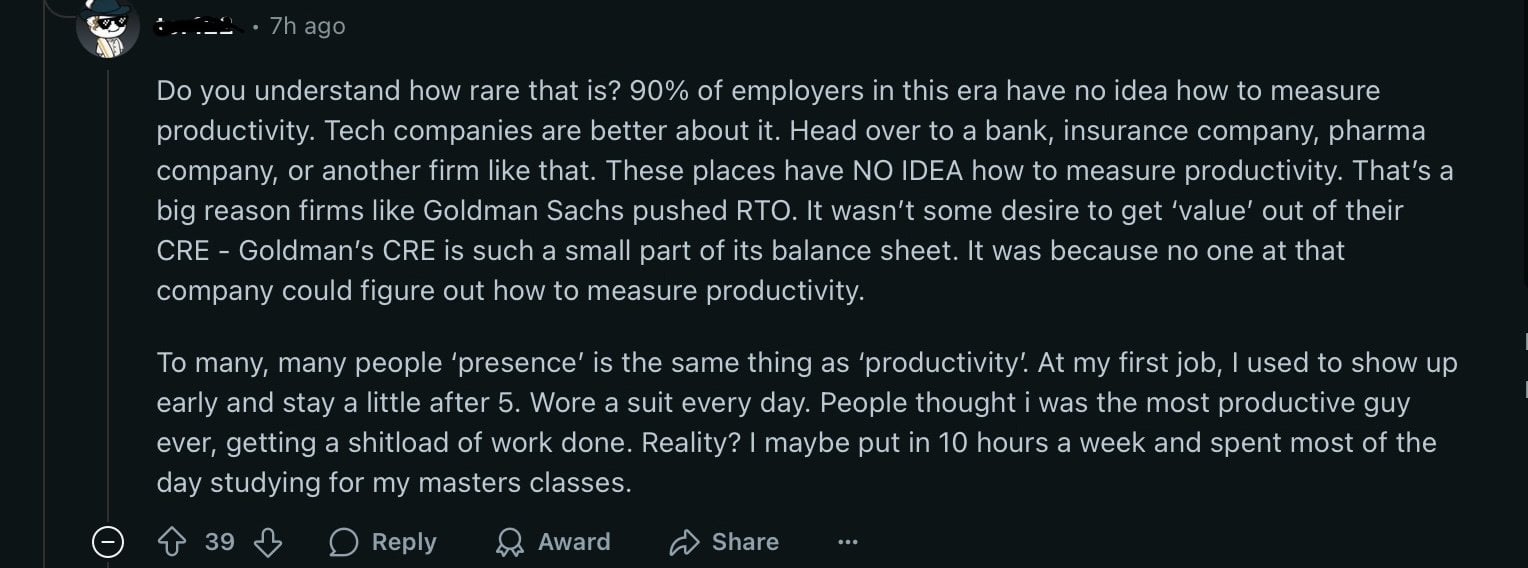
Tech and automation are a new frontier. 90% of companies have no clue how to estimate how long projects will take. Nor do they understand how to accurately measure productivity outside of bullshit metrics that can be fudged or completely circumvented. That's why they default to RTO. They assume that by being able to monitor employees in the office, they take the 'question mark' of remote work productivity out of the equation.
With that being said, I don't think RTO will actually help productivity much. Jobs that can be remote should all be remote. But this is the main reason companies want RTO and no one talks about it. That and to some extent the soft layoffs.
Posted by tantamle
4 Comments
Right on! Conspiracy page has been dropping bangers. Keep it coming
>”As long as I meet my deadlines, it’s nobody’s business what else I’m doing with my time”
It’s always like this, If there is logic in a business. You have a plan, meet the deadlines launch the product at the scheduled time etc. There is no logical point for a successful business having their employees nailed in a chair in an office for 8 hours. And that goes the other way around. Sometimes you may have to work more than 8 hours to meet a deadline.
The employee regulations imposed by governments in the private sector all they have done is to detriment productivity and being an obstacle to human progress.
No, the push for RTO is to keep the commercial real estate market from collapsing.
It basically comes down to a visibility bias. Some management (usually old school types) associate physical presence with productivity, even if data shows remote work can be equally or more productive.
RTO is about managerial control as it’s easier to observe and manage employees in person, especially in organizations with less experience managing remote teams.
There’s also a company culture and cohesion factor with some management (again, usually the old school “we’re family” types). That type of management often fears that company identity and values weaken over time with remote-only setups and that in-person work is believed to build stronger relationships and a sense of belonging. This is why you’ll always hear “collaboration and innovation” cited as reasons for RTO.
I’ve been working remotely for over 5 years now. I would not go back to an office, the time trade off is just not worth it to me. It would take me longer to find a job, but I’m confident I can find companies who are interested in attracting a wider pool of talent.