
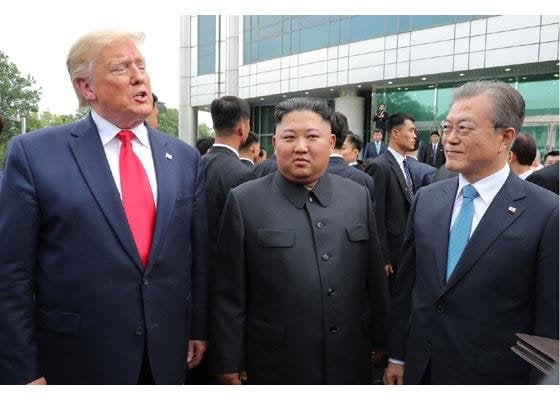
There are foreign news reports that the Donald Trump administration is internally discussing resuming dialogue with North Korea. The U.S. political media outlet Axios reported on April 27 that Andreas Bengtsson, the Swedish ambassador to North Korea who represents U.S. interests there, visited Washington last week to assess the American stance on potential U.S.-North Korea talks. President Trump, who has publicly expressed willingness to talk with North Korean leader Kim Jong-un, recently conveyed a concrete intention to pursue talks to his staff. According to Axios, the White House National Security Council (NSC) and State Department officials have held several internal meetings following this directive.
In the midst of this development, a new book titled What Does Trump Want from Kim Jong-un? has been published. The author, Dong-Ki Kim, is a lawyer who graduated from Seoul National University’s College of Law and passed both the Korean bar exam and the New York State bar exam. He has served as the head of the U.S. branch of Korea IT Venture Investment and is now the CEO of Salis Partners. He studies international finance, politics, and economics, and has also authored books such as The Power of Geopolitics and The Power of the Dollar. While he may not be a university professor—and thus may not be considered a traditional academic in the Korean context—his background may actually be more suitable for grasping the realities of the Korean Peninsula from a macro and historical perspective. This book was first published on February 17, 2025.
These days, many people are curious: Why does Trump want to talk to Kim Jong-un again? Is it because he wants to win the Nobel Peace Prize? Is he eyeing potential economic gains, such as real estate development in the Wonsan-Kalma region of North Korea? Is he afraid that North Korea might attack the U.S. with nuclear weapons?
According to the book, none of these are the main reasons. Of course, the U.S. wants to maintain the Nuclear Non-Proliferation Treaty (NPT) regime, which allows only major powers to possess nuclear weapons. But that alone doesn’t explain Trump’s strong eagerness to engage with North Korea.
The U.S. is currently in a hegemonic competition with China. From a national interest standpoint, Trump strongly desires to contain China, and engaging with North Korea serves that goal. The book concludes that Trump’s outreach to North Korea is part of a broader strategy to draw the entire Korean Peninsula—including both South and North Korea—closer to the U.S. and away from China. If successful, this would be a highly cost-effective East Asia strategy for the United States.
During his first term, Trump met with Kim Jong-un three times in 2018. At the time, most U.S. foreign policy elites, the media, and Congress did not support his approach. But during these talks, the U.S. discovered a previously unknown dimension of North Korea. A revealing moment occurred in March 2018 when CIA Director Mike Pompeo visited Pyongyang and spoke with Kim Jong-un. Part of their conversation is as follows:
Pompeo: “China says you would be very happy if the U.S. withdraws its troops from South Korea.”
Kim Jong-un: (banging the table and laughing loudly) “China is lying. China wants U.S. troops out so it can treat the Korean Peninsula like Tibet or Xinjiang. I need U.S. troops to protect myself.”
This was a shocking remark. It showed that North Korea wasn’t aligning closely with China, but instead felt the need to counterbalance China—even by relying on U.S. power.
After encountering such revelations, U.S. experts began to shift their thinking. They recognized that relations between North Korea and China were far from friendly and were in fact quite strained. This led to a new assessment: perhaps North Korea could be used to help counter China. In other words, the U.S. “rediscovered” North Korea’s strategic value.
Former U.S. Forces Korea Commander Vincent Brooks and others began to emphasize the friction between North Korea and China and advocated for a major U.S.-North Korea deal. In January 2022, the U.S.-China Economic and Security Review Commission, an official body under the U.S. Congress, issued a report recommending dialogue and compromise with North Korea.
The author argues that Trump’s approach to Kim Jong-un is not merely a personal whim, but aligns with a broader shift in U.S. expert opinion.
Meanwhile, many South Korean conservative commentators are worried that the U.S. might suddenly resume talks with North Korea. They fear that if the U.S. accepts North Korea as a nuclear power and reaches a compromise, South Korea will be left out in the cold and its national security will be jeopardized—similar to what happened to Ukraine, which was effectively abandoned by the U.S.
But the book’s author has a different perspective. Can South Korea realistically prevent the U.S. from engaging in dialogue with North Korea? Of course not. Instead, the author argues that South Korea should actively support U.S.-North Korea talks and use the momentum to end hostilities on the Korean Peninsula and establish a peace regime. As for concerns about North Korea’s nuclear weapons—countries like the U.S., France, and India also possess nukes, yet they don’t pose a threat to South Korea. That’s because South Korea maintains friendly political relations with them. Likewise, improving inter-Korean and U.S.-North Korea relations could reduce the North Korean nuclear threat.
Some argue that since North Korea is armed with nuclear weapons, South Korea must arm itself as well. But the author suggests we avoid such simplistic logic and instead consider alternative solutions, like the one he proposes.
The book consists of four chapters:
• Chapter 1 reviews U.S.-China relations since the Nixon administration.
• Chapter 2 outlines North Korea-China relations since the Korean War.
• Chapter 3 discusses the history of U.S.-North Korea contacts.
• Chapter 4 examines South Korea’s diplomatic and security challenges.
However, one might raise questions about a particular point. After his re-election campaign began, Trump proposed a global multilateral nuclear disarmament initiative, claiming that “there are too many nuclear weapons, and they are dangerous and costly.” He suggested inviting not just the U.S., Russia, and China, but also smaller nuclear powers like India, Pakistan, Iran, and North Korea to the negotiation table. According to a White House statement on March 18, Trump even discussed this idea with Russian President Vladimir Putin, who agreed.
This suggests that while the U.S. does indeed want to use North Korea to contain China, there’s also a broader global dimension to its strategy. Since these developments occurred after the author completed the manuscript, it would be beneficial to see them analyzed in a future edition of the book.
Posted by Freewhale98
10 Comments
I swear to god we’re two years into some Terra Invicta fever dream
https://preview.redd.it/g3uu0hjx982f1.jpeg?width=905&format=pjpg&auto=webp&s=9d411a5998782ca8714be0417ff33bfe49a90abf
Allying with North Korea to counter China is like allying with South Ossetia to counter Russia.
imo, this is Kim telling Trump what he wants to hear to get concessions out of him without actually doing anything to counter China.
This might be the dumbest thing that I have heard Trump say he wants to do.
>lawyer who graduated from Seoul National University’s College of Law and passed both the Korean bar exam and the New York State bar exam
>U.S. branch of Korea IT Venture Investment and is now the CEO of Salis Partners
>his background may actually be more suitable for grasping the realities of the Korean Peninsula from a macro and **historical** perspective
I am not going to pretend like I’ve read this book but a lawyer who’s gone into business doensn’t strike me someone to give a correct historical analysis. Let alone being ‘more suitable’ than (Korean) historians.
>
Some argue that since North Korea is armed with nuclear weapons, South Korea must arm itself as well. But the author suggests we avoid such simplistic logic and instead consider alternative solutions, like the one he proposes.
While arming themselves is far from the only solution, I do think it’s a bit simplistic to argue that NK having nukes doesn’t have to be a problem since SK is friendly with other nuclear countries. As Russia is showing in both Ukraine and other nations in their former sphere of influence – if you give a hostile country an inch, they’ll take a mile. Ukraine *tried* to appease Russia, they *tried* to make a deal and get more friendly relations. Russia ended up betraying that trust.
Nothing tells me NK is a reputable regime which’ll act in good faith.
I’m sure a regime that is basically propped up by China will be quick to join an alliance against them.
Of all the stupid ideas proposed during the 2nd Trump Administration this is the dumbest so far.
This is so stupid. China is… right fucking there and is much more stable in FoPo
Pretty interesting anecdote about Pompeo and Kim
No idea if it’s true but it’s interesting!
https://preview.redd.it/4acchg7tc82f1.png?width=320&format=png&auto=webp&s=c97968c13d4ee9ec1986bb824dc1c0630c8f5acb
https://preview.redd.it/iiow5rm9d82f1.jpeg?width=480&format=pjpg&auto=webp&s=35f8dd3530cec25d46831025ce4f0683e1a25ee5