
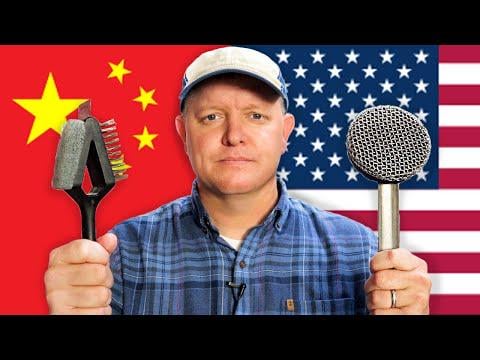
I'm conflicted about this.
If you're familiar with his channel, he's very scientific, and doesn't have any MAGA agenda. The key issues he highlights are that tool and die making technology has effectively gone exitinct in America. He almost could not find anyone who can make a tool and die for injection molding.
While i believe in globalization, comparative advantage, and the ultimate goal of keeping prices as cheap as possible for the consumer, this knowledge going extinct sounds like national security issue.
But then again, I'm not sure. The US excels in advanced manufacturing. Like Boeing, SpaceX. They make the tools for that and all.
Surely, if there's a war, US can figure out a way to train injection mold makers? Like what else can US govt do? Keep subsidizing grill scrubbers?
What do you think?
Posted by uncle-iroh-11
8 Comments
I think it doesn’t make sense economically, only as defence. Better to pick up machining or injection molding as a hobby then buying more and more guns.
[Claude](https://claude.ai/) says:
“The US still has injection molding expertise and companies, but there’s been a significant shift in the industry over the past few decades.
What likely happened is that much of the US’s high-volume, cost-competitive injection molding capacity has indeed moved overseas – particularly to China and other Asian countries. This is especially true for consumer goods, automotive parts, and other products where cost is a major factor.
The US capabilities that remain tend to be concentrated in:
High-precision, low-volume specialty parts
Medical devices and FDA-regulated products
Aerospace components
Rapid prototyping and short-run production
High-end automotive applications
So the guy in the video was probably right that for a grill part – which would typically need to be produced in high volumes at low cost – the domestic US capacity is limited or expensive compared to overseas options. Many US injection molders have moved to higher-value, specialized work rather than competing on commodity parts.”
So we still have the hard part, but we’ve lost the easy part. It would be somewhat painful to scale up in a crisis, but a country can expand production faster than it can develop people with the capacity to know how to engineer complex solutions to difficult problems.
That being said, there is a case for friend-shoring production to Europe, pro-US Asia, and Latin America. There’s also a case for expanding legal immigration so that people making a dollar a day in failed states/kleptocracies can come to the US and expand the labor supply enough for such low-value-added work to be economical within the US.
The video is quite good from an engineering perspective, but quite lackluster from an economics one. He talks about how his parents worked in factories and hopes that by bring manufacturing back to the USA other people would have the same opportunities as his parents. But bringing manufacturing back to the US would not bring back most of the jobs, because the main driver of the decline of manufacturing jobs is automation not China. The US actually is producing more then it has produced ever before.
Panicking about national security because of the decline of manufacturing jobs is silly, because the US military consumes and produces surprisingly when compared to the general US economy. There are more then enough tool and dye makers for the military.
Why does he hate the global poor?
Don’t have the time to watch this yet, but seems like economic nostalgia more than anything
Ill just link to the comment i made about this a few days ago
https://www.reddit.com/r/neoliberal/comments/1l65zli/comment/mwq1dtn/?context=3
“…figure out a way to train injection makers”
Meanwhile Shenzen revs up in a way unseen since 1944 Detroit. We can’t afford to start hitting the gym on game day
I kinda doubt he cant find an American tool and die for the mold, we’re crawling in those kinds of places in Michigan.
Edit: yeah, Alabama has just never been the center of that industry, sorry. Come to metro Detroit or Grand Rapids.