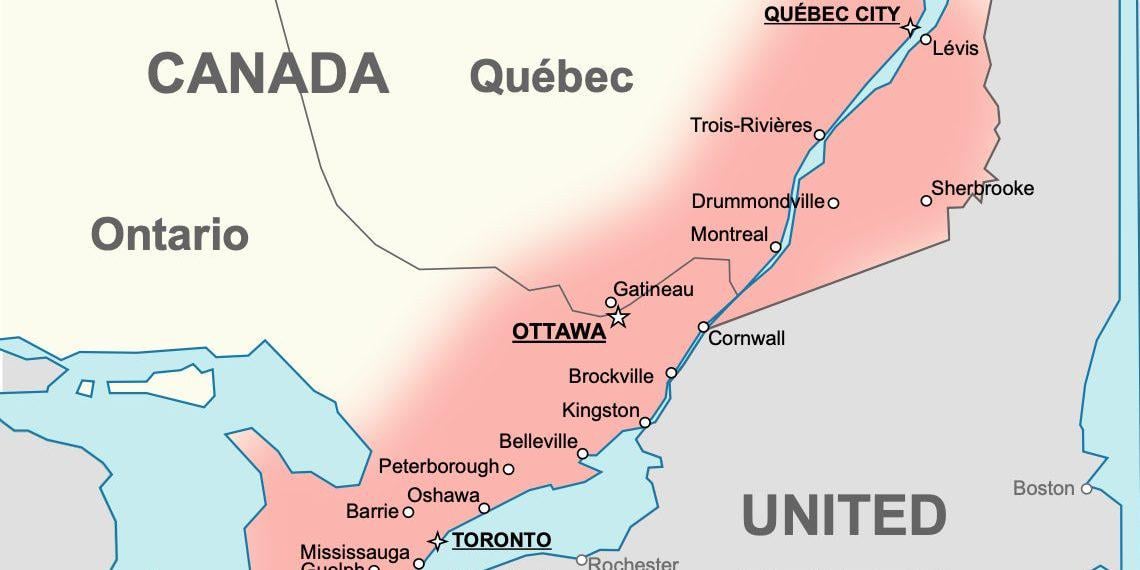
>The Alto project is like a piece of fake antique furniture; it looks great from a distance until you get up close and scratch the veneer. Most of aforementioned direct and indirect benefits have been estimated most recently in a C.D. Howe Institute report. Their most optimistic estimate—assuming fares are not too high—of direct plus indirect benefits, realized over 60 years amounts to about $27-billion. But hey, let’s suppose this is a huge underestimate, and that total benefits [of high speed rail in the Windsor-Quebec corridor] turn out to be double.
>At $54-billion, Alto’s total benefits would still be outweighed by the costs, which the Alto organization itself has estimated to be $60-million to $90-billion. Other cost estimates by non-advocates are closer to $120-billion, and with other examples like the ongoing high-speed rail project in California, there are good reasons to expect delays and cost overruns. But it’s not just that costs outweigh benefits. In economics we consider opportunity costs. What else could we do with $90-billion?
>The same C.D. Howe study found that revamping existing rail systems in the same corridor could give us economic benefits of $17-billion, but at a fraction of Alto’s costs. Okay, you say, but what about the geo-political climate, national unity, supporting steel and aluminum industries? The problem here is that while Prime Minister Mark Carney and the premiers want shovel-ready infrastructure projects, the initial planning phase for Alto—no actual construction—is scheduled to take five years.
>Sure, Alto might aid in strengthening international alliances, but remember opportunity costs: if we don’t spend $90-billion on Alto, then we have a lot of resources in the kitty to woo Europe. If these arguments don’t persuade you, consider the evolution of technology. In the early 1950s, it would have been a huge mistake to invest heavily in passenger steam ships and associated infrastructure. Why? Because we knew jet aircraft technology was poised to revolutionize international travel forever.
>In far less time than it will take to build Alto, we will have electric aircraft capable of travelling between Toronto and Montreal in just over an hour. In fact, Heart Aviation’s ES-30 electronic passenger plane, with a hybrid range of 800 kilometres, has already had its first fully electric test flight in New York state.
>Suddenly, a three-hour train trip seems less appealing.
!ping Can&Ferroequinologists
Maximilianne on
Feel like shit, just wanna be like Spain where even little towns have electrified train lines and even small towns of like 80000 people have an HSR line 😭
tomtomson-03x on
I want this, but to extend to Chicago.
wayoverpaid on
Instead of this well understood, highly functional technology, how about if we hope that this future tech will be available one day!
I’ve seen this show before.
StarbeamII on
Electric plane is still a plane, which means:
* Having show up 2 hours early to go through airport security
* Slow boarding and unboarding
* Cramped seating
* Airport delays
* Less frequent and lower capacity service than a train
* No service to intermediate stops
SadBowler5381 on
Phases 1 (already completed) and 2 (under construction) of the Moroccan HSR network will total 600km and cost 8b dollars
This proposed HSR line of 800km will cost at a minimum 60b dollars
That’s why it seems like it is a bad idea cost opportunity, because the costs are almost 10 times what other nations pay
Of course, anything that is a good idea becomes a bad one when it is 10 times more expensive!

6 Comments
>The Alto project is like a piece of fake antique furniture; it looks great from a distance until you get up close and scratch the veneer. Most of aforementioned direct and indirect benefits have been estimated most recently in a C.D. Howe Institute report. Their most optimistic estimate—assuming fares are not too high—of direct plus indirect benefits, realized over 60 years amounts to about $27-billion. But hey, let’s suppose this is a huge underestimate, and that total benefits [of high speed rail in the Windsor-Quebec corridor] turn out to be double.
>At $54-billion, Alto’s total benefits would still be outweighed by the costs, which the Alto organization itself has estimated to be $60-million to $90-billion. Other cost estimates by non-advocates are closer to $120-billion, and with other examples like the ongoing high-speed rail project in California, there are good reasons to expect delays and cost overruns. But it’s not just that costs outweigh benefits. In economics we consider opportunity costs. What else could we do with $90-billion?
>The same C.D. Howe study found that revamping existing rail systems in the same corridor could give us economic benefits of $17-billion, but at a fraction of Alto’s costs. Okay, you say, but what about the geo-political climate, national unity, supporting steel and aluminum industries? The problem here is that while Prime Minister Mark Carney and the premiers want shovel-ready infrastructure projects, the initial planning phase for Alto—no actual construction—is scheduled to take five years.
>Sure, Alto might aid in strengthening international alliances, but remember opportunity costs: if we don’t spend $90-billion on Alto, then we have a lot of resources in the kitty to woo Europe. If these arguments don’t persuade you, consider the evolution of technology. In the early 1950s, it would have been a huge mistake to invest heavily in passenger steam ships and associated infrastructure. Why? Because we knew jet aircraft technology was poised to revolutionize international travel forever.
>In far less time than it will take to build Alto, we will have electric aircraft capable of travelling between Toronto and Montreal in just over an hour. In fact, Heart Aviation’s ES-30 electronic passenger plane, with a hybrid range of 800 kilometres, has already had its first fully electric test flight in New York state.
>Suddenly, a three-hour train trip seems less appealing.
!ping Can&Ferroequinologists
Feel like shit, just wanna be like Spain where even little towns have electrified train lines and even small towns of like 80000 people have an HSR line 😭
I want this, but to extend to Chicago.
Instead of this well understood, highly functional technology, how about if we hope that this future tech will be available one day!
I’ve seen this show before.
Electric plane is still a plane, which means:
* Having show up 2 hours early to go through airport security
* Slow boarding and unboarding
* Cramped seating
* Airport delays
* Less frequent and lower capacity service than a train
* No service to intermediate stops
Phases 1 (already completed) and 2 (under construction) of the Moroccan HSR network will total 600km and cost 8b dollars
This proposed HSR line of 800km will cost at a minimum 60b dollars
That’s why it seems like it is a bad idea cost opportunity, because the costs are almost 10 times what other nations pay
Of course, anything that is a good idea becomes a bad one when it is 10 times more expensive!