
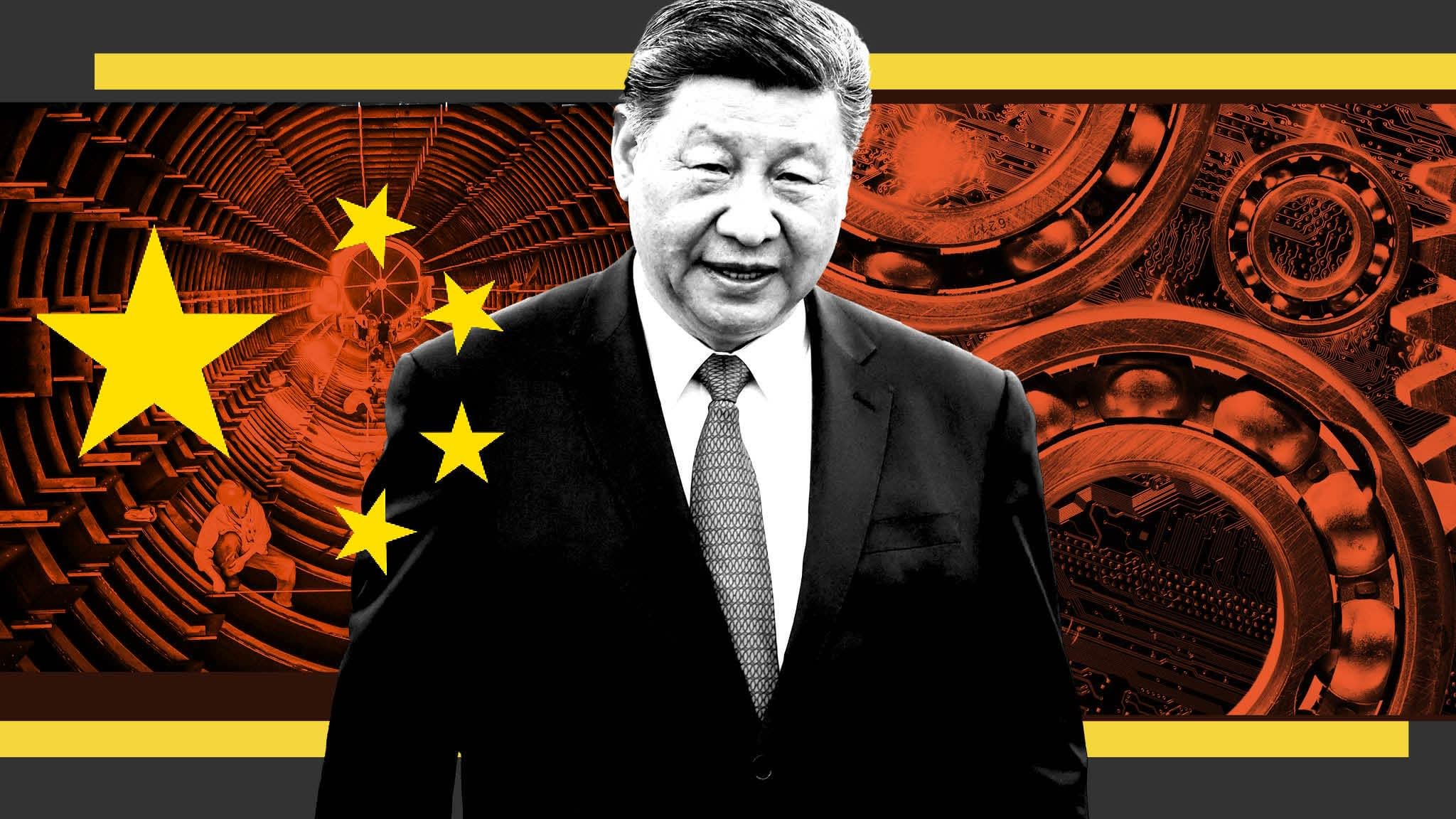
The vulnerabilities holding back Chinese industry | Despite its prowess, China has not been able to overcome dozens of ‘choke points’ that are the essential building blocks of modern manufacturing
Posted by ONETRILLIONAMERICANS
The vulnerabilities holding back Chinese industry | Despite its prowess, China has not been able to overcome dozens of ‘choke points’ that are the essential building blocks of modern manufacturing
Posted by ONETRILLIONAMERICANS
1 Comment
> In the early 1950s as the Communist party set out to rebuild a China ravaged by years of war, Mao Zedong, the revolutionary hero and party chairman, bluntly assessed the bleak state of the nation’s industry: “We can make tables and chairs, teacups and teapots . . . But we cannot make a single motor car, plane, tank or tractor.” Soon the No 1 Tractor Plant and an adjacent factory producing ball bearings was established in Luoyang, an ancient city in the central Henan province — one of 156 industrial projects conceived under the party’s First Five Year Plan, according to Karina Khasnulina of Leipzig University. Just a few years later, in 1958, the first Chinese-made tractor, named Dongfang Hong, “the East is Red”, rolled off the production lines.
> Seventy years on and China has risen to be a global powerhouse, the world’s second-biggest economy and one of two true military superpowers. And yet, as the country’s leaders in Beijing are acutely aware, the nation has not been able to overcome dozens of industrial “choke points”.
> From a western standpoint, the good news is that these choke points are ultimately holding back China’s quest for independence and leave it vulnerable to US pressure in an era of trade wars and exports controls. As well as cutting edge computer chips, they also include a series of obscure components and materials that are essential building blocks of modern manufacturing.
> The bad news, for the west and its companies at least, is that China is addressing these problems in a methodical and systematic manner and is using tools such as AI to advance more quickly. Leading European, Japanese and American rivals, which have long been insulated from competition from China because of problems with quality and inconsistent yield in Chinese factories, are now on high alert. “What should give us pause is that the dynamic of China’s technological dependency on the west is rapidly changing,” says Elisa Hörhager, the Beijing-based chief representative in China of the Federation of German Industries, known as BDI. “Many foreign companies still hold a clear edge when it comes to high-quality industrial products, thanks to their reputation for precision and engineering excellence. But Chinese competitors are catching up fast.”
> While several choke points, such as advanced semiconductor manufacturing, remain years, if not decades, from being conquered, others appear close to being resolved. These products include carbon fibre used for aviation and ball bearings. Last month, Chinese leader Xi Jinping chose the factory floor of the current iteration of the Mao-era Luoyang factory, now operated by the state-backed Luoyang Bearing Group, to issue a rallying cry for China to address any remaining potential choke points. The visit to Luoyang by Xi, China’s most powerful leader since Mao, was both symbolic and timely.
> Successive American presidents have steadily expanded export controls to restrict access to cutting-edge technologies, fearful that China’s technological might benefits the country’s military and threatens US national security. These controls — or the threat thereof — have driven Beijing to throw more resources into mitigating its vulnerabilities than they would have otherwise, says Kyle Chan, a researcher in Chinese industrial policy at Princeton University. The motivation for Xi’s quest for industrial self-sufficiency has only intensified since Donald Trump returned to the White House and launched a global trade war that threatens to accelerate the decoupling of the world’s two biggest economies.