
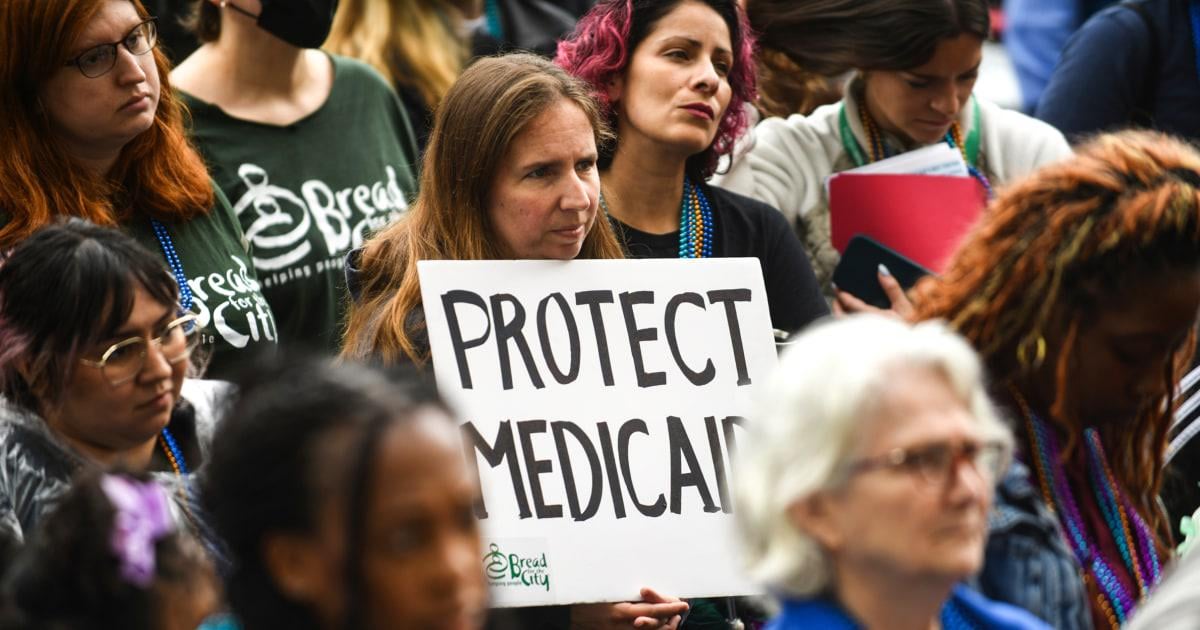
President Donald Trump is expected Friday to sign into law his sprawling domestic policy bill, which includes nearly $1 trillion in cuts to Medicaid, the government health insurance program for low-income and disabled Americans.
Dubbed the “big, beautiful bill,” the new legislation will extend Trump’s 2017 tax cuts and make up for them in part by slashing federal Medicaid funding, introducing copays for some services and — for the first time — implementing nationwide Medicaid work requirements. The final version of the bill didn’t include an estimate of coverage losses; an earlier Congressional Budget Office report projected that about 11 million people could lose their health coverage and become uninsured by 2034 because of the program cuts.
Over the 10 months Arkansas’ work requirement was in place, more than 18,000 people in the state lost Medicaid coverage. Georgia hasn’t done a good job keeping track of how many have lost coverage, but enrollment remains low, said Leighton Ku, director of the Center for Health Policy Research at the Milken Institute School of Public Health at George Washington University.
To justify the cuts, Republicans have argued that they’re not taking Medicaid from those who are rightfully entitled to it — such as, they say, single mothers or the disabled — but from “young, able-bodied men” who they say are abusing the system. But as seen in Georgia and Arkansas, that’s not who is largely affected.
Likewise, in Arkansas, only 3% or 4% of the people on Medicaid in 2018 weren’t working and didn’t qualify for the exemptions under the state program, said Dr. Benjamin Sommers, a physician and health economist at Harvard T.H. Chan School of Public Health. Sommers published a study in the New England Journal of Medicine in 2019 looking at the impact of Arkansas’ work requirements.
His research found that about 40% of the other roughly 96% of people on Medicaid in the state were working the required 80 hours a month under the state program. The rest either had medical conditions that prevented them from working or had other responsibilities, such as school or caring for family members.
Implementing work requirements also didn’t result in a higher employment rate — one of the arguments Arkansas officials used in favor of the new work rules.
Posted by John3262005
4 Comments
https://preview.redd.it/gjf9ihah9raf1.png?width=5000&format=png&auto=webp&s=b1bc7cdb88718720078ff30864869604ed2755d1
Anyone who falls for this garbage and thinks these stupid rules they keep attaching actually fix “fraud” or whatever, isn’t even worth humoring. Idiotic peasant behavior.
How will this affect health care in blue states? Obviously a lot of red states have wanted to implement work requirements but only a few have succeeded in implementing them due to previous federal barriers. Now that they are mandated federally, how will this play out for states that are forced to implement them against their will?
> Implementing work requirements also didn’t result in a higher employment rate
Curious how realistic this could really be. Arkansas and Georgia do have a prime age employment ratios behind the national average (77% vs 80%), but I’m not sure how much higher it can really go.