
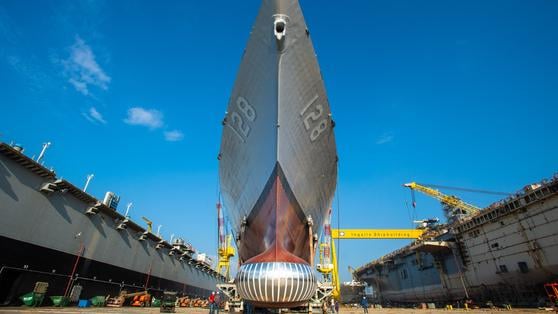
Although U.S. President Donald Trump has been advocating for a “revival of the shipbuilding industry,” analysis suggests that policy efforts to rebuild the sector are currently stalled.
On July 2 (local time), The Wall Street Journal (WSJ) reported that the number of staff in the newly established Office of Shipbuilding under the White House National Security Council (NSC) has recently been reduced from seven to two. President Trump set up this office in March to draft a shipbuilding revitalization plan, but it is reportedly still failing to function properly. The WSJ explained that the reduction came amid a sweeping purge of personnel within the administration who held policy views differing from Trump’s.
There is also analysis that the U.S. shipbuilding and shipping restoration policies are regressing due to clashes with other policy directions. On July 1, the Trump administration dismantled the U.S. Agency for International Development (USAID), which oversaw America’s foreign aid programs, and scaled back food aid policies — a move that reportedly dealt a blow to the U.S. shipping industry. A representative from Korea’s domestic shipbuilding industry commented, “U.S. shipping companies used to secure stable profits by handling the transport of USAID food aid, but going forward, they may be forced to halt vessels and lay off employees.”
Efforts to lift ship regulations have also recently lost momentum. In the U.S. Congress, both the House and Senate have introduced the “Open America’s Waters Act,” which would repeal the Jones Act — a law requiring that merchant ships operating between U.S. ports be built in America. While there have been repeated attempts in the past to repeal the Jones Act, they have consistently failed due to opposition from the shipbuilding industry and local interests. Yang Jong-seo, a senior researcher at the Export-Import Bank of Korea, remarked, “For the Korean shipbuilding industry to enter the U.S. ship construction market, regulations like the Jones Act need to be relaxed, but the relevant discussions are currently progressing very slowly.”
Meanwhile, Korean shipbuilders working to secure local shipyard infrastructure in the U.S. are struggling with facility upgrades. Hanwha Ocean, which acquired Philadelphia’s Philly Shipyard in December last year, has two docks (ship construction facilities), but one has been left unused and neglected for several years, making it considerably outdated. Securing skilled local labor is also a major challenge. Warships delivered to the U.S. Navy are classified as defense materials, meaning only U.S. citizens are permitted to build them. An executive at one shipbuilding company said, “Even when we hire locally, many people quit, resulting in a turnover rate of nearly 100%. On top of that, the workforce isn’t highly skilled, and issues like drug use are persistent.”
Kim Yong-hwan, a professor at Seoul National University’s Department of Naval Architecture and Ocean Engineering, commented, “There’s no doubt that cooperation with the U.S. shipbuilding industry presents a huge opportunity for Korea, but expecting progress overnight is close to a myth,” adding, “We need to focus on building partnerships with a long-term perspective.”
P.S. It seems the contradictory and volatile government policy and the low quality of American workforce ( the main issues are high turnover. low skill level and drug addiction ) are causing troubles for South Korean shipbuilders who are trying to build ships in the US.
Posted by Freewhale98
2 Comments
The reality is that US Shipbuilding is a dried, barely breathing husk that would need literal billions and decades of continued work to revive for no immediate tangible benefit.
But again, what’s the fucking point of having allies if you don’t trust them when you actually need them?
It’s all about pride and nationalist bullshit where “those damned Koreans are stealing Murican jerbs.”
I am once again pleading with anyone that will listen to end *large portions of* the Jones Act