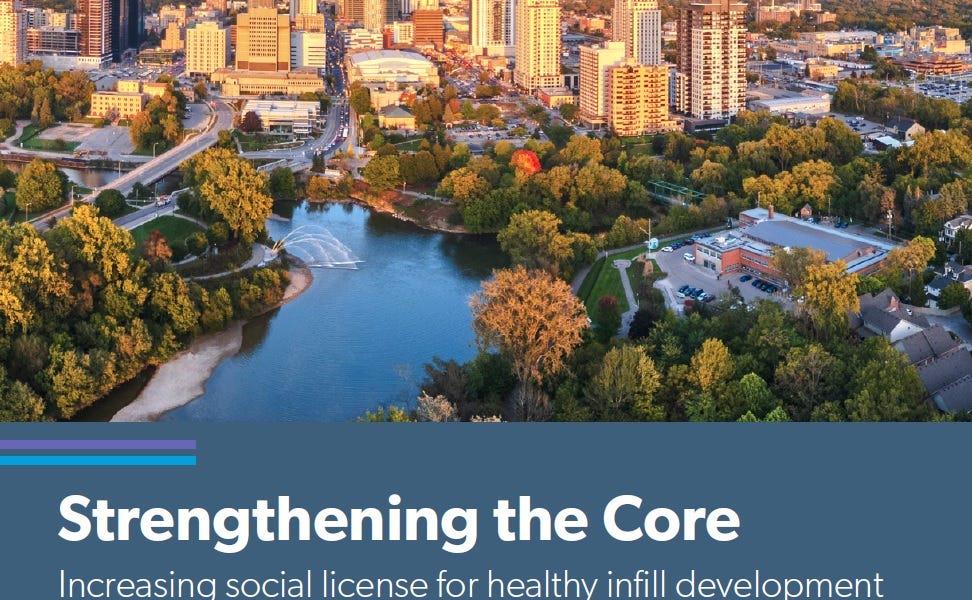
* Today, the Smart Prosperity Institute and the Missing Middle Initiative released the report Strengthening the Core: Increasing social license for healthy infill development in London, Ontario. MMI’s Jesse Helmer authored the report, which the Public Health Agency of Canada funded; it is available for download at the bottom of this page.
* The report describes and analyzes 4,059 planning committee decisions in the City of London, over almost 15 years and four distinct municipal council terms, to understand support for (and opposition to) residential infill development.
* Based on this analysis, the report makes seven recommendations.
* Create a collaborative, community-wide housing strategy, modelled after London’s Whole of Community System Response to homelessness.
* Accelerate zoning reform to permit missing middle and mid-rise housing as envisioned in the London Plan, especially on major streets.
* Prioritize infill on underutilized commercial and parking lots, where opposition is often lower and proximity to jobs is higher.
* Encourage office-to-residential conversions to minimize construction disruption and bring housing closer to employment hubs.
* Follow up with communities after infill is built, to evaluate real impacts and build trust through data and engagement.
* Celebrate success through awards and recognition, to highlight well-executed infill projects and set positive examples.
* Develop a focused built heritage strategy, using incentives and funding to preserve heritage assets while enabling adaptive reuse for housing.

1 Comment
* Today, the Smart Prosperity Institute and the Missing Middle Initiative released the report Strengthening the Core: Increasing social license for healthy infill development in London, Ontario. MMI’s Jesse Helmer authored the report, which the Public Health Agency of Canada funded; it is available for download at the bottom of this page.
* The report describes and analyzes 4,059 planning committee decisions in the City of London, over almost 15 years and four distinct municipal council terms, to understand support for (and opposition to) residential infill development.
* Based on this analysis, the report makes seven recommendations.
* Create a collaborative, community-wide housing strategy, modelled after London’s Whole of Community System Response to homelessness.
* Accelerate zoning reform to permit missing middle and mid-rise housing as envisioned in the London Plan, especially on major streets.
* Prioritize infill on underutilized commercial and parking lots, where opposition is often lower and proximity to jobs is higher.
* Encourage office-to-residential conversions to minimize construction disruption and bring housing closer to employment hubs.
* Follow up with communities after infill is built, to evaluate real impacts and build trust through data and engagement.
* Celebrate success through awards and recognition, to highlight well-executed infill projects and set positive examples.
* Develop a focused built heritage strategy, using incentives and funding to preserve heritage assets while enabling adaptive reuse for housing.
Other news:
https://nationalnewswatch.com/2025/07/15/carney-expects-u-s-trade-talks-to-intensify-ahead-of-august-deadline
https://www.ctvnews.ca/canada/article/carney-expects-us-trade-talks-to-intensify-ahead-of-deadline-and-35-threat/
https://nationalnewswatch.com/2025/07/15/inflation-rises-to-1-9-in-june-as-vehicle-price-hikes-accelerate
https://ca.news.yahoo.com/dnd-start-construction-f-35-080053983.html
https://nationalnewswatch.com/2025/07/15/carney-to-meet-with-incident-response-group-to-discuss-the-wildfire-situation
!ping Can&YIMBY