
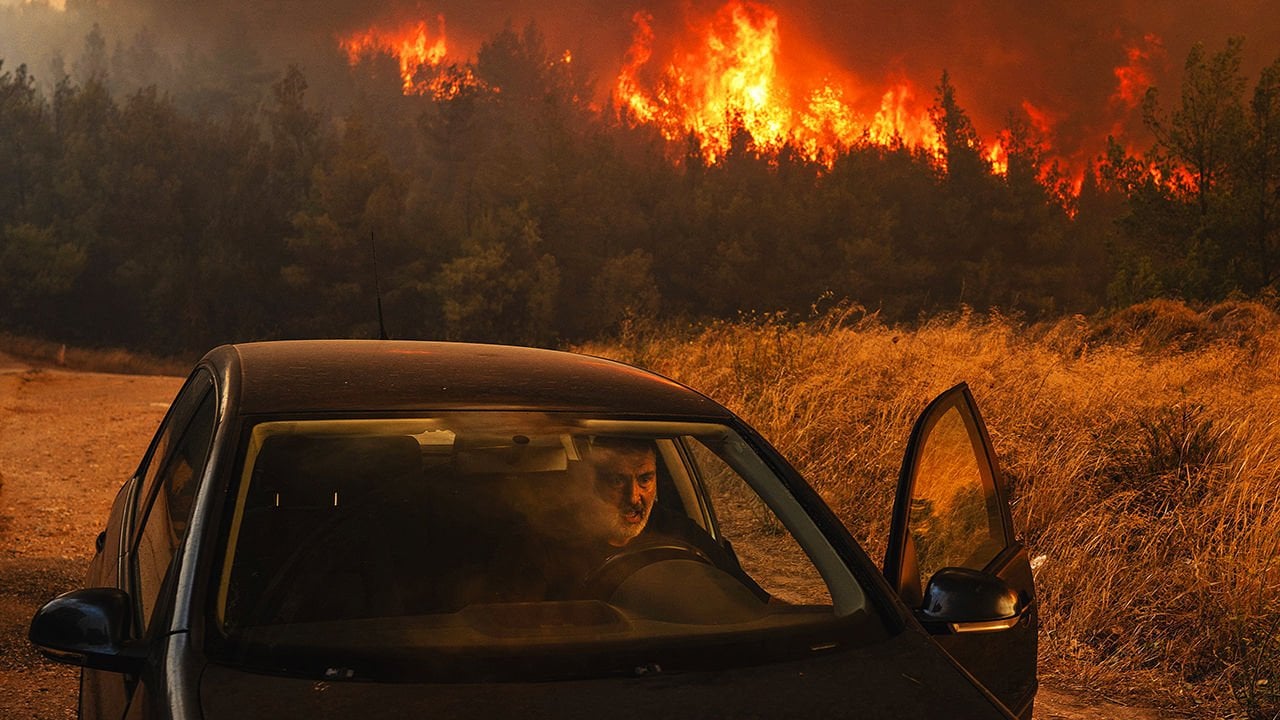
Wildfires are getting more frequent and more devastating | Climate change is accelerating the blaze
Posted by Independent-Low-2398
Wildfires are getting more frequent and more devastating | Climate change is accelerating the blaze
Posted by Independent-Low-2398
1 Comment
https://preview.redd.it/5pjgohkq20ld1.png?width=796&format=png&auto=webp&s=00375d12b801cce1e16fe438b079afd6625de129
>HUMANITY HAS lived and played with fire for at least 300,000 years. The oldest hearth, discovered at Qesem Cave in Israel and thick with wood ash, is as old as Homo sapiens. Burning never subsequently went out of fashion. Millennia later, the large-scale combustion of coal, oil and natural gas unlocked energy on a scale far beyond the hearth—and in so doing set in train profound changes to the planet’s climate. Humankind, activists are fond of saying, set fossil fuels alight and the world with it. They brandish placards with images of a burning blue marble.
>They have a point. Wildfires are more than a powerful visual metaphor for climate change. Data show they are increasingly fuelled by the extreme conditions resulting from greenhouse-gas emissions. What is more, some researchers believe that they are helping drive climate change themselves, powering feedback loops with destructive consequences for human health and ecological stability.
>The past five years have been marked by a sequence of particularly extreme wildfires. In late 2019 and early 2020 the “Black Summer” bushfires burned through 23% of south-eastern Australia’s temperate forests. While New South Wales burned, Siberia smouldered, as fires from the previous summer simmered beneath the snow, re-emerging to lay waste to an area bigger than Britain. In 2021 a persistent heat dome over North America’s Pacific north-west produced perfect conditions for widespread burns which would have taxed firefighters even if they had not been synchronised. The day after temperatures in the Canadian town of Lytton soared to a record-breaking 49.6°C, Lytton was no more. In 2022 more of the European Union went up in flames than in any year since 2000, bar one. The next year, more than 950 square kilometres burned near the Greek city of Alexandroupoli in the EU’s largest single wildfire since the 1980s.
>The most remarkable blazes of the century, though, engulfed much of Canada between March and October 2023. Thousands of individual fires, many of them out of control for weeks or months at a time, set records for both their size and the speed at which they spread. No region was spared, from the Atlantic coast to the Pacific and from the southern border to the Arctic’s Beaufort Sea. The fires burned more than 180,000 square kilometres, nearly seven times the average burn area in recent years; 232,000 people were evacuated. Cumulatively, they produced almost 1,800m tonnes of carbon dioxide: three times Canada’s industrial greenhouse-gas emissions that year.
>According to a study of extreme fire events published in June in the journal Nature Ecology & Evolution, the years since 2018 have been six of the seven worst since 2003. Over the same time-span the total amount of heat given off by the 20 worst fires of any given year has more than doubled. Noting that global warming was long claimed to be leading to more extreme fires, the authors say there is now evidence to show that this trend is real (see chart).
!ping ECO