
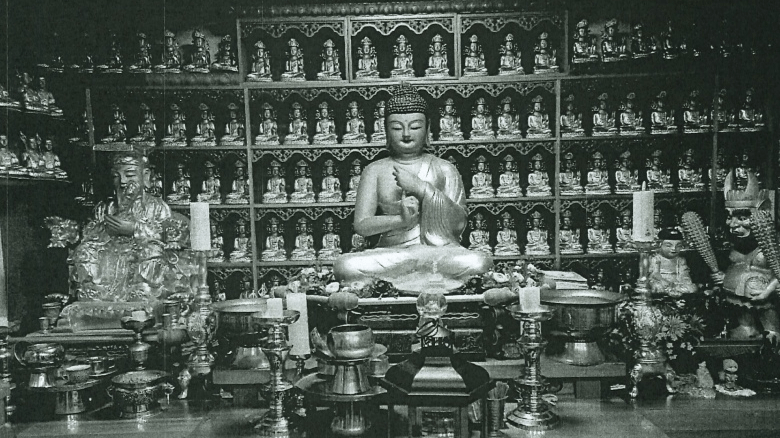
On the morning of the 15th at 8 a.m., a team of 4 to 5 members from the special prosecutor’s office investigating Kim Keon-hee (Yoon Suk-Yoel’s wife) stormed into the Buddhist temple of Jeon Seong-bae (64), also known as Geonjin Beopsa, located in Yeoksam-dong, Gangnam-gu, Seoul.
This marks the first raid in seven months since the Seoul Southern District Prosecutors’ Office searched the temple in December last year.
Reportedly, the special prosecutor’s team conducted this second raid after receiving intelligence that the prosecution had missed two “secret rooms” — one in the basement (B1) and one on the second floor — during its previous search.
Jeon’s temple is located on the second floor of a detached house, with a total building area of 279㎡ (about 84.4 pyeong), spanning from the basement (B1) to the second floor.
The second floor (90.18㎡) contains a living room, a large room, a small room, and a bathroom. The first floor (134.02㎡) is laid out like a typical residential space, with an internal staircase immediately to the right of the entrance leading up to the second-floor temple.
It has been determined that both the living room and the large room on the second floor house altars: one Buddhist altar with a statue of Buddha and another Shinto-style altar with a statue of Amaterasu, a deity from Japanese mythology.
The reason Geonjin Beopsa (Jeon) enshrined Amaterasu—considered the ancestral deity of the Japanese imperial family and the main god of Shinto—is believed to stem from the influence of Japanese Shintoism on Korean traditional shamanism, particularly through shrine worship practices during the Japanese colonial period.
The small room serves as a reception area with a table and floor cushions, where Jeon reportedly met several figures, including the 2018 Liberty Korea Party’s Yeongcheon mayoral preliminary candidate (involved in political nomination donation allegations), businessman Mr. Lee, and football player Lee Chun-soo.
On this day, the key targets of the special prosecutor team’s search were the space behind the Buddha statue in the second-floor Buddhist altar and a separate area adjacent to the basement garage, covering an area of 54㎡ (about 16 pyeong).
It was suspected that Jeon may have used these areas to store valuables or confidential materials. The special prosecutor’s team, during its review of investigation records, discovered that the prosecution had failed to seize items from the secret space connected to the second-floor altar and the basement area. As a result, the team had planned the re-search from the outset of the investigation.
P.S. Amaterasu, the sun goddess and mythical ancestress of the Japanese imperial family, was the central divine figure in State Shinto, the state-imposed ideological system of Imperial Japan. During the 1930s, State Shinto served as a crucial foundation for Japan’s imperial fascism, embedding emperor worship and ultranationalist values into every aspect of public life. Through the veneration of Amaterasu, the regime sanctified the emperor’s divine authority, justified colonial expansion, and mobilized the populace for militarism and sacrifice, turning religious devotion into a powerful tool of political control and fascist ideology.
Posted by Freewhale98
5 Comments
Now THIS is the kinda juicy stuff I wanna hear about
Woah, that’s gunna be a massive hit to any politician especially one who leans into nationalism.
That criminal Itachi robbed the shrine of amaterasu
So the shinto shrine wasn’t hidden in the secret room like the headline implies, just out in the big room. The secret room’s door was hidden by the Buddhist shrine.
My takeaway is that the shinto shrine is innocent and immaterial to the raid’s purpose. What was the Buddhist shrine hiding is the real question.
…so it’s not the Moonies this time? lmao