
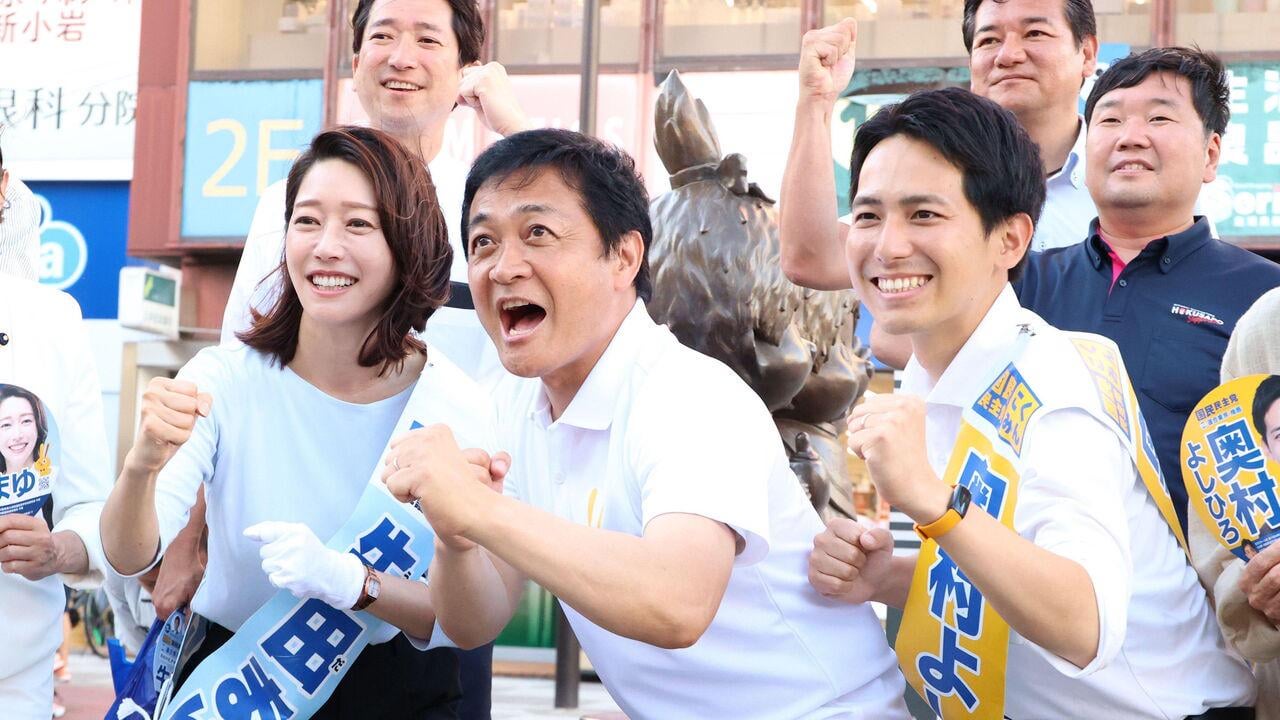
I read this article in the Economist yesterday, and thought it might be of interest given the recent posts about the other upstart party in Japan's latest upper house elections.
Excerpt:
In last year’s lower-house election, Mr Tamaki’s party quadrupled its number of seats to become the fourth-largest force. The ruling Liberal Democratic Party (LDP) was left leading a minority government, and needing Mr Tamaki’s help to pass legislation. On July 20th voters will elect a new upper house, where the LDP and its junior coalition partner, Komeito, are at risk of losing their majority.
[ . . . ]
He considers himself “neither left nor right” but a champion of Japan’s young and working-age population. Their prospects are bleak: disposable incomes have barely increased in decades. Mr Tamaki criticises Japan’s “silver democracy”: over-65s make up nearly 30% of the population and vote in greater numbers. This, plus a seniority-based culture in politics and workplaces, often sidelines younger people. Mr Tamaki calls them the “forgotten people”. One recent poll showed his DPFP to be more popular than the LDP among voters under 40.
[ . . . ]
Mr Tamaki is openly ambitious, not shy of voicing his desire to become prime minister. He also styles himself an economic-policy otaku, or obsessive. His signature policies include slashing the consumption tax—a position now shared by most opposition parties—and introducing “education bonds” to fund spending on children and social programmes.
[ . . . ]
Meanwhile, another disrupter threatens to overshadow him. The Do It Yourself Party (Sanseito), a hard-right outfit founded just five years ago, is rising in the polls with its “Japanese First” messaging. Immigration, long a fringe issue in Japanese politics, has moved to the centre ahead of the upper-house election. The number of foreign workers in Japan has quadrupled since 2008 to 2m, though it really needs more, not fewer. The LDP appears to be under pressure to act: it recently announced the creation of a cross-agency “control tower” to oversee foreign residents.
Mr Tamaki, though occasionally labelled as “right-leaning”, has resisted the xenophobic impulse. He is pragmatic on foreign affairs and supports building up the armed forces in the face of increasing threats from China and North Korea. But he has progressive positions on social issues; he favours, for example, allowing married couples to retain separate surnames. He sees economic malaise as the true source of Japanese voters’ frustrations. “People feel left behind and are starting to blame foreigners,” he said in a recent interview. “That’s exactly why we need better domestic policy—to energise Japan.”
According to early exit polls, both the DPFP/DPP and Sanseito made major gains in the recent election:
Conservative opposition groups, especially the DPP and Sanseito, gained significant ground at the Liberal Democrats’ expense, while the centrist top opposition CDPJ was sluggish. The DPP quadrupled to 17 seats from four, according to interim results reported by Japanese media. Sanseito surged to 14 from just one.
DPP leader Yuichiro Tamaki said his party made saw a big gain because voters chose it “as a new alternative.”
Posted by TIYATA
2 Comments
[removed]
>I don’t want the LDP to have such a firm grip over Japan
Monkey paw curls