there is no way Canadians would ever tolerate a government that would sharply increase the price of vehicles using a ‘certificate of entitlement’ car tax that would add ~$100,000 to the cost to a car. That’s one of the two main reasons why car ownership is so depressed in Singapore compared to Toronto (the other reason being the excellent transit system in Singapore of course)
>Every day the traffic problem in Toronto seems to get a little worse. Because it is getting worse – measurably, miserably worse. A recent Globe story offers some telling statistics: Torontonians spend 63 hours a year, on average, stuck in traffic. It takes 11 per cent longer on average to get to where you’re going than it did even 10 years ago, when traffic was merely intolerable.
>Toronto also has the longest commute time of any city in Canada, at more than 33 minutes. All told, according to the 2023 Traffic Index, compiled by the GPS software firm TomTom, Toronto’s traffic is third worst among 387 major cities in 55 countries around the world. Third worst *in the world.*
>[…]
>It doesn’t have to be this way. For a vision of what is possible, we take you now to another city, half a world away: Singapore. The city-state has a population of more than six million – nearly as many as the Greater Toronto Area, only packed into an island about a tenth the size.
>Yet it ranks 170th on the TomTom index – about the same as Halifax (population 480,000). Where the average time it takes to travel 10 kilometres in Toronto is nearly 30 minutes, in Singapore it is under 17 minutes. The average speed at rush hour in Toronto is 18 kilometres an hour. In Singapore it is 28.
>Things weren’t always so free-flowing. Fifty years ago, Singapore had traffic problems on par with most other rapidly expanding cities, particularly in its central business district (CBD). What changed? Road pricing: only for real, not the time-based parody of it. In 1975, Singapore implemented the world’s first system of congestion pricing, a ring of 28 overhead gantries around the CBD. Drivers had to buy and display paper licences costing roughly $3 a day.
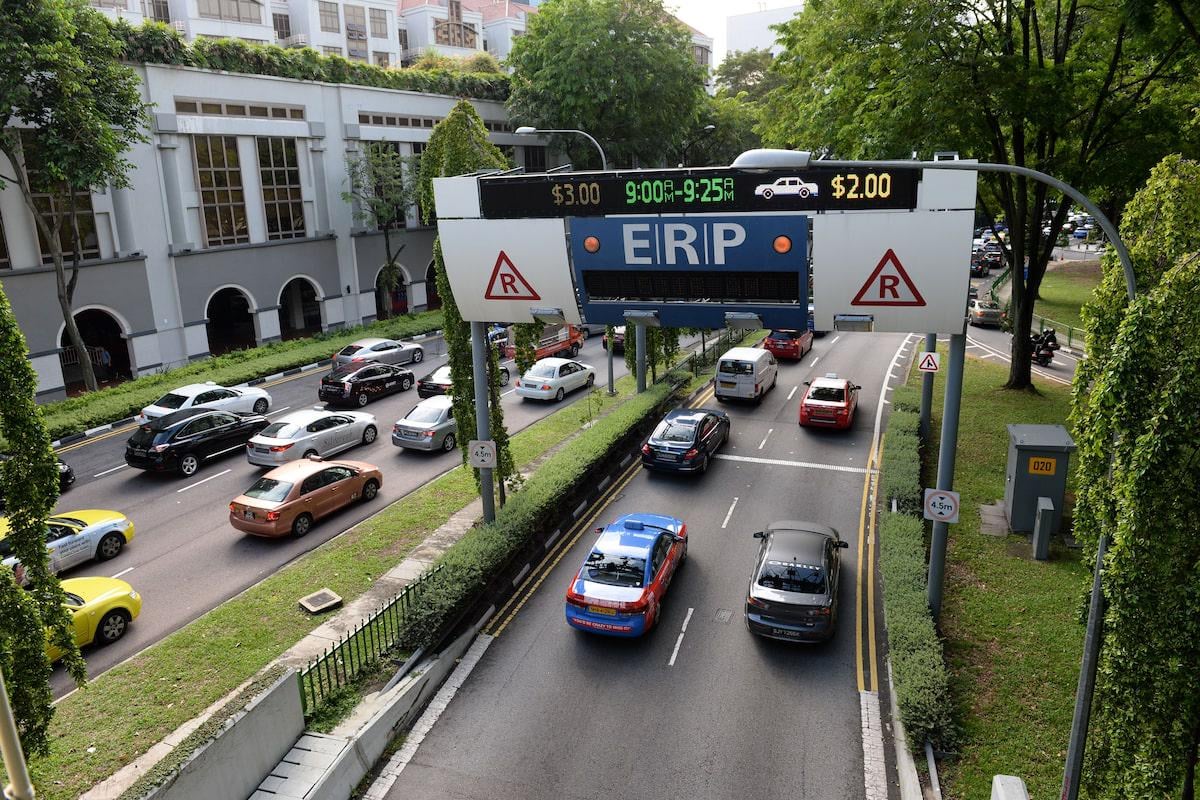
>In 1998 the system was expanded and upgraded: the world’s first *electronic* road pricing system. Since then dozens of gantries have been installed, not just around the CBD but on every major artery, with sensors that can detect the transponders in people’s cars as they pass. The price is deducted from stored-value cards in the transponders, varying with the size of the road and the time of day.
>And coming soon: ERP 2.0 – the world’s first *GPS-based* electronic road pricing system. No more gantries: the on-board transponders will correspond with satellite-based monitors. In principle, this means you could price, not just major arteries, but every road, with prices changing dynamically, in line with congestion levels. And no, that doesn’t mean the government tracks everyone’s movements. The data are all anonymized.
>Traffic is not only one of the worst of urban blights, but one of the few that could be cured literally overnight. Road pricing works. Singapore has proved it. Or forget Singapore: Toronto already has a working model of road pricing, the hugely successful Highway 407, which opened in 1997 – one year before Singapore’s. Yet here we all sit, decades later, stuck in traffic.
>It’s one thing to refuse to learn from other people’s successes, but to refuse to learn from our own is criminal.
Could, but absolutely wont, as the unifying factor across the entire Canadian political spectrum is vulgar suburbanism that it utterly prohibitive of something like this. To the extent that Premier Ford outright banned tolling provincial highways, and would absolutely not allow Toronto to toll roads under its own responsibility
And Toronto’s councillors wouldnt bite either. Their own political constituencies are still dominated by drivers even in the inner wards, and the most ‘progressive’ or ostensibly pro-urban electeds are incredibly weak on urban issues.

3 Comments
there is no way Canadians would ever tolerate a government that would sharply increase the price of vehicles using a ‘certificate of entitlement’ car tax that would add ~$100,000 to the cost to a car. That’s one of the two main reasons why car ownership is so depressed in Singapore compared to Toronto (the other reason being the excellent transit system in Singapore of course)
Archived version: https://archive.fo/BaPUY.
>Every day the traffic problem in Toronto seems to get a little worse. Because it is getting worse – measurably, miserably worse. A recent Globe story offers some telling statistics: Torontonians spend 63 hours a year, on average, stuck in traffic. It takes 11 per cent longer on average to get to where you’re going than it did even 10 years ago, when traffic was merely intolerable.
>Toronto also has the longest commute time of any city in Canada, at more than 33 minutes. All told, according to the 2023 Traffic Index, compiled by the GPS software firm TomTom, Toronto’s traffic is third worst among 387 major cities in 55 countries around the world. Third worst *in the world.*
>[…]
>It doesn’t have to be this way. For a vision of what is possible, we take you now to another city, half a world away: Singapore. The city-state has a population of more than six million – nearly as many as the Greater Toronto Area, only packed into an island about a tenth the size.
>Yet it ranks 170th on the TomTom index – about the same as Halifax (population 480,000). Where the average time it takes to travel 10 kilometres in Toronto is nearly 30 minutes, in Singapore it is under 17 minutes. The average speed at rush hour in Toronto is 18 kilometres an hour. In Singapore it is 28.
>Things weren’t always so free-flowing. Fifty years ago, Singapore had traffic problems on par with most other rapidly expanding cities, particularly in its central business district (CBD). What changed? Road pricing: only for real, not the time-based parody of it. In 1975, Singapore implemented the world’s first system of congestion pricing, a ring of 28 overhead gantries around the CBD. Drivers had to buy and display paper licences costing roughly $3 a day.
>In 1998 the system was expanded and upgraded: the world’s first *electronic* road pricing system. Since then dozens of gantries have been installed, not just around the CBD but on every major artery, with sensors that can detect the transponders in people’s cars as they pass. The price is deducted from stored-value cards in the transponders, varying with the size of the road and the time of day.
>And coming soon: ERP 2.0 – the world’s first *GPS-based* electronic road pricing system. No more gantries: the on-board transponders will correspond with satellite-based monitors. In principle, this means you could price, not just major arteries, but every road, with prices changing dynamically, in line with congestion levels. And no, that doesn’t mean the government tracks everyone’s movements. The data are all anonymized.
>Traffic is not only one of the worst of urban blights, but one of the few that could be cured literally overnight. Road pricing works. Singapore has proved it. Or forget Singapore: Toronto already has a working model of road pricing, the hugely successful Highway 407, which opened in 1997 – one year before Singapore’s. Yet here we all sit, decades later, stuck in traffic.
>It’s one thing to refuse to learn from other people’s successes, but to refuse to learn from our own is criminal.
Further reading:
[Toronto traffic: Council to vote on traffic czar this week – CTV](https://www.ctvnews.ca/toronto/article/toronto-is-closer-to-hiring-a-traffic-czar-here-is-what-experts-say-their-first-task-should-be/)
[New York City’s congestion pricing reducing traffic, increasing transit ridership in first six months | Mass Transit](https://www.masstransitmag.com/management/press-release/55301775/metropolitan-transportation-authority-ny-mta-new-york-citys-congestion-pricing-reducing-traffic-increasing-transit-ridership-in-first-six-months)
!ping Can
Could, but absolutely wont, as the unifying factor across the entire Canadian political spectrum is vulgar suburbanism that it utterly prohibitive of something like this. To the extent that Premier Ford outright banned tolling provincial highways, and would absolutely not allow Toronto to toll roads under its own responsibility
And Toronto’s councillors wouldnt bite either. Their own political constituencies are still dominated by drivers even in the inner wards, and the most ‘progressive’ or ostensibly pro-urban electeds are incredibly weak on urban issues.