
The final words on my grandfathers deathbed He worked for Honeywell in Tampa in the 1960’s and most of his office died from a “mysterious cancer”. The day after he died Men in Black came and took all of his belongings. He worked on Apollo rockets and was an incredible man according to my mother, but he died when she was 4 (around 1969). And his last words were “never trust the government”. One of his work associates who didn’t get the disease joined us one year for Christmas in about 2010. We asked questions and tried to get any insight on the things they were working on, and this man well into his 80’s was still too scared to say anything.
“I honestly can’t tell you I wish I could”.
He died a few months later
What’s so scary to be working on that a man near death won’t tell you?
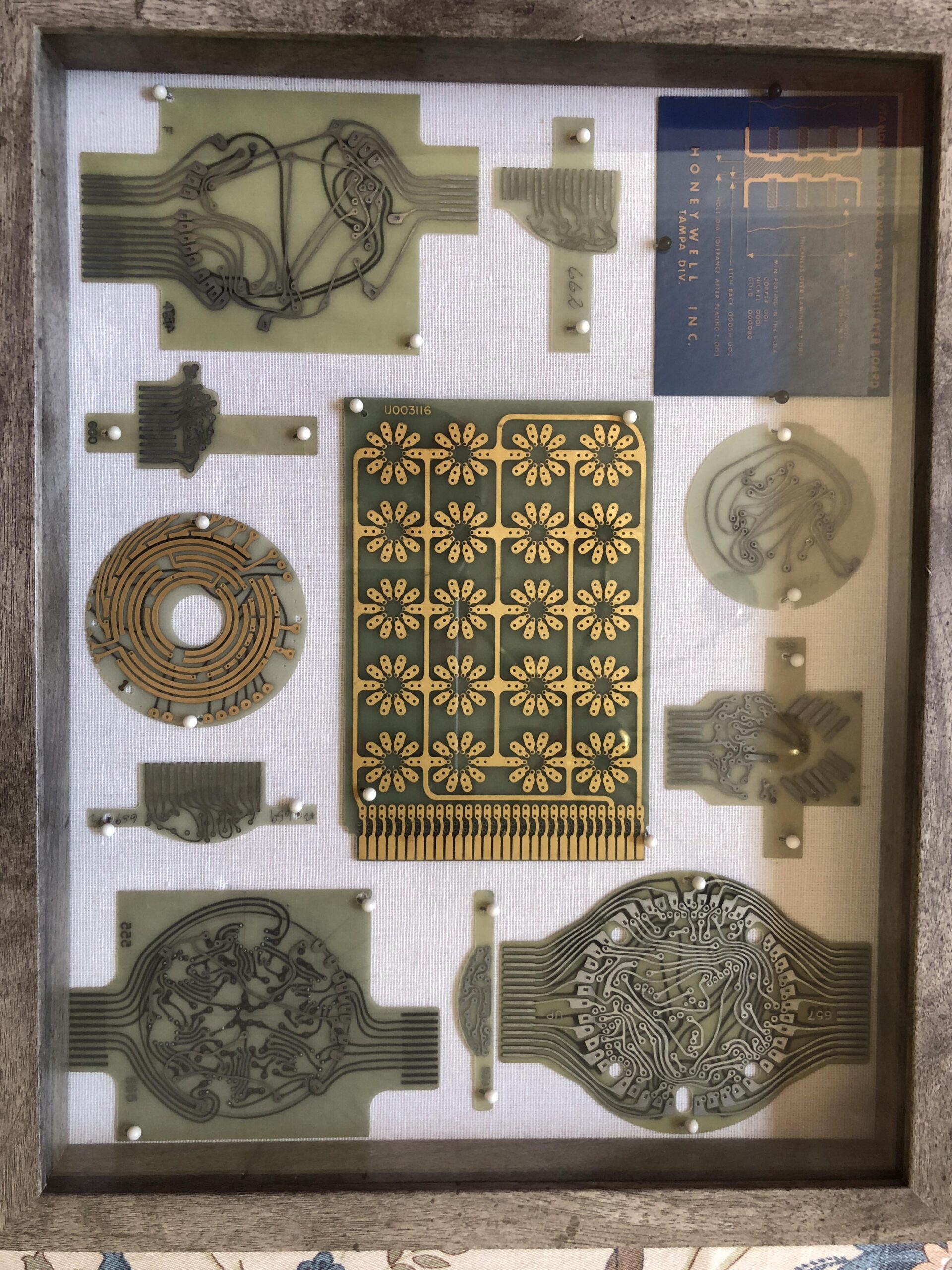
Here’s some photos of circuit boards we found hidden around the house when we cleaned it out.
Not like I needed to hear “never trust the government” because I already don’t. But I’m more curious as to what were these guys working on that they lost their life for. I know they aren’t alone either.
Posted by guitarman1103
3 Comments
Where did you find those boards? Did you find anything else?
What really stands out here is how fluid these layouts look, especially for circuit boards supposedly from the 1950s and ’60s.
ChatGTP’s 2 pence –
Unlike the rigid, grid-based traces you’d find in most Cold War–era electronics, these designs feel almost biomorphic. They curve, loop, and branch like nervous systems or root structures.
The central piece with the gold plating is likely a backplane or connector array, maybe for early computing or signal routing. The rest? Possibly prototype PCBs for sensors, signal processors, or telemetry interfaces.
judging by the ‘Honeywell Inc. – Tampa Div.’ tag, this could be linked to military or aerospace research. Honeywell was deeply involved in guidance systems and early automation tech, particularly for NASA and defense projects.
What’s striking is how some of these resemble the visual complexity of hybrid circuits or even early MEMS (microelectromechanical systems), yet those didn’t hit mainstream development until the 1970s and ’80s. This adds to the mystery — it’s as if form and function were merging in a way that’s more common in modern PCB design, where electromagnetic behavior and artistic layout sometimes blur.
It’s rare to see such aesthetic intentionality in old circuitry. If these were hand-taped layouts — as was common back then — the designer had a serious sense of rhythm and flow. Feels less like industrial engineering and more like the work of someone quietly communicating in copper lines. You don’t usually get that kind of soul from a circuit board.
plz elaborate