1
The Hadash party announced Sunday that it would promote direct dialogue with other Arab parties, including the Islamist Ra’am, to explore the revival of a Joint List, a party that briefly united disparate Arab and Arab-majority parties.
The move comes amid growing pressure from within Arab society to bolster political influence, not just in the opposition in Knesset, but through participation in government. Recent anti-war activism has also created a rare moment of alignment among Arab political leaders.
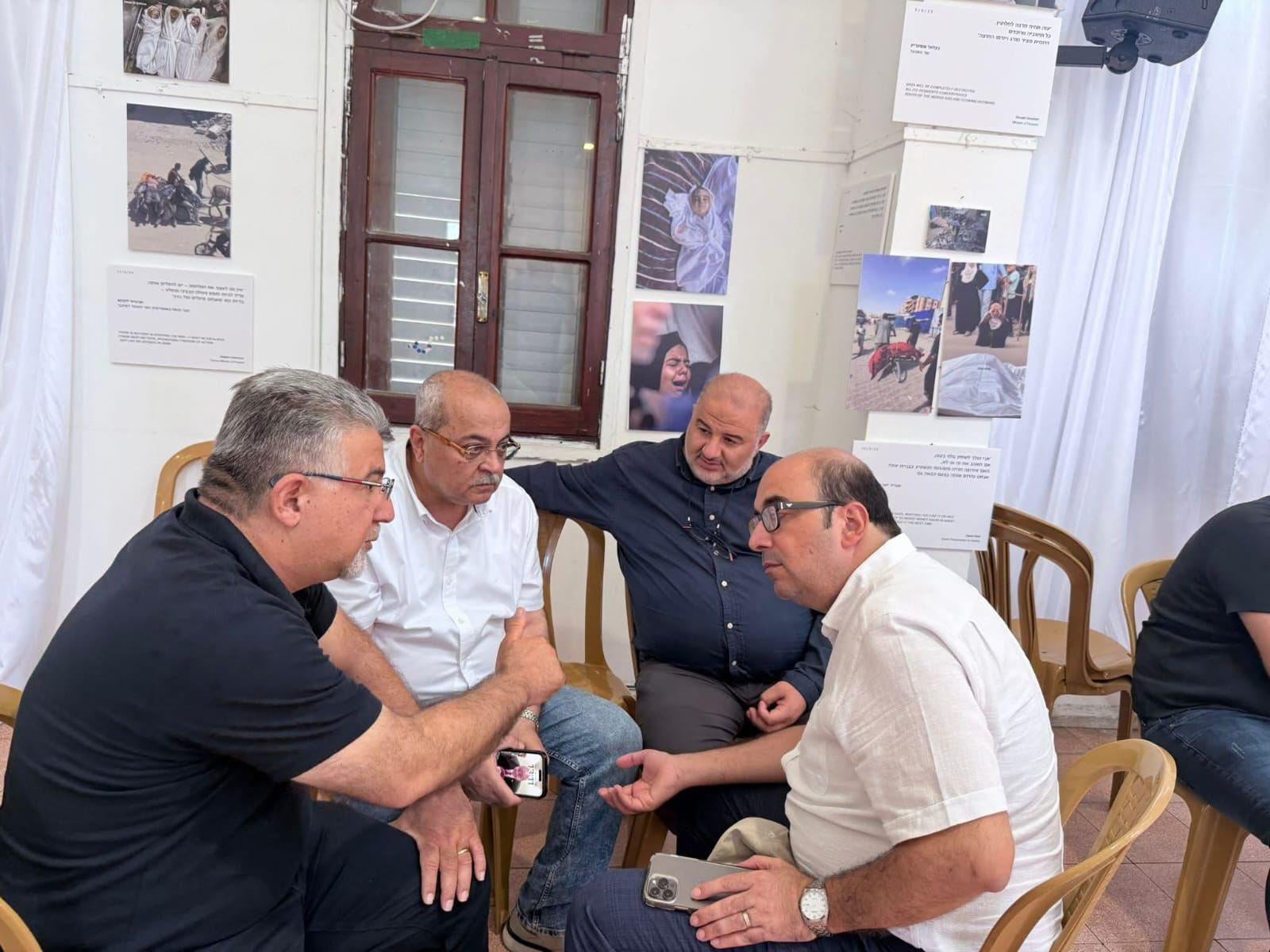
On Sunday, a three-day hunger strike was launched in Jaffa with a joint press conference by lawmakers from Ra’am, Ta’al, Hadash, and leaders from Balad, which is not currently in Knesset. In a shared message, they called for an immediate end to the war in Gaza, the release of hostages, and international recognition of Palestinian statehood.
This followed a 10,000-person protest against the war in Gaza on Friday in the northern Arab town of Sakhnin, just a day after 24 people were arrested at a similar demonstration in Haifa. According to Arabic-language outlet Arab48, smaller anti-war rallies also took place in Jaffa, Tira, and Kabul.
“After Sakhnin and Jaffa, the desire to build upon the Joint List project is growing,” a Hadash spokesperson told The Times of Israel. “But this is something that has been in the works for a long time.”
Though details remain sparse regarding the progress of the talks, Ra’am MK Iman Khatib-Yassin welcomed the development, saying: “Ra’am has always called for a joint list — this is just a continuation of that conversation.”
Hadash leader Ayman Odeh has been working in recent months to reestablish the Joint List, which was a unified slate of Arab parties with sharply differing ideological views but a track record of energizing Arab voters and bringing the community unprecedented political influence.
In the 2015 elections, the newly formed Joint List won 13 seats out of 120 in the Knesset, while boosting turnout in Arab-majority locales to 64% — a significant rise over the 55% turnout recorded two years earlier.
Bitter arguments over the allocation and rotation of Knesset seats eventually led Mansour Abbas’s Islamist United Arab List (Ra’am) to break away in 2021. Abbas ultimately joined Naftali Bennett and Yair Lapid’s short-lived coalition government, becoming the first Arab party to sit in an Israeli coalition.
This left Odeh’s Hadash, a joint Jewish-Arab leftist faction incorporating Israel’s old Communist Party, allied with MK Ahmad Tibi’s Ta’al and the secular nationalist Balad party, the latter of which failed to pass the electoral threshold in the last election. The Joint List finally collapsed ahead of the 2022 election.
Public support grows for political inclusion
News of a potential merger among the Arab parties appears to reflect a growing desire among Arab constituents for their representatives to participate in government. This is supported by data from a survey published in June by the Konrad Adenauer Program for Jewish-Arab Cooperation at the Moshe Dayan Center at Tel Aviv University, which found that 73.3% of Arab respondents support the inclusion of an Arab party in the next governing coalition. Additionally, 41.8% said they would support joining any government, not only a center-left one.
According to the study, “These rates are consistent with what we’ve seen throughout the war — a stable, majority desire for political inclusion and impact.”
Okbuddyliberals on
The question of course is whether a United Arab List could manage to form a government that united with not just the Jewish left leaning Democrats (avoda and meretz merger) and not just those and the centrists (lapid and gantz’ parties) but also the nationalist right wing (but not in coalition with Netanyahu) Lieberman and Bennet Parties that could theoretically make up over half of a hypothetical opposition coalition all by themselves
There was that one time when YB and Bennet joined with a center/left coalition with Raam also in coalition, but that was before October 7, which may have made Israeli Jewish parties as a whole way less willing to work with Arabs…
JebBD on
There is no way the Arab parties are joining any government any time soon. Coalition with arab parties was a very contentious issue even before 10/7, to this day right wingers accuse Bennett and Lapid of “capitulating” to the “Muslim brotherhood” and “giving billions to Abbas”, after 10/7 they’re going to have an absolute meltdown if the left even talks to Abbas or Odeh (or whoever replaces him after he leaves).

3 Comments
1
The Hadash party announced Sunday that it would promote direct dialogue with other Arab parties, including the Islamist Ra’am, to explore the revival of a Joint List, a party that briefly united disparate Arab and Arab-majority parties.
The move comes amid growing pressure from within Arab society to bolster political influence, not just in the opposition in Knesset, but through participation in government. Recent anti-war activism has also created a rare moment of alignment among Arab political leaders.
On Sunday, a three-day hunger strike was launched in Jaffa with a joint press conference by lawmakers from Ra’am, Ta’al, Hadash, and leaders from Balad, which is not currently in Knesset. In a shared message, they called for an immediate end to the war in Gaza, the release of hostages, and international recognition of Palestinian statehood.
This followed a 10,000-person protest against the war in Gaza on Friday in the northern Arab town of Sakhnin, just a day after 24 people were arrested at a similar demonstration in Haifa. According to Arabic-language outlet Arab48, smaller anti-war rallies also took place in Jaffa, Tira, and Kabul.
“After Sakhnin and Jaffa, the desire to build upon the Joint List project is growing,” a Hadash spokesperson told The Times of Israel. “But this is something that has been in the works for a long time.”
Though details remain sparse regarding the progress of the talks, Ra’am MK Iman Khatib-Yassin welcomed the development, saying: “Ra’am has always called for a joint list — this is just a continuation of that conversation.”
Hadash leader Ayman Odeh has been working in recent months to reestablish the Joint List, which was a unified slate of Arab parties with sharply differing ideological views but a track record of energizing Arab voters and bringing the community unprecedented political influence.
In the 2015 elections, the newly formed Joint List won 13 seats out of 120 in the Knesset, while boosting turnout in Arab-majority locales to 64% — a significant rise over the 55% turnout recorded two years earlier.
Bitter arguments over the allocation and rotation of Knesset seats eventually led Mansour Abbas’s Islamist United Arab List (Ra’am) to break away in 2021. Abbas ultimately joined Naftali Bennett and Yair Lapid’s short-lived coalition government, becoming the first Arab party to sit in an Israeli coalition.
This left Odeh’s Hadash, a joint Jewish-Arab leftist faction incorporating Israel’s old Communist Party, allied with MK Ahmad Tibi’s Ta’al and the secular nationalist Balad party, the latter of which failed to pass the electoral threshold in the last election. The Joint List finally collapsed ahead of the 2022 election.
Public support grows for political inclusion
News of a potential merger among the Arab parties appears to reflect a growing desire among Arab constituents for their representatives to participate in government. This is supported by data from a survey published in June by the Konrad Adenauer Program for Jewish-Arab Cooperation at the Moshe Dayan Center at Tel Aviv University, which found that 73.3% of Arab respondents support the inclusion of an Arab party in the next governing coalition. Additionally, 41.8% said they would support joining any government, not only a center-left one.
According to the study, “These rates are consistent with what we’ve seen throughout the war — a stable, majority desire for political inclusion and impact.”
The question of course is whether a United Arab List could manage to form a government that united with not just the Jewish left leaning Democrats (avoda and meretz merger) and not just those and the centrists (lapid and gantz’ parties) but also the nationalist right wing (but not in coalition with Netanyahu) Lieberman and Bennet Parties that could theoretically make up over half of a hypothetical opposition coalition all by themselves
There was that one time when YB and Bennet joined with a center/left coalition with Raam also in coalition, but that was before October 7, which may have made Israeli Jewish parties as a whole way less willing to work with Arabs…
There is no way the Arab parties are joining any government any time soon. Coalition with arab parties was a very contentious issue even before 10/7, to this day right wingers accuse Bennett and Lapid of “capitulating” to the “Muslim brotherhood” and “giving billions to Abbas”, after 10/7 they’re going to have an absolute meltdown if the left even talks to Abbas or Odeh (or whoever replaces him after he leaves).
It’s just not happening