The article argues that while violent crime rates in the US and UK are near multi‑decade lows, visible low‑level crimes and public disorder are climbing, fueling public anxiety. This “crime paradox” helps explain why people feel less safe even as serious violence continues to fall.
A few thoughts:
– Post‑COVID, there really does seem to be an uptick in aggressiveness and antisocial behavior—not just among the homeless or in struggling neighborhoods, but in affluent areas too. I’ve seen way more angry confrontations, line‑cutting, and general friction between otherwise “normal” middle‑class people.
– Some crimes are genuinely up relative to pre‑pandemic: UK phone‑snatching rose ~50% in 2024, and US road‑rage shootings have more than quadrupled since 2014, with over 3,000 people shot during that period. Both the US and UK have also seen police follow‑through tank: in the UK, only about 1% of phone thefts now lead to charges.
– That said, some of the panic may be overblown. For example, there’s evidence that pandemic‑era shoplifting numbers were often misreported or hyped by retail lobbyists. Similarly, viral social media clips can make localized incidents feel like nationwide collapse.
**Article text**:
We appear to be in the middle of a crime paradox.
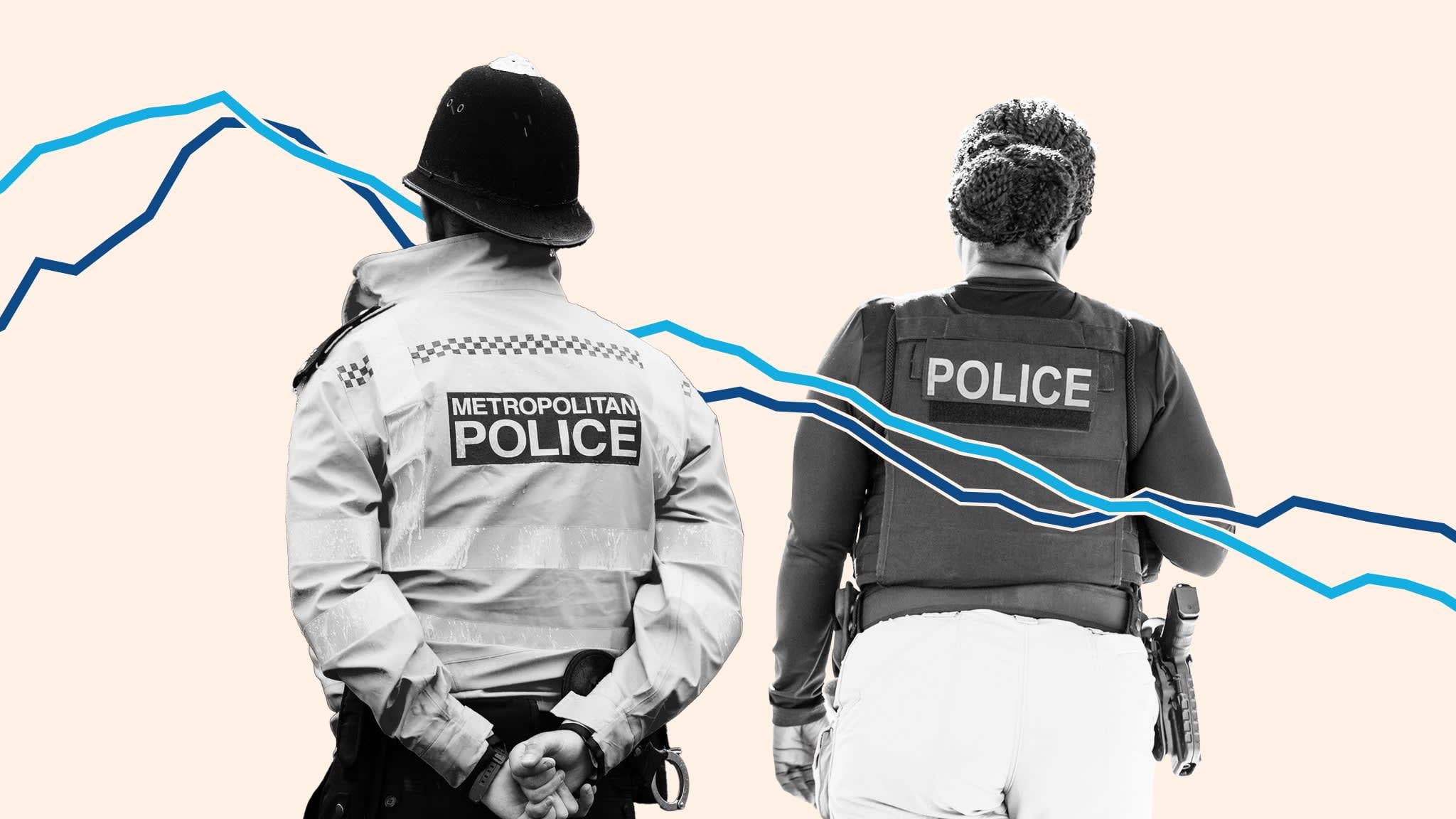
This year is on course to show the lowest rate of violent crime in decades in both Britain and America. While dreadful incidents like Tuesday’s shooting in New York deservedly receive widespread attention, they are increasingly exceptional. US rates of both violence in general and homicide specifically are down more than half from their modern peaks in the 1990s, and approaching record lows.
It’s a similar story in the UK, where violent crime has been trending downwards for three decades and continued its descent this year. But against this backdrop, the British public’s concern about crime has been trending steadily upwards for several years. And in the US, most people say crime is still rising both locally and nationally. Leaning in to the growing sense of unease, Nigel Farage, leader of the rightwing populist Reform UK party, last month hosted a press conference to warn that crime has risen so much the UK is “facing societal collapse”.
In the face of conflicting data, it would be easy to dismiss growing concern as a function of our bias towards fear and the media’s long-established proclivity towards negativity and spectacle. But while people are notoriously bad at judging prevalence, they tend to be better on the direction of travel — a 2016 paper by British political scientist Will Jennings shows this is also true for crime. So what is going on?
A key factor driving public perceptions is that while the most dangerous crimes have thankfully become much rarer, many of the most visible offences are on the rise.
The UK is a good example. Violent crime is down significantly, a fact backed up by both population-wide surveys and hospital admissions data. The public feels this change: in the late 1990s, 25 per cent of Britons were worried about violent crime, today it’s 8 per cent. But other offences are sharply up, most notably shoplifting and theft from the person, both of which are at their highest in at least 15 years.
This shapes perceptions. Violent crime is especially alarming, but most of it is not random — just over half of victims know the perpetrator and have been attacked before. It also often happens away from public view, making it a distant phenomenon for the majority. By contrast, rapidly rising “snatch theft” is almost always carried out in public by a stranger on a first-time victim, giving a much greater sense that “this could happen to me”.
Shoplifting is especially damaging to the sense of public order, as people witness not only the act but the lasting consequences: the growing presence of security personnel and protective casings or locks on items from steak to cosmetics.
Both these low-level crimes provide a palpable signal that things are out of control, no media refraction needed. And both have been on the rise in many parts of the US and UK.
It fits into a wider pattern identified by US crime researcher Charles Fain Lehman, who argues that while America’s violent crime problem is clearly waning, there is a countervailing problem of mounting public disorder. This expanded and somewhat fuzzy category is hard to track, but Lehman proposes a number of possible yardsticks, including fare evasion on public transport, driving offences and dog attacks.
My analysis of UK data mirrors his findings. Fare evasion in London and New York is running much higher than a decade ago, hospitalisations for dog bites have more than doubled over the past 20 years and careless driving also appears to be ticking up.
This once again tracks with public opinion. Britons report feeling safer than ever walking alone after dark, but there has been a steep rise in the share of people saying antisocial behaviour is rising.
All of this is compounded by the sense that criminals are operating with impunity, as the rates of arrest, charging and prosecution for all crime types has been trending downward in both countries.
The overall picture fits neatly with a 2021 study which found that people’s worries about crime are heavily shaped by their sense of lower-level disorder and police performance, rather than more serious but distant attacks.
It’s tempting to blame the media and opportunistic politicians for fanning the flames. It might not even be entirely wrong. But it also misses the point. America and Britain are less dangerous than ever, but more disorderly than they have been in some time.

2 Comments
**Submission statement**
The article argues that while violent crime rates in the US and UK are near multi‑decade lows, visible low‑level crimes and public disorder are climbing, fueling public anxiety. This “crime paradox” helps explain why people feel less safe even as serious violence continues to fall.
A few thoughts:
– Post‑COVID, there really does seem to be an uptick in aggressiveness and antisocial behavior—not just among the homeless or in struggling neighborhoods, but in affluent areas too. I’ve seen way more angry confrontations, line‑cutting, and general friction between otherwise “normal” middle‑class people.
– Some crimes are genuinely up relative to pre‑pandemic: UK phone‑snatching rose ~50% in 2024, and US road‑rage shootings have more than quadrupled since 2014, with over 3,000 people shot during that period. Both the US and UK have also seen police follow‑through tank: in the UK, only about 1% of phone thefts now lead to charges.
– That said, some of the panic may be overblown. For example, there’s evidence that pandemic‑era shoplifting numbers were often misreported or hyped by retail lobbyists. Similarly, viral social media clips can make localized incidents feel like nationwide collapse.
**Article text**:
We appear to be in the middle of a crime paradox.
This year is on course to show the lowest rate of violent crime in decades in both Britain and America. While dreadful incidents like Tuesday’s shooting in New York deservedly receive widespread attention, they are increasingly exceptional. US rates of both violence in general and homicide specifically are down more than half from their modern peaks in the 1990s, and approaching record lows.
It’s a similar story in the UK, where violent crime has been trending downwards for three decades and continued its descent this year. But against this backdrop, the British public’s concern about crime has been trending steadily upwards for several years. And in the US, most people say crime is still rising both locally and nationally. Leaning in to the growing sense of unease, Nigel Farage, leader of the rightwing populist Reform UK party, last month hosted a press conference to warn that crime has risen so much the UK is “facing societal collapse”.
In the face of conflicting data, it would be easy to dismiss growing concern as a function of our bias towards fear and the media’s long-established proclivity towards negativity and spectacle. But while people are notoriously bad at judging prevalence, they tend to be better on the direction of travel — a 2016 paper by British political scientist Will Jennings shows this is also true for crime. So what is going on?
A key factor driving public perceptions is that while the most dangerous crimes have thankfully become much rarer, many of the most visible offences are on the rise.
The UK is a good example. Violent crime is down significantly, a fact backed up by both population-wide surveys and hospital admissions data. The public feels this change: in the late 1990s, 25 per cent of Britons were worried about violent crime, today it’s 8 per cent. But other offences are sharply up, most notably shoplifting and theft from the person, both of which are at their highest in at least 15 years.
This shapes perceptions. Violent crime is especially alarming, but most of it is not random — just over half of victims know the perpetrator and have been attacked before. It also often happens away from public view, making it a distant phenomenon for the majority. By contrast, rapidly rising “snatch theft” is almost always carried out in public by a stranger on a first-time victim, giving a much greater sense that “this could happen to me”.
Shoplifting is especially damaging to the sense of public order, as people witness not only the act but the lasting consequences: the growing presence of security personnel and protective casings or locks on items from steak to cosmetics.
Both these low-level crimes provide a palpable signal that things are out of control, no media refraction needed. And both have been on the rise in many parts of the US and UK.
It fits into a wider pattern identified by US crime researcher Charles Fain Lehman, who argues that while America’s violent crime problem is clearly waning, there is a countervailing problem of mounting public disorder. This expanded and somewhat fuzzy category is hard to track, but Lehman proposes a number of possible yardsticks, including fare evasion on public transport, driving offences and dog attacks.
My analysis of UK data mirrors his findings. Fare evasion in London and New York is running much higher than a decade ago, hospitalisations for dog bites have more than doubled over the past 20 years and careless driving also appears to be ticking up.
This once again tracks with public opinion. Britons report feeling safer than ever walking alone after dark, but there has been a steep rise in the share of people saying antisocial behaviour is rising.
All of this is compounded by the sense that criminals are operating with impunity, as the rates of arrest, charging and prosecution for all crime types has been trending downward in both countries.
The overall picture fits neatly with a 2021 study which found that people’s worries about crime are heavily shaped by their sense of lower-level disorder and police performance, rather than more serious but distant attacks.
It’s tempting to blame the media and opportunistic politicians for fanning the flames. It might not even be entirely wrong. But it also misses the point. America and Britain are less dangerous than ever, but more disorderly than they have been in some time.
!ping broken-windows