
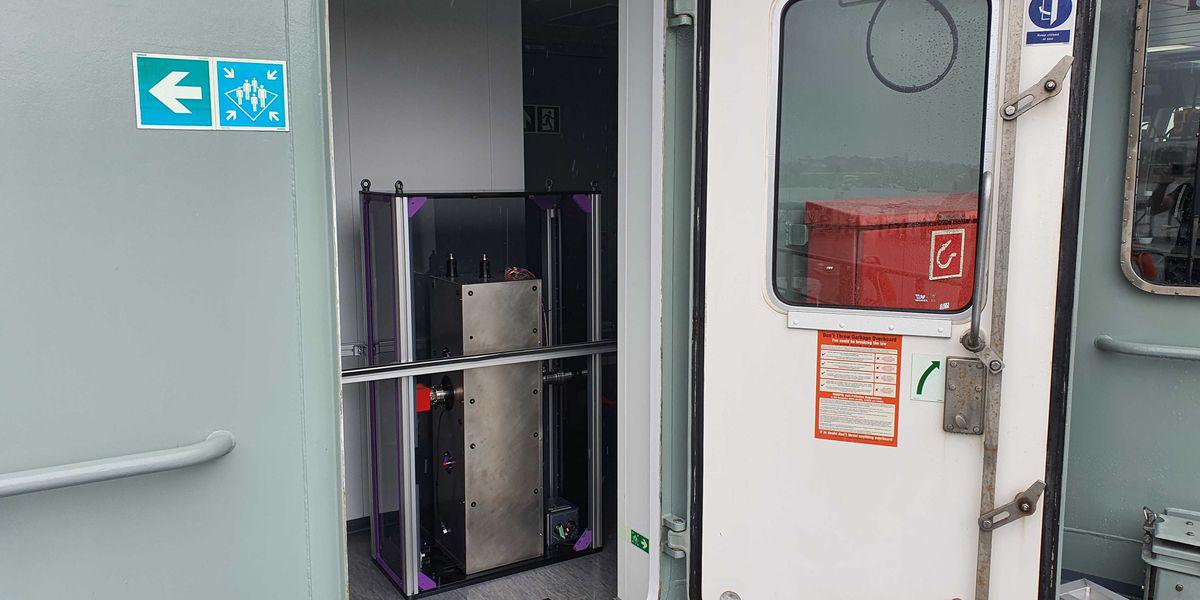
A Quantum Gravimeter for GPS Backup: Australian ship navigated for six days using the device, which can’t be spoofed or jammed ( like Russia did to many European ships)
Posted by Straight_Ad2258
A Quantum Gravimeter for GPS Backup: Australian ship navigated for six days using the device, which can’t be spoofed or jammed ( like Russia did to many European ships)
Posted by Straight_Ad2258
1 Comment
>Despite the planet’s relatively regular spheroid shape, the Earth’s gravitational pull is not uniform. It differs based on the distribution of mass inside the planet but also reflects features of the landscape such as hills and valleys and differences in density of the [minerals](https://spectrum.ieee.org/tag/minerals) underground.
>In addition to the superb accuracy, quantum gravity sensing is also unjammable and unspoofable.
>**“You can’t spoof gravity without literally moving a mountain,” said Biercuk.**
>**The passive nature of the sensor, which doesn’t require any active signal emissions (unlike** [**lidar**](https://spectrum.ieee.org/tag/lidar)**- or radar-based systems) helps defense users avoid detection by the adversary.**
>The prototype system tested off the Australian coast is about the size of a server rack, but Biercuk hopes Q-CTRL’s engineers will be able to further shrink it to about the size of a small fridge before taking it to the market next year. The development took about 14 months, he said, and challenged the team once they began experimenting with the sensor outside their labs.
>“These sensors are extraordinarily sensitive and when you take them from a pristine laboratory environment to anything less than pristine, the whole world conspires against you,” said Biercuk. “Mechanical vibrations, [radio interference](https://spectrum.ieee.org/tag/radio-interference), and the movements of a vessel in all directions creates noise, which completely obscures the signal.”
>The Q-CTRL team solved the problem through a complex software solution that filters out the unwanted noise.
>Despite the promising performance, Biercuk doesn’t think that quantum gravimeters could ever completely replace satellite navigation for any kind of users. But in addition to areas suffering from GPS interference, the system could help ships navigating around polar regions where GPS is notoriously unreliable due to the geometry of the satellites’ orbits.
>“GPS is a very good technology when you can trust it,” said Biercuk. “But for the situations when you can’t or when it’s not available, you need a robust alternative.”
Wondering if it keeps getting miniaturized in the future if it could end up being used by land military vehicles or even by drones while flying over sea