
https://www.upmedia.mg/news_info.php?Type=24&SerialNo=236374 – Link to original poll, body text translation in comments
Posted by Otherwise_Young52201
https://www.upmedia.mg/news_info.php?Type=24&SerialNo=236374 – Link to original poll, body text translation in comments
Posted by Otherwise_Young52201
1 Comment
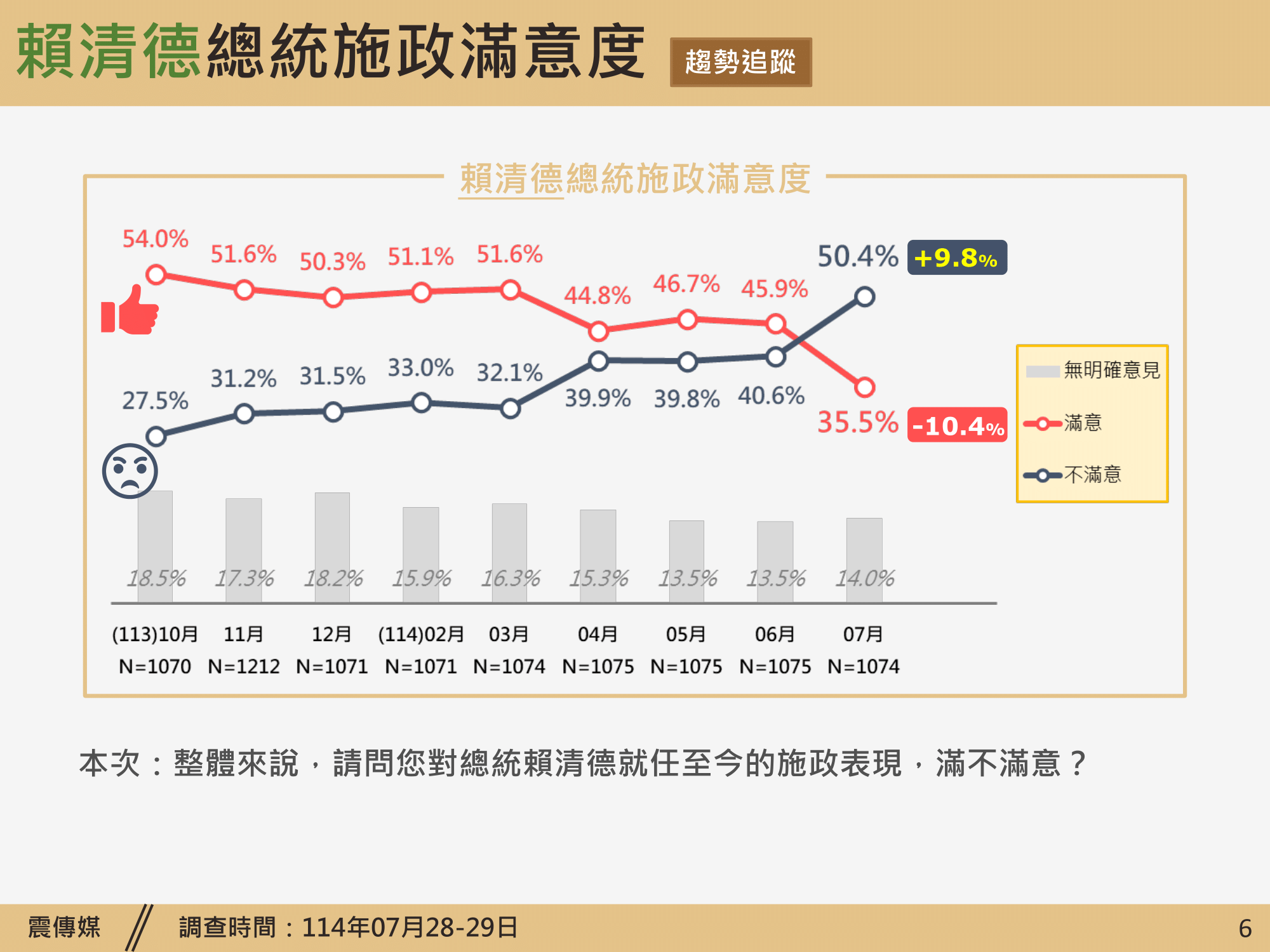
Zhen Media released the latest poll today (31st), and the most respondents believe that the lack of legitimacy of the recall is the key factor in the reason why the recall was not passed on July 26. In terms of President Lai Ching-te’s governance evaluation, the survey showed that 35.5% of respondents were satisfied and 50.4% expressed dissatisfaction, which was the first time that the proportion of dissatisfaction was higher than that of satisfied people. As for the cabinet reshuffle, 53.1% believe that adjustments are necessary, while 18.6% believe that there is no need for changes, and the proportion of respondents who think that the general resignation should be increased by 5.8% to 26.8% compared to the survey results in May this year.
The top four reasons for the failure of the recall were that the recall lacked legitimacy (16.1%), that the DPP opposed the issuance of 10,000 yuan in cash (14%), that they were disappointed with President Lai’s administration or chose to vote no confidence in their policies (7.8%), and that President Lai’s disaster survey performance during the storm was poor (6.7%). According to the analysis of party support tendencies, the most common reason cited by DPP supporters is opposition to the issuance of money (29.1%), while 26.8% of KMT supporters believe that the recall itself is not legitimate, and 23.7% of PPP supporters hold the same view. As for the claim that the blue and white cooperation led to the defeat of the recall, only 1.0% of respondents believed that it was the main reason.
In terms of satisfaction with the president’s administration, 35.5% of respondents said they were satisfied and 50.4% were dissatisfied, compared with the last poll, the satisfaction with President Lai Ching-te’s governance decreased by 10.4%, and the dissatisfaction increased by 9.8%, which is also the first time since the poll was implemented that dissatisfaction was higher than satisfaction. From the perspective of cross-analysis, New Taipei City has the highest dissatisfaction rate (55.8%), while Tainan City has the highest number of people who are satisfied with governance (50.1%). Except for those over 70 years old and those with junior high school education or below, the proportion of dissatisfaction in the other groups was higher than that of satisfaction. Among intermediate voters, the dissatisfaction rate with President Lai exceeded 40% for the first time, reaching 45.4%.
As for whether a cabinet reshuffle should be carried out, 53.1% believe that adjustment is necessary, while 18.6% believe that there is no need for change. Compared with the survey results in May this year, the proportion of those advocating the replacement of some cabinet members increased by 5.3% to 26.3%; The proportion of respondents who think they should resign also increased by 5.8% to 26.8%. If you look at the opinions of DPP supporters, 32.3% are in favor of partial substitutions and 7.9% support general resignation, and the total proportion of support for restructuring is 40.2%, which is higher than that of those who think that reshrinking should not be done (35.9%).
In terms of party orientation, 29.5% of respondents expressed their agreement with the DPP, 21.9% supported the KMT, and 15.5% supported the PPP. Compared with the previous survey, the proportion of supporters of the DPP decreased by 7.3%, the KMT decreased slightly by 0.1%, and the support of the People’s Party increased slightly by 0.9%. Further classification, 32.9% consider themselves pan-green, 29% consider themselves pan-blue, and another 27.7% classify themselves as intermediate voters.
The poll was commissioned by Zhen Media and conducted by Shanshui Public Opinion Research Co., Ltd., from July 28 to July 29, 2025, and was conducted by telephone interviews through CATI [Computer-Aided Telephone Access System] for people over the age of 20 in Taiwan. [Households] is based on the sampling structure of residential telephone users in the visited area; The system randomly draws phone numbers with the last 2 codes. [Mobile phone] According to the NCC announcement, each mobile telecom operator will be assigned a prefix, and then a random number of 5 digits will be randomly drawn. The weighting method is based on the demographic data of the Ministry of the Interior, and is weighted by region, gender, age group, and education level to conform to the population structure. 1,074 people (536 households and 538 mobile phones before weighting) were successfully interviewed, with a sampling error of about ± 2.99 percentage points at the 95% confidence level.