
V. Conclusion
Citizens’ principled support and attachment to democracy itself, namely diffuse support, constitute the foundation for democratic stability. A decline in public conviction and trust in democracy signals an erosion from the bottom and a weakening of resistance against erosion from the top. Currently, concerns are growing regarding the democratic erosion in South Korea due to political turmoil, including the declaration of martial law, the impeachment of the president, and two by-elections within a span of ten years. This study examined the evolution of democratic support among South Korean citizens over the past two decades.
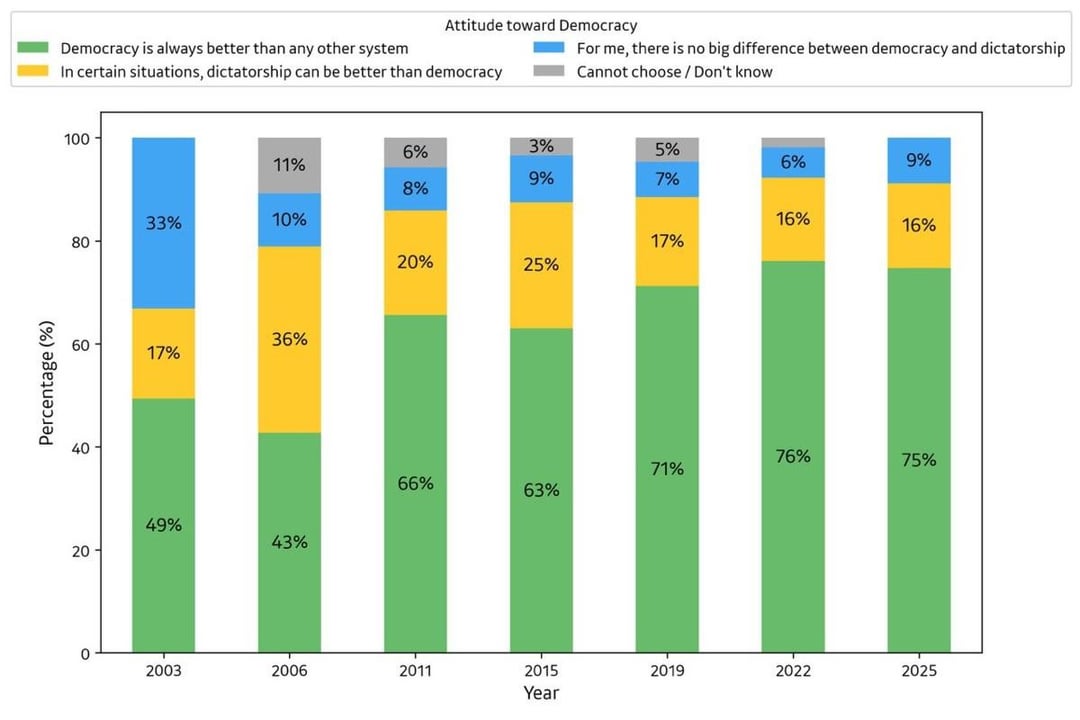
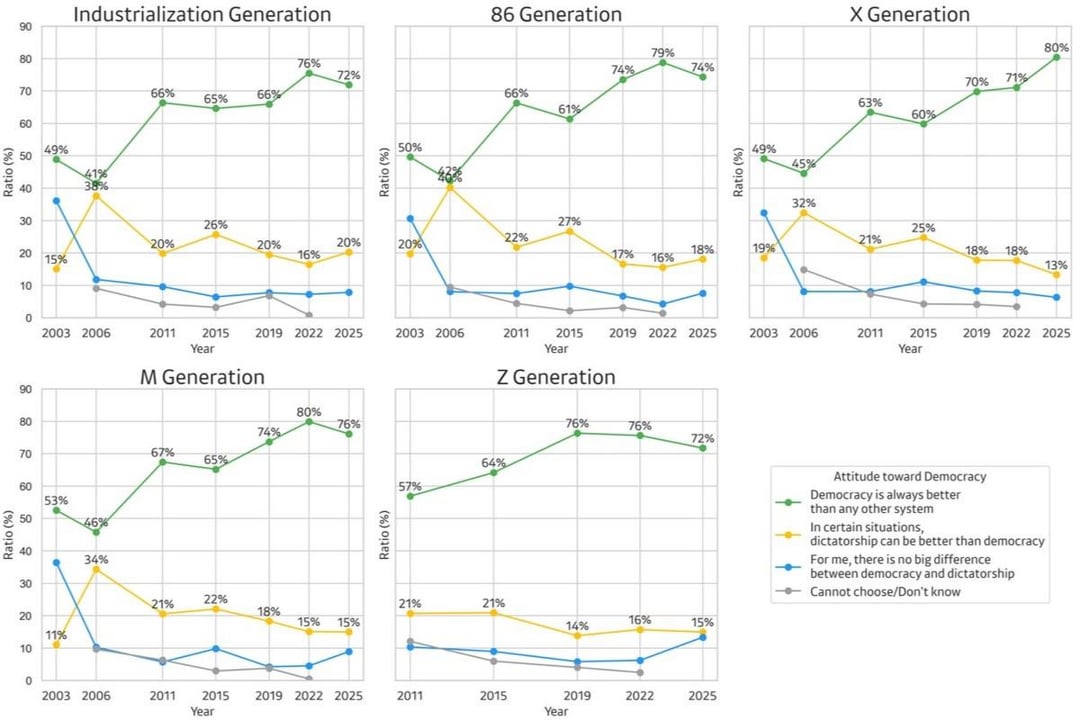
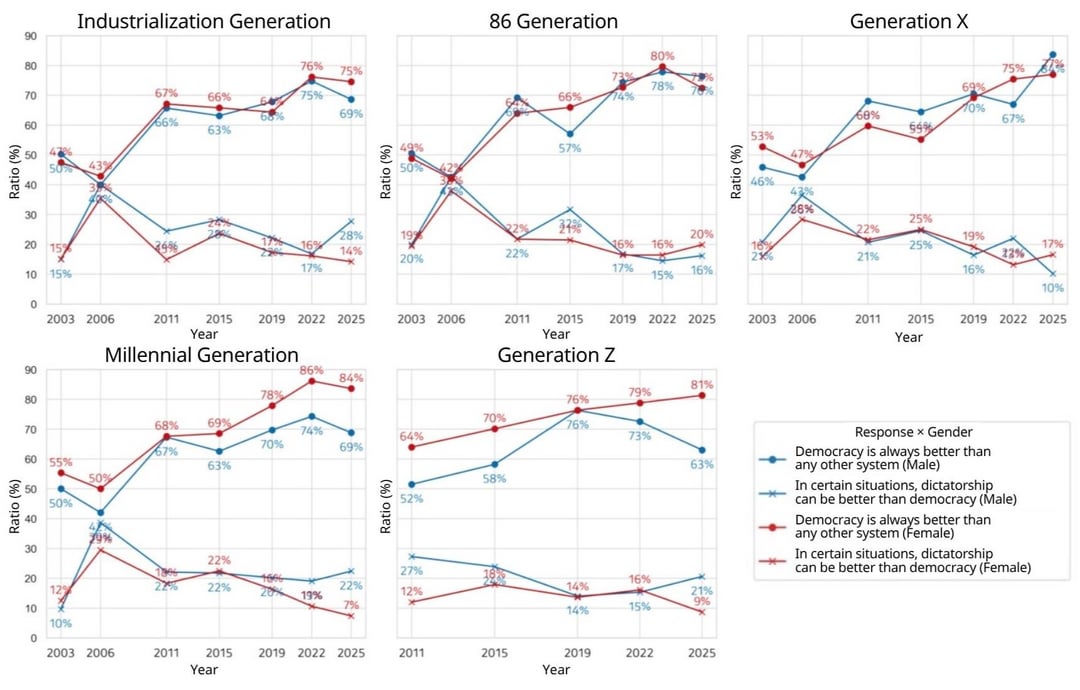
An analysis of seven surveys conducted between 2003 and 2025 reveals that support for democracy has deepened among the public. In 2006, only 43% of respondents stated that democracy was better than any other systеm; however, this figure increased to 76% in 2022, marking a 33-percentage point rise. Concurrently, support for dictatorship under certain circumstances diminished from 36% in 2006 to 12% in 2022, signifying a decline to one-third of the original level. The survey conducted in January 2025 survey revealed no substantial shift in public attitudes towards democracy or dictatorship, even conducted in the aftermath of the declaration of martial law and during the presidential impeachment proceedings. However, the data indicated generational and gender-based disparities in responses to the crisis. The 2025 survey revealed a decline in support for democracy and an increase in authoritarian sympathy among men from the Industrialization Generation, Millennials, and Gen Z. In contrast, Generation X men, Millennial women, and Gen Z women exhibited an increase in support for democracy, leading to a minimal overall change in aggregate figures.
The lower support for democracy among Millennial and Generation Z men—and its decline during the martial law situation—corresponds with the discourse around the “conservatization of men in their 20s.” Nonetheless, it is crucial to acknowledge that 68% of Millennial men and 63% of Generation Z men regard democracy as “the only game in town,” and the proportion who prefer dictatorship remains merely one-third that of those who support democracy. A notable distinction emerges when South Korea is juxtaposed with the United States and Western Europe, where democratic erosion from the bottom is a matter of increasing concern. In contrast, the decline among younger men in South Korea remains modest. For example, Foa and Mounk (2016) reported that while approximately 60% of Americans born in the 1940s (the Industrialization Generation) agreed that residing in a democratic country is essential, only about 30% of those born in the 1980s (Millennials) concurred with that perspective, thereby unveiling a considerably pronounced generational decline.
Despite the prevailing circumstances of martial law and impeachment, South Korean democracy has exhibited remarkable resilience. This resilience is bolstered by the unwavering commitment of South Korean citizens to democratic values. Since the democratization that took place in 1987, the public has gradually come to accept democracy as not only a systеm of governance, but also a fundamental societal value. This shift in perspective has been the result of a prolonged process of political learning. At present, in the year 2025, South Korean society largely accepts democracy as “the only game in town”—the benchmark for democratic consolidation defined by Linz and Stepan (1996)—despite some variation across generational and gender lines. These findings suggest that recent democratic erosion in South Korea is driven less by grassroots disaffection and more by elite strategies from above. The public’s robust support for democracy will prove to be a pivotal asset in countering and reversing top-down democratic erosion in the forthcoming years.
Source: https://www.eai.or.kr/new/en/pub/view.asp?intSeq=23350&board=eng_workingpaper
Posted by Freewhale98
2 Comments
Based Korea 🥹
I am not too familiar with Korean history. What happened in 2006?