
President Lee Jae-myung’s diplomatic strategy toward Japan was revealed in concrete form during the Liberation Day ceremony marking the 80th anniversary of Korea’s independence, held just days before the upcoming Korea–Japan summit on the 23rd. While mentioning historical terms like “liberation” and “independence” in a calm tone, he deliberately put aside demands for apologies or rhetoric fueling anti-Japan sentiment. Observers note that a “two-track approach,” separating historical issues from future-oriented cooperation, has become the new principle of Korea’s diplomacy toward Japan.
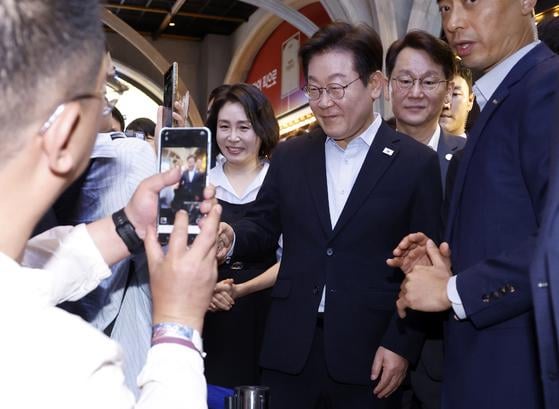
On the 17th, President Lee attended a screening of the documentary film “Independence Army: The War That Never Ended” at a Seoul cinema with citizens. The film, produced by the Liberation Association and the Hong Beom-do General Memorial Foundation to mark the 80th anniversary, commemorates Korea’s independence struggle. President Lee stated, “Through the life of General Hong Beom-do, we can realize the sacrifices and devotion upon which the foundation of the Republic of Korea was built. I hope this film reminds ‘us today’ of the questions it poses and the meaning of the 80th anniversary of liberation.”
In his Liberation Day address on August 15, Lee also remarked, “Even now, there are still many among us suffering from unresolved historical issues. At the same time, we remember the dreams of the independence fighters.” Yet on that day too, he made no mention of Japan’s wartime sexual slavery (comfort women) or forced labor, nor did he demand an apology from Japan.
Since taking office, President Lee has distanced himself from the anti-Japan stance he took during his time as opposition leader. In this year’s Liberation Day speech, all he said directly to Japan was: “We expect the Japanese government to face the painful past squarely and to make efforts not to undermine the trust between our two countries.” Instead, he emphasized, “Because Korea and Japan have long shared a tumultuous history, defining our relationship with Japan has always been both important and difficult.”
Recently, Lee’s foreign policy toward Japan has been summed up as the “shared yard neighbor theory.” In his Liberation Day address, he said, “Japan is our neighbor with whom we share a yard, and an indispensable partner for economic development.” This phrasing first appeared during the Korea–Japan summit on the sidelines of the G7 summit in Canada this past June, when he stated: “(Korea and Japan are) like next-door neighbors who share a front yard—an inseparable relationship.” According to Lee Won-deok, a professor of Japanese Studies at Kookmin University, “Now that the same message is being delivered consistently, Japan has begun to view President Lee as stable. In the past, Korea and Japan often failed to achieve practical cooperation because of historical disputes, but the current administration from the outset has set the principle of ‘facing history while strategically advancing future cooperation.’”
Those close to the President say his thinking solidified during Korea–U.S. tariff negotiations, where Japan’s experiences were frequently referenced, making the need for Korea–Japan cooperation all the more apparent. Indeed, in his June meeting with Japanese Prime Minister Shigeru Ishiba, President Lee mentioned the difficult international trade environment and stressed: “Since Korea and Japan have a complementary relationship, cooperation across many areas would be greatly beneficial to both sides.”
Within the ruling party, there is also a belief that “the Democratic Party government must open the way for Korea–Japan relations during its term.” The aim, if conditions are right, would be to achieve a breakthrough similar to the 1998 Korea–Japan Joint Declaration announced by President Kim Dae-jung and Prime Minister Keizō Obuchi, which elevated bilateral relations to a new level. However, a senior presidential official noted: “This is something to consider in the longer term, but it is not on the agenda for the summit on the 23rd. Given scheduling issues, the meeting may be a working-level summit.”
Posted by Freewhale98
1 Comment
The Axis chest code. Have a good economy so people want to be friends with you despite your past offenses.