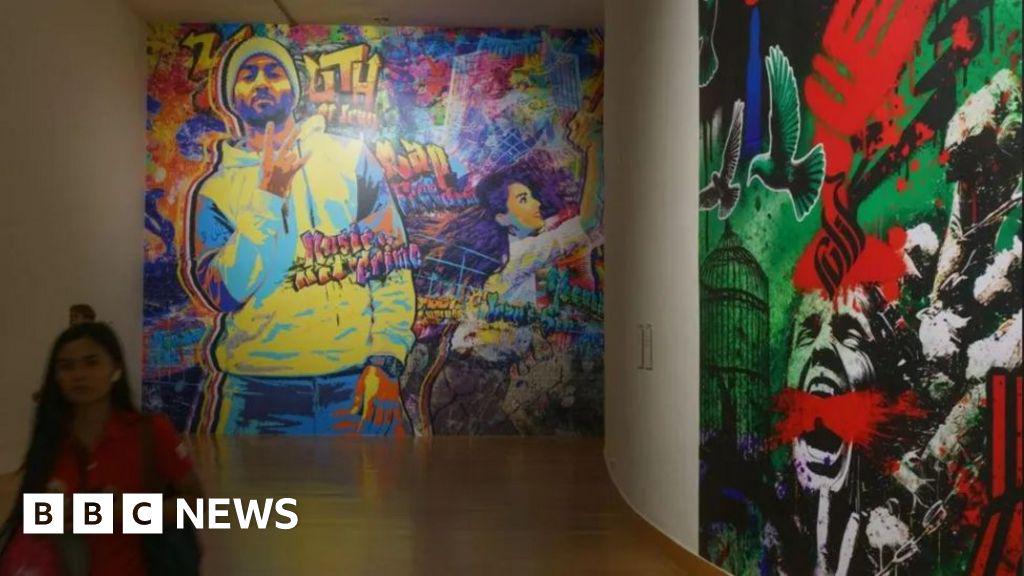
> Featuring exiled artists from countries such as China, Russia and Iran, Sai says his exhibition, which opened on 26 July at the Bangkok Arts and Cultural Centre, saw repeated visits by Chinese embassy representatives, accompanied by Bangkok city officials, shortly after it opened.
>The show, titled Constellation of Complicity: Visualising the Global Machine of Authoritarian Solidarity, aims to show how authoritarian regimes collaborate in repression, according to one official description.
Sai claims that the Chinese officials lodged complaints about works by Tibetan, Uyghur and Hong Kong artists, and initially demanded that the show be completely shut down.
>But, he said, the arts centre managed to negotiate a compromise that allowed the exhibition to continue after sensitive artworks and elements of art installations were removed.
>**A BBC journalist who visited the exhibition in Bangkok this week saw several artists’ names covered up with black paint in the descriptions of artworks.**
>A description of the artists’ homelands was also partially covered with black paint to conceal references to Tibet, Hong Kong and Xinjiang
> Most of the censored artworks were by the Tibetan artist Tenzin Mingyur Paldron. Television screens that were supposed to show several films by the artist – one was about the Dalai Lama – had been switched off.
Tibetan and Uyghur flags had also been removed, as well as a novel about a Tibetan family in exile and a postcard about China, Israel and Xinjiang.
> A gallery staff member told the BBC that the exhibition had attracted many visitors in recent days after news of the censorship went viral online.
>The arts centre’s management did not respond to the BBC’s questions.
But the BBC understands there was an email where the centre said they were “warned that the exhibition may risk creating diplomatic tensions between Thailand and China”.
>The email also stated they made the adjustments “due to pressure from the Chinese embassy” transmitted through the Thai foreign affairs ministry and the Bangkok city government, which is the centre’s main supporter.
>A Chinese embassy statement in response to BBC queries accused the exhibition of openly promoting Tibetan, Uyghur and Hong Kong independence.
> The Human Rights Foundation has called the incident “intimidation” that “reflects a coordinated effort to suppress artistic expression”, while prominent Thailand-based activist Phil Robertson said it was “outrageous and unacceptable” that Bangkok city officials allowed Chinese censorship.
>The BBC has asked Thailand’s prime minister’s office for a response to these views.
>Fears of China’s transnational repression – broadly defined as a government harassing or surveilling individuals in other territories – have risen in recent years. It has raised questions of whether host countries are aware of such actions, or even complicit.
>The relationship between Thailand and China has also been closely scrutinised.
In 2015 Swedish citizen Gui Minhai, one of the founders of a Hong Kong bookshop that sold and published titles critical of Beijing, mysteriously vanished while holidaying in Thailand.
>He later reappeared in mainland China in police custody. Officials said he had gone to China voluntarily, but rights groups maintain he was abducted by Chinese agents.
>Earlier this year, at least 40 Uyghurs were deported from Thailand to China despite serious concerns expressed by the United Nations, the US and the UK. Beijing said the repatriation was conducted in accordance with Chinese, Thai and international law.
> That case had occurred while Sai was still planning his show at the Bangkok Arts and Cultural Centre. Despite concerns, he said, the centre decided to go ahead with the exhibition anyway.
>Now, Sai is contemplating his next steps while in the UK. He and his wife plan to showcase the uncensored art show in other countries once the exhibition ends its run in Bangkok in October.
>**He believes the censorship has ironically boosted the profile of their art show, with “now many people in the world interested in seeing the exhibition” and discussing it online.**
>”We didn’t start this movement, the CCP (Chinese Communist Party) started it. We just laid the foundation (with the exhibition)… the rest has been nurtured organically, and endorsed, by CCP censorship like fertiliser.”

1 Comment
> Featuring exiled artists from countries such as China, Russia and Iran, Sai says his exhibition, which opened on 26 July at the Bangkok Arts and Cultural Centre, saw repeated visits by Chinese embassy representatives, accompanied by Bangkok city officials, shortly after it opened.
>The show, titled Constellation of Complicity: Visualising the Global Machine of Authoritarian Solidarity, aims to show how authoritarian regimes collaborate in repression, according to one official description.
Sai claims that the Chinese officials lodged complaints about works by Tibetan, Uyghur and Hong Kong artists, and initially demanded that the show be completely shut down.
>But, he said, the arts centre managed to negotiate a compromise that allowed the exhibition to continue after sensitive artworks and elements of art installations were removed.
>**A BBC journalist who visited the exhibition in Bangkok this week saw several artists’ names covered up with black paint in the descriptions of artworks.**
>A description of the artists’ homelands was also partially covered with black paint to conceal references to Tibet, Hong Kong and Xinjiang
> Most of the censored artworks were by the Tibetan artist Tenzin Mingyur Paldron. Television screens that were supposed to show several films by the artist – one was about the Dalai Lama – had been switched off.
Tibetan and Uyghur flags had also been removed, as well as a novel about a Tibetan family in exile and a postcard about China, Israel and Xinjiang.
> A gallery staff member told the BBC that the exhibition had attracted many visitors in recent days after news of the censorship went viral online.
>The arts centre’s management did not respond to the BBC’s questions.
But the BBC understands there was an email where the centre said they were “warned that the exhibition may risk creating diplomatic tensions between Thailand and China”.
>The email also stated they made the adjustments “due to pressure from the Chinese embassy” transmitted through the Thai foreign affairs ministry and the Bangkok city government, which is the centre’s main supporter.
>A Chinese embassy statement in response to BBC queries accused the exhibition of openly promoting Tibetan, Uyghur and Hong Kong independence.
> The Human Rights Foundation has called the incident “intimidation” that “reflects a coordinated effort to suppress artistic expression”, while prominent Thailand-based activist Phil Robertson said it was “outrageous and unacceptable” that Bangkok city officials allowed Chinese censorship.
>The BBC has asked Thailand’s prime minister’s office for a response to these views.
>Fears of China’s transnational repression – broadly defined as a government harassing or surveilling individuals in other territories – have risen in recent years. It has raised questions of whether host countries are aware of such actions, or even complicit.
>The relationship between Thailand and China has also been closely scrutinised.
In 2015 Swedish citizen Gui Minhai, one of the founders of a Hong Kong bookshop that sold and published titles critical of Beijing, mysteriously vanished while holidaying in Thailand.
>He later reappeared in mainland China in police custody. Officials said he had gone to China voluntarily, but rights groups maintain he was abducted by Chinese agents.
>Earlier this year, at least 40 Uyghurs were deported from Thailand to China despite serious concerns expressed by the United Nations, the US and the UK. Beijing said the repatriation was conducted in accordance with Chinese, Thai and international law.
> That case had occurred while Sai was still planning his show at the Bangkok Arts and Cultural Centre. Despite concerns, he said, the centre decided to go ahead with the exhibition anyway.
>Now, Sai is contemplating his next steps while in the UK. He and his wife plan to showcase the uncensored art show in other countries once the exhibition ends its run in Bangkok in October.
>**He believes the censorship has ironically boosted the profile of their art show, with “now many people in the world interested in seeing the exhibition” and discussing it online.**
>”We didn’t start this movement, the CCP (Chinese Communist Party) started it. We just laid the foundation (with the exhibition)… the rest has been nurtured organically, and endorsed, by CCP censorship like fertiliser.”