
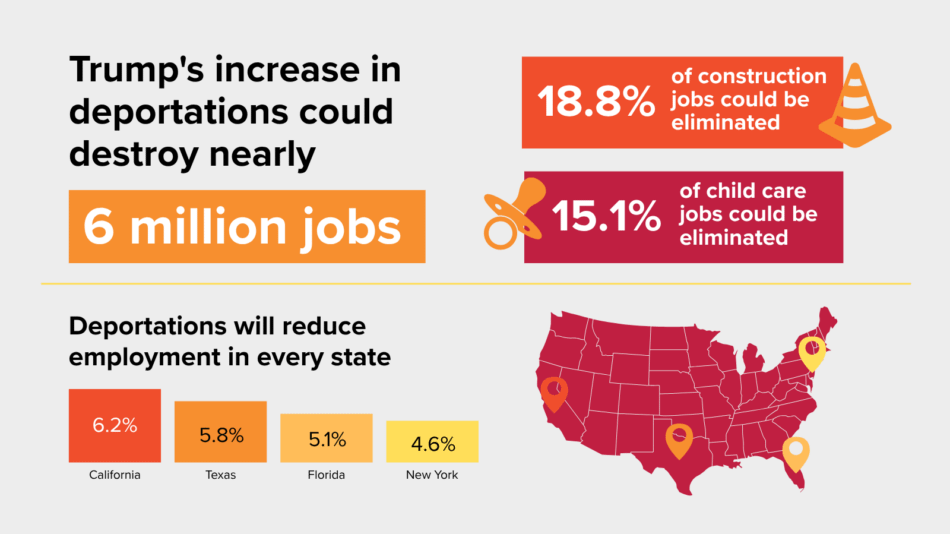
Trump’s deportation agenda will destroy millions of jobs | Both immigrants and U.S.-born workers would suffer job losses, particularly in construction and child care
Posted by ONETRILLIONAMERICANS
Trump’s deportation agenda will destroy millions of jobs | Both immigrants and U.S.-born workers would suffer job losses, particularly in construction and child care
Posted by ONETRILLIONAMERICANS
2 Comments
Very economically depressing read but very informative, I recommend taking a couple minutes for this article:
> **If the administration follows through on its goals of deporting 4 million people over four years:**
> * **There will be 3.3 million fewer employed immigrants and 2.6 million fewer employed U.S.-born workers at the end of that period.**
> * Employment in the construction sector will drop sharply: U.S.-born construction employment will fall by 861,000, and immigrant employment will fall by 1.4 million.
> * The deportations will eliminate half a million child care jobs.
> Deportations sharply reduce the supply of labor, threatening the ability of employers to generate revenue and pay for business expenses like rent, machinery, and even the labor of any remaining workers. Immigrant labor supply will fall because immigrants tend to have high employment rates, so arresting, detaining, and removing immigrants from the country removes people from the workforce. Also, others who are not formally deported may need to leave the country to accompany their deported family or community members. In addition, deportations raise the risks of arrest and removal for remaining immigrants and cause them to curtail activities with the potential for interaction with the government, like labor market participation.
> These chilling effects can even extend to citizens who are by law not subject to deportation but are nevertheless connected to communities at risk. For example, Alsan and Yang (2024) examined the effects of “Secure Communities,” a large interior immigration enforcement program in the United States that began in 2008. This program linked state and local government databases to federal immigration enforcement in order to detect immigrants who are deportable and led to increased detentions and deportations.1 Alsan and Yang (2024) found that Hispanic citizen-headed households reduced their participation in federal safety programs in response to Secure Communities enforcement actions, perhaps out of concern for other family members and close contacts.
> Regardless of the exact mechanisms, deportations can cause a sharp and abrupt enough fall in labor supply that some employers will respond by shutting down operations entirely. For example, Ali, Brown, and Herbst (2024) found that Secure Communities, which led to increased immigration-related arrests and deportations, reduced the number of child care facilities, harming both immigrant and U.S.-born employment in the child care sector.
> Because jobs held by U.S.-born and immigrant workers are often complementary and economically linked, the shrinking supply of immigrant labor can adversely affect employer demand for jobs held by both groups of workers. As Howard, Wang, and Zhang (2024) observe, when there are fewer immigrant roofers and framers to build the basic structure of homes, there will be less work available for U.S.-born electricians and plumbers. If there are fewer dishwashers and cooks, restaurants may limit their hours or shift their operations toward takeout, reducing the overall employment of waitstaff and managers.
> Complementary immigrant and U.S.-born employment can also cut across sectors. East and Velásquez (2024) found that the Secure Communities enforcement program reduced the hours of immigrant child care workers and cleaners, and U.S.-born mothers of young children worked less in response, presumably due to increased care responsibilities at home.
> Finally, the reduction in the immigrant population and their public activities is a reduction in consumers and business owners, negatively affecting consumer demand and investment on top of falling local demand due to reduced immigrant and U.S.-born employment. As immigrant employment and earnings fall, so will consumption of goods and services. Removing immigrants will also slow business creation and weaken employment demand, as immigrants are more likely than U.S.-born workers to start businesses (Azoulay et al. 2022).2 A large mass deportation program could also in principle generate very broad chilling effects on consumption. For example, declining numbers of international travelers to the United States will negatively affect the tourism industry. In general, purchases by nonresidents, including foreign students, are a major U.S. export, but that spending may drop precipitously when noncitizens face higher risks of detention and deportation.
!ping IMMIGRATION&ECON
But Americans will finally be able to get those crop-picking and slaughterhouse jobs they’ve been clamoring for