> [T]he tide is rising. According to a [comprehensive accounting](https://www.aeaweb.org/articles?id=10.1257/aer.20202045) of populist government leaders dating back to 1900, around one-quarter of countries (out of a stable sample of 60) are now led by either right-wing or left-wing populists.
> The authors use a standard and broad definition of populism — a political style that is centred on the “people” versus the “establishment” or “elite”. Of course, definitions vary across research, thus so does the final tally. But the upwards trend is consistent and clear across competing methodologies.
> Populist parties are also of course snapping at the heels of government in many other countries, such as the UK, Germany and France. “Establishment” leaders are positively freaked out, driving them to adapt their policies and rhetoric — consider Labour Prime Minister Sir Keir Starmer’s tough talk on immigration, including saying the UK risks becoming an “island of strangers”. Even when populists are not in office, they can wield considerable power.
> Now, what of the economic consequences? Free Lunch on Sunday prides itself on contrarian takes, but alas on this topic the evidence is as you might expect: populism makes for truly bad economics.
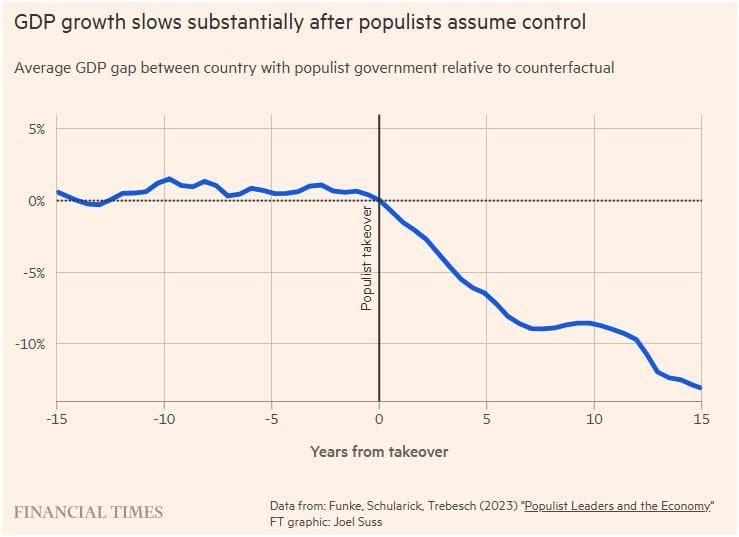
> The aforementioned study, published in the American Economic Review in 2023 by a trio of economists at the Kiel Institute, analyses how economies are impacted by populists in power. **It finds that after 15 years of populist leadership, real per capita GDP declines by more than 10 per cent compared with a reasonable, non-populist counterfactual.**
> Importantly, it doesn’t matter whether left- or right-wing, in Europe or South America — populist-led economies suffer across the board.

1 Comment
> [T]he tide is rising. According to a [comprehensive accounting](https://www.aeaweb.org/articles?id=10.1257/aer.20202045) of populist government leaders dating back to 1900, around one-quarter of countries (out of a stable sample of 60) are now led by either right-wing or left-wing populists.
> The authors use a standard and broad definition of populism — a political style that is centred on the “people” versus the “establishment” or “elite”. Of course, definitions vary across research, thus so does the final tally. But the upwards trend is consistent and clear across competing methodologies.
> Populist parties are also of course snapping at the heels of government in many other countries, such as the UK, Germany and France. “Establishment” leaders are positively freaked out, driving them to adapt their policies and rhetoric — consider Labour Prime Minister Sir Keir Starmer’s tough talk on immigration, including saying the UK risks becoming an “island of strangers”. Even when populists are not in office, they can wield considerable power.
> Now, what of the economic consequences? Free Lunch on Sunday prides itself on contrarian takes, but alas on this topic the evidence is as you might expect: populism makes for truly bad economics.
> The aforementioned study, published in the American Economic Review in 2023 by a trio of economists at the Kiel Institute, analyses how economies are impacted by populists in power. **It finds that after 15 years of populist leadership, real per capita GDP declines by more than 10 per cent compared with a reasonable, non-populist counterfactual.**
> Importantly, it doesn’t matter whether left- or right-wing, in Europe or South America — populist-led economies suffer across the board.
https://archive.is/t0Fsj