
YIMBYs beat the politicians. Now they have to beat the judges | As legislatures have said yes to new housing, obstacles still remain
Posted by ONETRILLIONAMERICANS
YIMBYs beat the politicians. Now they have to beat the judges | As legislatures have said yes to new housing, obstacles still remain
Posted by ONETRILLIONAMERICANS
1 Comment
> The intellectual fight over liberalizing land-use regulations is over. The YIMBYs have won.
> Almost all economists and legal scholars agree that land-use regulations have played a central role in creating a housing crisis, slowing economic growth and increasing economic inequality without producing sufficient benefits. (The few dead-enders out there are increasingly rare.) Politicians of all stripes — from the hard right to the socialist left and all between — at least gesture toward the need for zoning reform.
> Only a decade or so ago, arguing that private developers needed a freer hand to build housing was an unpopular take. Arguments that leading political figures should put zoning reform at the center of their agendas would have been seen as totally crazy. Now, even many of the movement’s harshest skeptics are careful to note that they, too, support land-use reform, opposing only the intensity of the focus on land-use reform.
> But winning this fight on paper was never the point. The point was to build more housing.
> And to do that, we are going to have to take on the NIMBY judges.
> These judges are products of local political systems and interest group formations that have proven immune to the sudden changes that have swept much of the rest of our politics. In many cities, there are scores of politicians and interest groups who arrived in power during an era when land-use reform was a topic for economics classroom seminars but not the real world, and for whom opposition to development and developers is still a righteous cause.
> Sometimes these judges’ decisions have been hyper-legalistic and niggling, like when Judge David Schell halted Arlington’s recent “missing middle” zoning reform for failing to pass an “initiating resolution.” Schell rebuked the local legislature for failing to advertise the fact that reforms were being considered before proceeding with the law (not that anyone interested hadn’t heard about them) and for failing to study localized environmental effects like stormwater spillover (although a county expert testified that the infrastructure was sufficient).
> In other situations, these anti-development decisions have been anything but legalistic. For instance, before Judge Arthur Engoron stopped construction of a big project on the Lower East Side in New York City, he reportedly stated in open court: “These are huge towers. I’ve lived in the city my whole life. You can’t just do this because the zoning allows it. I just can’t believe this is the case.”
> A Montana trial court granted a preliminary injunction against a state law that preempted local regulations on accessory dwelling units. The court argued that the law violated the equal protection clause and there would be irreparable injury if it went into effect. Why? Because some homeowners were part of private homeowners associations that didn’t allow accessory dwelling units and others were not. (I promise it did not make more sense than that!) And the irreparable injury was because, absent an injunction, a homeowner “could wake up one morning to find that, without any notice at all, a new duplex or ADU (accessory dwelling unit) is going up next door in their previously peaceful and well-maintained single-family neighborhood.” Quelle horreur.
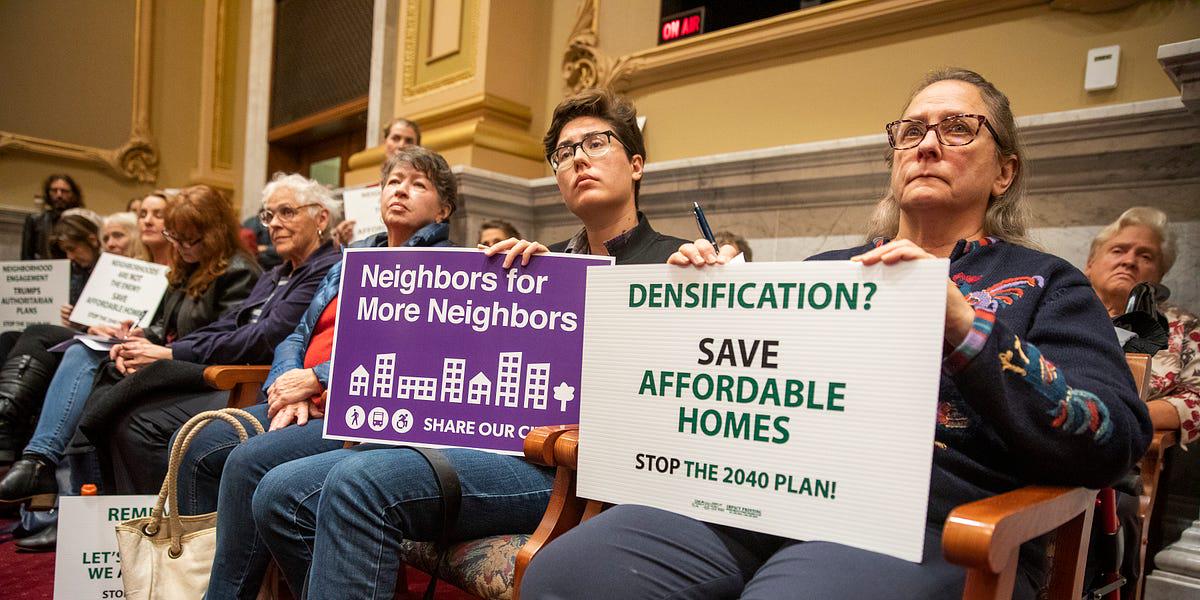
> All of these decisions were reversed, as was a trial court decision delaying Minneapolis’ widely lauded “2040 Plan.”
> But, even when higher-level courts reverse trial courts, the cost of dealing with such a long and arduous legal battle is a huge deterrent to developers and elected officials who seek to build more housing and upzone their cities. Indeed, despite winning in court eventually, New York’s Two Bridges project — which was supposed to create 1,300 new homes — is not going forward.
!ping YIMBY&LAW